




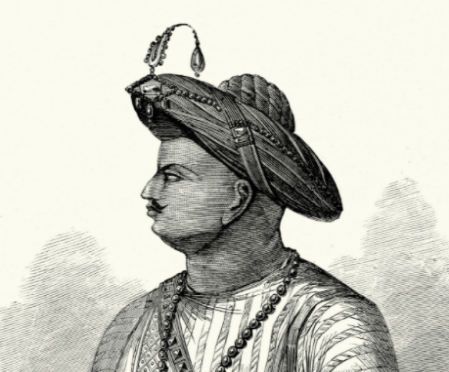
Look at the picture and answer the following questions?
Name the fort where he was captured and killed.
Answer
 Verified
526.5k+ views
Hint: Tipu Sultan, also known as Tipu Sahab or the Tiger of Mysore, was the ruler of the Kingdom of Mysore, based in South India, and a pioneer of rocket artillery from 20 November 1750 to 4 May 1799. He introduced several administrative innovations during his rule, including a new coinage system and calendar and the new land revenue system that initiated the growth of the Mysore silk industry.
Complete answer:
Seringapatam, a small town near Mysore, is an island fortress ruled by Haidar Ali and then by his son Tipu Sultan until his death in 1799, surrounded by the Kaveri River. The British faced continued opposition from Haidar Ali, and numerous wars were fought for southern India's control. In 1782, Haidar Ali died, but his son continued his military campaign against the British.
The British stormed the island's fortress at Seringapatam on 4 May 1799, and Tipu Sultan was killed. According to legend, he was killed on the spot seen in this picture, but it was 182 m east of this spot, marked by a small enclosure.
At the Hoally (Diddy) Gateway, located 300 yards from the N.E., Tipu Sultan was killed by Angle at the Fort of Srirangapatna. The next afternoon, he was buried in Gumbaz, next to his father's grave. Several members of the British East India Company felt that during the war, Nawab of Carnatic Umdat Ul-Umra secretly assisted Tipu Sultan and sought his deposition after 1799.
Note: Tipu Sultan expanded the iron-cased Mysorean rockets, and the military manual Fathul Mujahidin was commissioned. During the Anglo-Mysore Wars, including the Battle of Pollilur and the Siege of Seringapatam, he deployed rockets against British forces' advances and their allies.
Complete answer:
Seringapatam, a small town near Mysore, is an island fortress ruled by Haidar Ali and then by his son Tipu Sultan until his death in 1799, surrounded by the Kaveri River. The British faced continued opposition from Haidar Ali, and numerous wars were fought for southern India's control. In 1782, Haidar Ali died, but his son continued his military campaign against the British.
The British stormed the island's fortress at Seringapatam on 4 May 1799, and Tipu Sultan was killed. According to legend, he was killed on the spot seen in this picture, but it was 182 m east of this spot, marked by a small enclosure.
At the Hoally (Diddy) Gateway, located 300 yards from the N.E., Tipu Sultan was killed by Angle at the Fort of Srirangapatna. The next afternoon, he was buried in Gumbaz, next to his father's grave. Several members of the British East India Company felt that during the war, Nawab of Carnatic Umdat Ul-Umra secretly assisted Tipu Sultan and sought his deposition after 1799.
Note: Tipu Sultan expanded the iron-cased Mysorean rockets, and the military manual Fathul Mujahidin was commissioned. During the Anglo-Mysore Wars, including the Battle of Pollilur and the Siege of Seringapatam, he deployed rockets against British forces' advances and their allies.
Recently Updated Pages
Master Class 11 Computer Science: Engaging Questions & Answers for Success

Master Class 11 Business Studies: Engaging Questions & Answers for Success
Master Class 11 Economics: Engaging Questions & Answers for Success
Master Class 11 English: Engaging Questions & Answers for Success
Master Class 11 Maths: Engaging Questions & Answers for Success
Master Class 11 Biology: Engaging Questions & Answers for Success
Trending doubts
There are 720 permutations of the digits 1 2 3 4 5 class 11 maths CBSE
Discuss the various forms of bacteria class 11 biology CBSE
Draw a diagram of a plant cell and label at least eight class 11 biology CBSE
Explain zero factorial class 11 maths CBSE
What organs are located on the left side of your body class 11 biology CBSE
Draw a diagram of nephron and explain its structur class 11 biology CBSE