




List out two Indian carps and two exotic carps.
Answer
 Verified
673.2k+ views
Hint: Some fishes that are raised in India are native to the Indian regions or nearby countries in the Asian continent. But, some are non-indigenous and have been brought to India from countries outside Asia.
Complete step-by-step answer:
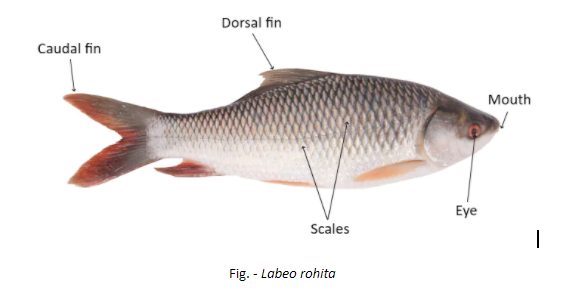
The two examples of Indian carps are Catla catla (catla) and Labeo rohita (rohu) while the two exotic carps are Carassius carassius (golden fish) and Ctenophyringodon idella (white amur).
Catla is an economically important freshwater fish and is native to the lakes and rivers found in northern India. It belongs to the Cyprinidae carp family and is also considered as a major South Asian carp. Rohu is also native to the rivers and lakes of the South Asian region. In India, it is found in the northern, central as well as eastern parts of the country. It is an omnivorous fish and is considered to be a good choice for aquaculture practices.
The golden carp is also known as crucian carp and was brought to India from central Europe. It is primarily used as food fish. It is a freshwater river fish but can be grown even in the confined water bodies like lakes. Though it breeds throughout the year, the growth rate is quite slow and can attain a maximum length of 45 centimeters only. The white amur is also known as grass carp and is native to the Amur river in Russia and also some rivers of China. It is also a freshwater fish.
Note: -Indian carp is a common name for the species of fishes that are either native to India or are raised by aquaculture in the other nearby Asian countries.
-Exotic carps are non-indigenous species of the fishes that were currently grown in India but have been introduced from the regions outside Asia.
Complete step-by-step answer:
The two examples of Indian carps are Catla catla (catla) and Labeo rohita (rohu) while the two exotic carps are Carassius carassius (golden fish) and Ctenophyringodon idella (white amur).
Catla is an economically important freshwater fish and is native to the lakes and rivers found in northern India. It belongs to the Cyprinidae carp family and is also considered as a major South Asian carp. Rohu is also native to the rivers and lakes of the South Asian region. In India, it is found in the northern, central as well as eastern parts of the country. It is an omnivorous fish and is considered to be a good choice for aquaculture practices.
The golden carp is also known as crucian carp and was brought to India from central Europe. It is primarily used as food fish. It is a freshwater river fish but can be grown even in the confined water bodies like lakes. Though it breeds throughout the year, the growth rate is quite slow and can attain a maximum length of 45 centimeters only. The white amur is also known as grass carp and is native to the Amur river in Russia and also some rivers of China. It is also a freshwater fish.
Note: -Indian carp is a common name for the species of fishes that are either native to India or are raised by aquaculture in the other nearby Asian countries.
-Exotic carps are non-indigenous species of the fishes that were currently grown in India but have been introduced from the regions outside Asia.
Recently Updated Pages
Which will be the least stable resonating structure class 11 chemistry CBSE

How many 5 digit telephone numbers can be construc-class-11-maths-CBSE
How do you find the angle of the resultant vector class 11 physics CBSE
Draw labelled diagram of the following i Gram seed class 11 biology CBSE
1 Quintal is equal to a 110 kg b 10 kg c 100kg d 1000 class 11 physics CBSE
What is the need and importance of classification class 11 biology CBSE
Trending doubts
Find the value of the expression given below sin 30circ class 11 maths CBSE
One Metric ton is equal to kg A 10000 B 1000 C 100 class 11 physics CBSE
10 examples of friction in our daily life
Draw a diagram of a plant cell and label at least eight class 11 biology CBSE
Difference between physical and chemical change class 11 chemistry CBSE
Proton was discovered by A Thomson B Rutherford C Chadwick class 11 chemistry CBSE