




When light travels from optically denser medium to optically rarer medium after refraction ------.
$A.$ m < i > m < r
$B.$ m < i < m < r
$C.$ m < i = m< r
$D.$ m < I $ \geqslant $ m < r
Answer
 Verified
629.1k+ views
- Hint: The direction of propagation of an obliquely incident ray of light that enters the other medium, changes at the interference at the interface of two media. This phenomenon is called refraction of light. Refraction is that the change in direction of wave propagation thanks to a change in its transmission medium. The phenomenon is explained by the conservation of energy and the conservation of momentum. Due to change of medium, the phase velocity of the wave is modified but its frequency remains constant.
Complete step-by-step answer:
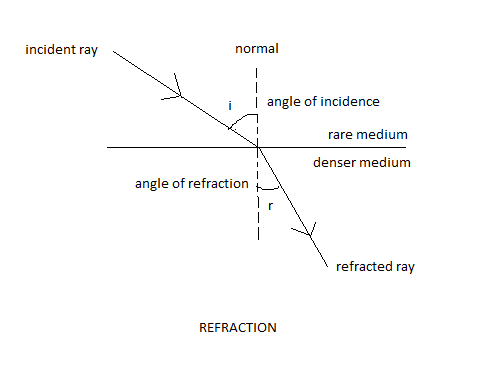
Now moving to question, we have
When light travels from optically denser medium to optically rarer medium, after refraction of light it diverts away from the normal. Therefore, option A. is the correct answer for the above question
Note: Terms related to refraction
Incident ray- the ray which falls on the surface of separation (or interface) to enter into the new medium.
Refracted ray- the ray in the second medium, obtained after refraction.
Normal- imaginary straight line perpendicular to the refracting surface at the point of refraction.
Angle of incidence (i)- angle between the incident ray and therefore the normal
Angle of refraction (r)- angle between the refracted ray and the normal.
When light ray is incident normally, only speed changes and direction of light remains the same. When light ray passes from a rarer medium to a denser medium, it bends towards the normal. When light ray passes from denser medium to rarer medium, it bends faraway from the normal.
Complete step-by-step answer:
Now moving to question, we have
When light travels from optically denser medium to optically rarer medium, after refraction of light it diverts away from the normal. Therefore, option A. is the correct answer for the above question
Note: Terms related to refraction
Incident ray- the ray which falls on the surface of separation (or interface) to enter into the new medium.
Refracted ray- the ray in the second medium, obtained after refraction.
Normal- imaginary straight line perpendicular to the refracting surface at the point of refraction.
Angle of incidence (i)- angle between the incident ray and therefore the normal
Angle of refraction (r)- angle between the refracted ray and the normal.
When light ray is incident normally, only speed changes and direction of light remains the same. When light ray passes from a rarer medium to a denser medium, it bends towards the normal. When light ray passes from denser medium to rarer medium, it bends faraway from the normal.
Recently Updated Pages
Master Class 12 Economics: Engaging Questions & Answers for Success

Master Class 12 English: Engaging Questions & Answers for Success
Master Class 12 Social Science: Engaging Questions & Answers for Success
Master Class 12 Maths: Engaging Questions & Answers for Success
Master Class 12 Physics: Engaging Questions & Answers for Success
Master Class 12 Business Studies: Engaging Questions & Answers for Success
Trending doubts
Which are the Top 10 Largest Countries of the World?
Draw a labelled sketch of the human eye class 12 physics CBSE
Differentiate between homogeneous and heterogeneous class 12 chemistry CBSE
Why is the cell called the structural and functional class 12 biology CBSE
Draw ray diagrams each showing i myopic eye and ii class 12 physics CBSE
Which is the correct genotypic ratio of mendel dihybrid class 12 biology CBSE