




When the light rays enter the eye, most of the refraction occurs at the
A. crystalline lens
B. outer surface of the cornea
C. iris
D. pupil
Answer
 Verified
609.9k+ views
Hint: Cornea is defined as the transparent spherical portion of the eye which covers the pupil and the iris. The rays from the object enter through this transparent cornea when an object comes in front of the eye. This refraction happens at the outer surface.
Complete answer:
First of all let us take a look at the phenomenon of refraction. It is the phenomenon which is producing the image in front of the eye and also in front of the cameras and other systems containing lenses.
As the transition from the air into the cornea is taking place firstly at the surface of the cornea, most of the refraction is occurring in this area. Here is the largest variation in the refractive index for refraction the light is experiencing. Only the 20 percent of the refraction is occurring in the inner crystalline lens and almost 80 percent of the refraction is happening in the cornea. As we all know that the inner lens is the smaller area for the refraction, it is acting as the total source of the ability to include the focus of the eye for making close objects visible. In the case of a normal eye, the inner lens can vary the total focal length of the eye to a great extent.
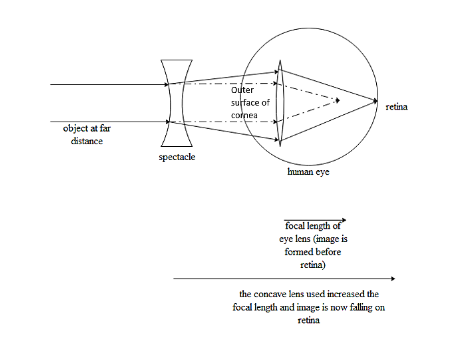
So, the correct answer is “Option B”.
Note:
There are so many eye defects which are seen in common that one is called for the refractive errors which can be corrected by the usage of compensating lenses. They may include myopia or hypermetropia. Hypermetropia is the long sightedness which is corrected using a convex lens and myopia is the near sightedness which is compensated by the use of a concave lens.
Complete answer:
First of all let us take a look at the phenomenon of refraction. It is the phenomenon which is producing the image in front of the eye and also in front of the cameras and other systems containing lenses.
As the transition from the air into the cornea is taking place firstly at the surface of the cornea, most of the refraction is occurring in this area. Here is the largest variation in the refractive index for refraction the light is experiencing. Only the 20 percent of the refraction is occurring in the inner crystalline lens and almost 80 percent of the refraction is happening in the cornea. As we all know that the inner lens is the smaller area for the refraction, it is acting as the total source of the ability to include the focus of the eye for making close objects visible. In the case of a normal eye, the inner lens can vary the total focal length of the eye to a great extent.
So, the correct answer is “Option B”.
Note:
There are so many eye defects which are seen in common that one is called for the refractive errors which can be corrected by the usage of compensating lenses. They may include myopia or hypermetropia. Hypermetropia is the long sightedness which is corrected using a convex lens and myopia is the near sightedness which is compensated by the use of a concave lens.
Recently Updated Pages
Master Class 12 Business Studies: Engaging Questions & Answers for Success

Master Class 12 Biology: Engaging Questions & Answers for Success
Master Class 12 Chemistry: Engaging Questions & Answers for Success
Class 12 Question and Answer - Your Ultimate Solutions Guide
Master Class 11 Social Science: Engaging Questions & Answers for Success
Master Class 11 English: Engaging Questions & Answers for Success
Trending doubts
Which is more stable and why class 12 chemistry CBSE
Which are the Top 10 Largest Countries of the World?
Draw a labelled sketch of the human eye class 12 physics CBSE
Differentiate between homogeneous and heterogeneous class 12 chemistry CBSE
What are the major means of transport Explain each class 12 social science CBSE
Sulphuric acid is known as the king of acids State class 12 chemistry CBSE