




When the light passes through the achromatic combination of prisms, then what is observed
A. Only deviation
B. Only dispersion
C. deviation and dispersion
D. None of the above
Answer
 Verified
502.2k+ views
Hint: To answer this question first we must have a concept of what is achromatic combination. And we know achromatic combination is that combination in which the two lenses are of different nature and of different focal lengths. Achromatic lenses are those which are free from chromatic aberrations.
Complete answer:
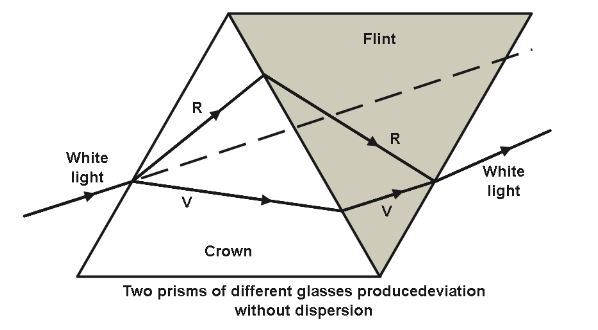
When white light goes through a prism, it splits into seven distinct bands. When two prisms are joined in such a way that the total of the angular dispersions of the crown and flint glass prisms is zero, the result is an achromatic prism combination. When the white light passes through the combination of achromatic prism, the internally scattered components of white light from the crown glass prism refract and then meet at the outer surface edge of the flint glass prism, transforming the refracted light back into white light with deviation and without any dispersion.
Hence, the correct option is A.
Note: In optics, a prism is a clear piece of glass or other transparent material with precise angles and plane faces that can be used to analyse and reflect light. A simple triangular prism can separate white light into its component colours, which is known as a spectrum.
Complete answer:
When white light goes through a prism, it splits into seven distinct bands. When two prisms are joined in such a way that the total of the angular dispersions of the crown and flint glass prisms is zero, the result is an achromatic prism combination. When the white light passes through the combination of achromatic prism, the internally scattered components of white light from the crown glass prism refract and then meet at the outer surface edge of the flint glass prism, transforming the refracted light back into white light with deviation and without any dispersion.
Hence, the correct option is A.
Note: In optics, a prism is a clear piece of glass or other transparent material with precise angles and plane faces that can be used to analyse and reflect light. A simple triangular prism can separate white light into its component colours, which is known as a spectrum.
Recently Updated Pages
Master Class 12 Business Studies: Engaging Questions & Answers for Success

Master Class 12 Chemistry: Engaging Questions & Answers for Success
Master Class 12 Biology: Engaging Questions & Answers for Success
Class 12 Question and Answer - Your Ultimate Solutions Guide
Master Class 11 English: Engaging Questions & Answers for Success
Master Class 11 Maths: Engaging Questions & Answers for Success
Trending doubts
Which is more stable and why class 12 chemistry CBSE
Which are the Top 10 Largest Countries of the World?
Draw a labelled sketch of the human eye class 12 physics CBSE
Differentiate between homogeneous and heterogeneous class 12 chemistry CBSE
What are the major means of transport Explain each class 12 social science CBSE
Sulphuric acid is known as the king of acids State class 12 chemistry CBSE