




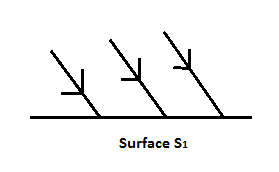
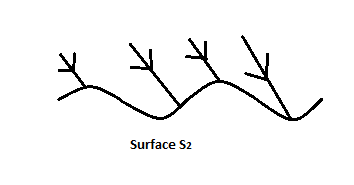
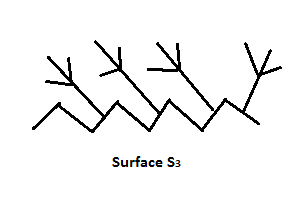
Light is falling on the surface \[{S_1},{S_2},{S_3}\]as shown in the figure. Surface on which the angle of incidence is equal to the angle of reflection is/are:
A. \[{S_1}\]only
B. \[{S_1}\] and \[{S_2}\] only
C. \[{S_2}\] and \[{S_3}\]
D. All the three surfaces
Answer
 Verified
576.6k+ views
Hint: In this question a ray of light is given which is incident on three different surfaces and according to the law of reflection we know that the angle of incidence made by incident ray is always equal to the angle of incident so we will check for each of the surface whether they will follow the law of reflection.
Complete step by step answer:
We know according to the law of reflection the incident ray, the reflected ray and the normal all lie on the same plane where angle of reflection is equal to the angle of the incidence and both the angles are measured with respect to the normal to the mirror.
We know the law of reflection is only dependent on the angle of the incidence made by incident rays from the normal but it does not depend on the nature of the surfaces, for rough surfaces also the law of reflection is valid.
Here the nature of the three surfaces are different but we know the law of reflection is valid for any surfaces so we can say the angle of incidence is equal to the angle of reflection for all the three surfaces.
Hence,Option D is correct.
Note- It is worth noting here that the angle of reflection made by light ray does not depend on the surface through which the light ray is reflected. Moreover, the concept of total internal reflection depends on the angle of incidence and the angle of refraction only.
Complete step by step answer:
We know according to the law of reflection the incident ray, the reflected ray and the normal all lie on the same plane where angle of reflection is equal to the angle of the incidence and both the angles are measured with respect to the normal to the mirror.
We know the law of reflection is only dependent on the angle of the incidence made by incident rays from the normal but it does not depend on the nature of the surfaces, for rough surfaces also the law of reflection is valid.
Here the nature of the three surfaces are different but we know the law of reflection is valid for any surfaces so we can say the angle of incidence is equal to the angle of reflection for all the three surfaces.
Hence,Option D is correct.
Note- It is worth noting here that the angle of reflection made by light ray does not depend on the surface through which the light ray is reflected. Moreover, the concept of total internal reflection depends on the angle of incidence and the angle of refraction only.
Recently Updated Pages
Master Class 12 Economics: Engaging Questions & Answers for Success

Master Class 12 Physics: Engaging Questions & Answers for Success
Master Class 12 English: Engaging Questions & Answers for Success
Master Class 12 Social Science: Engaging Questions & Answers for Success
Master Class 12 Maths: Engaging Questions & Answers for Success
Master Class 12 Business Studies: Engaging Questions & Answers for Success
Trending doubts
Which are the Top 10 Largest Countries of the World?
What are the major means of transport Explain each class 12 social science CBSE
Draw a labelled sketch of the human eye class 12 physics CBSE
Why cannot DNA pass through cell membranes class 12 biology CBSE
Differentiate between insitu conservation and exsitu class 12 biology CBSE
Draw a neat and well labeled diagram of TS of ovary class 12 biology CBSE