




Let $\vec{a},\vec{b}\text{ and }\vec{c}$ three unit vectors, out of which vectors $\vec{b}\text{ and }\vec{c}$ are non-parallel. If $\alpha $ and $\beta $ are the angles which vector $\vec{a}$ makes with vector $\vec{b}\text{ and }\vec{c}$ respectively and $\vec{a}\times \left( \vec{b}\times \vec{c} \right)=\dfrac{1}{2}\vec{b}$ then $\left| \alpha -\beta \right|$ is equal to:
\[\begin{align}
& A{{.60}^{\circ }} \\
& B{{.30}^{\circ }} \\
& C{{.90}^{\circ }} \\
& D{{.45}^{\circ }} \\
\end{align}\]
Answer
 Verified
586.8k+ views
Hint: To solve this question, we will use the formula of vector triple product of three vectors which is given as \[\vec{p}\times \left( \vec{q}\times \vec{r} \right)=\left( \vec{p}\cdot \vec{r} \right)\vec{q}-\left( \vec{p}\cdot \vec{q} \right)\vec{r}\] where $\vec{p},\vec{q}\text{ and }\vec{r}$ are there vectors. Then, we will compare the value obtained to $\dfrac{1}{2}\vec{b}$ as we are given $\vec{a}\times \left( \vec{b}\times \vec{c} \right)=\dfrac{1}{2}\vec{b}$ then we will use the formula of dot product of two vector when angle between them is given, $\vec{p}\cdot \vec{q}=\left| {\vec{p}} \right|\left| {\vec{q}} \right|\cos \theta $ where $\vec{p}\text{ and }\vec{q}$ are two vectors and $\theta $ is the angle between them.
Complete step by step answer:
Given that $\vec{a},\vec{b}\text{ and }\vec{c}$ are unit vectors.
Let us first define a unit vector. A unit vector is a vector having magnitude as 1. That is, if $\vec{p}$ is a unit vector than $\left| {\vec{p}} \right|=1$
If $\vec{p}=x\hat{i}+y\hat{i}+z\hat{k}$ then magnitude of $\vec{p}=\left| {\vec{p}} \right|=\sqrt{{{x}^{2}}+{{y}^{2}}+{{z}^{2}}}$
As $\vec{a},\vec{b}\text{ and }\vec{c}$ are unit vector $\left| {\vec{a}} \right|=1,\left| {\vec{b}} \right|=1\text{ and }\left| {\vec{c}} \right|=1$
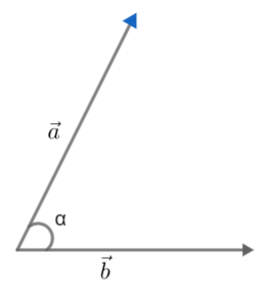
Given that $\alpha $ is angle between vector $\vec{d}\text{ and }\vec{b}$
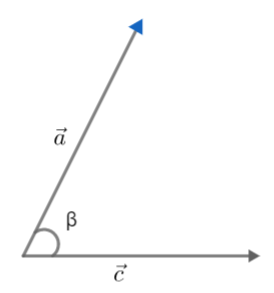
And $\beta $ is angle between $\vec{a}\text{ and }\vec{c}$
Now, we will define a vector triple product.
Vector triple product of three vectors $\vec{p},\vec{q}\text{ and }\vec{r}$ is defined as the cross product of the $\vec{p}$ with cross product of $\vec{q}\text{ and }\vec{r}$
It is represented as \[\vec{p}\times \left( \vec{q}\times \vec{r} \right)\]
The formula for vector triple product is
\[\begin{align}
& \vec{p}\times \left( \vec{q}\times \vec{r} \right)=\left( \vec{p}\cdot \vec{r} \right)\vec{q}-\left( \vec{p}\cdot \vec{q} \right)\vec{r} \\
& \Rightarrow \vec{p}\times \left( \vec{q}\times \vec{r} \right)=\left( \vec{p}\cdot \vec{r} \right)\vec{q}-\left( \vec{q}\cdot \vec{r} \right)\vec{p} \\
\end{align}\]
In general we have
\[\vec{p}\times \left( \vec{q}\times \vec{r} \right)\ne \left( \vec{p}\times \vec{q} \right)\times \vec{r}\]
We are given that \[\vec{a}\times \left( \vec{b}\times \vec{c} \right)=\dfrac{1}{2}\vec{b}\] which is vector triple product of $\vec{a},\vec{b}\text{ and }\vec{c}$
Using the formula of vector triple product we have:
\[\vec{a}\times \left( \vec{b}\times \vec{c} \right)=\left( \vec{a}\cdot \vec{c} \right)\vec{b}-\left( \vec{a}\cdot \vec{b} \right)\vec{c}\]
We had \[\begin{align}
& \vec{a}\times \left( \vec{b}\times \vec{c} \right)=\dfrac{1}{2}\vec{b} \\
& \left( \vec{a}\cdot \vec{c} \right)\vec{b}-\left( \vec{a}\cdot \vec{b} \right)\vec{c}=\dfrac{1}{2}\vec{b}\text{ }\text{. }\text{. }\text{. }\text{. }\text{. }\text{. }\text{. }\text{. }\text{. }\text{. }\text{. }\text{. (i)} \\
\end{align}\]
Comparing both sides of above equation and coefficient of vector $\vec{b}$ we get that
\[\left( \vec{a}\cdot \vec{c} \right)\vec{b}=\dfrac{1}{2}\vec{b}\text{ and }-\left( \vec{a}\cdot \vec{b} \right)\vec{c}=0\text{ }\text{. }\text{. }\text{. }\text{. }\text{. }\text{. }\text{. }\text{. }\text{. (ii)}\]
This is so as there is no term on RHS of (i) having $\vec{c}$
Again comparing terms of \[\left( \vec{a}\cdot \vec{c} \right)\vec{b}=\dfrac{1}{2}\vec{b}\] and cancelling vector $\vec{b}$ we get
\[\left( \vec{a}\cdot \vec{c} \right)=\dfrac{1}{2}\]
We have a formula of dot product of two vectors $\vec{p}\text{ and }\vec{q}$ when angle between them is $\theta $ is given as
\[\vec{p}\cdot \vec{q}=\left| {\vec{p}} \right|\left| {\vec{q}} \right|\cos \theta \]
Where $\vec{p}$ is magnitude of $\vec{p}\text{ and }\left| {\vec{q}} \right|$ is magnitude of $\vec{q}$
Using this formula above in $\vec{a}\cdot \vec{c}=\dfrac{1}{2}$ we get
\[\left| {\vec{a}} \right|\left| {\vec{c}} \right|\cos \beta =\dfrac{1}{2}\]
This is so as we had angle between $\vec{a}\text{ and }\vec{c}$ as $\beta $
Now, $\vec{a}\text{ and }\vec{c}$ are both unit vectors $\left| {\vec{a}} \right|=1\text{ and }\left| {\vec{c}} \right|=1$
Substituting this in above equation we get:
\[\begin{align}
& 1\cdot 1\cos \beta =\dfrac{1}{2} \\
& \cos \beta =\dfrac{1}{2} \\
\end{align}\]
Now, we know that value of \[\cos \dfrac{\pi }{3}=\dfrac{1}{2}\Rightarrow \cos \beta =\cos \dfrac{\pi }{3}\]
Applying \[{{\cos }^{-1}}\] both sides we get:
\[\beta =\dfrac{\pi }{3}\text{ }\text{. }\text{. }\text{. }\text{. }\text{. }\text{. }\text{. }\text{. }\text{. }\text{. (iii)}\]
We have obtained from equation (ii) that
\[\begin{align}
& 0=-\left( \vec{a}\cdot \vec{b} \right)\cdot \vec{c} \\
& \left( \vec{a}\cdot \vec{b} \right)\cdot \vec{c}=0 \\
\end{align}\]
Now, as $\vec{c}$ is unit vector $\left| {\vec{c}} \right|=1$ then
\[\begin{align}
& \left( \vec{a}\cdot \vec{b} \right)\cdot \vec{c}=0 \\
& \vec{a}\cdot \vec{b}=0 \\
\end{align}\]
Now, applying formula of dot product stated above between $\vec{a}\text{ and }\vec{b}$ we get:
\[\left| {\vec{a}} \right|\left| {\vec{b}} \right|\cos \alpha =0\]
As angle between $\vec{a}\text{ and }\vec{b}$ is $\alpha $
Now, as $\left| {\vec{a}} \right|=1=\left| {\vec{b}} \right|$ as both $\vec{a}\text{ and }\vec{b}$ are unit vector.
\[\begin{align}
& 1\cdot 1\cdot \cos \alpha =0 \\
& \cos \alpha =0 \\
\end{align}\]
We know that \[\cos \dfrac{\pi }{2}=0\Rightarrow \cos \alpha =\cos \dfrac{\pi }{2}\]
Applying ${{\cos }^{-1}}$ both sides of above equation we get
\[\alpha =\dfrac{\pi }{2}\text{ }\text{. }\text{. }\text{. }\text{. }\text{. }\text{. }\text{. }\text{. }\text{. }\text{. }\text{. }\text{. }\text{. (iv)}\]
So from equation (iii) and (iv) we have $\alpha =\dfrac{\pi }{2}\text{ and }\beta =\dfrac{\pi }{3}$
Then value of \[\begin{align}
& \left| \alpha -\beta \right|=\left| \dfrac{\pi }{2}-\dfrac{\pi }{3} \right| \\
& \left| \alpha -\beta \right|=\left| \dfrac{3\pi -2\pi }{6} \right|=\left| \dfrac{\pi }{6} \right| \\
\end{align}\]
Value of $\left| \alpha -\beta \right|=\left| \dfrac{\pi }{6} \right|\Rightarrow {{30}^{\circ }}$
So, the correct answer is “Option B”.
Note: The possibility of confusion in this question can be at the point where we have used \[\left( \vec{a}\cdot \vec{b} \right)\cdot \vec{c}=0\Rightarrow \vec{a}\cdot \vec{b}=0\] this is possible as $\vec{c}$ is a unit vector. $\vec{c}$ being unit vector $\left| {\vec{c}} \right|=1$ hence if the magnitude of any vector is 1 or non-zero then it cannot be a 0 vector. So, only possibility left is that \[\vec{a}\cdot \vec{b}=0\]
Complete step by step answer:
Given that $\vec{a},\vec{b}\text{ and }\vec{c}$ are unit vectors.
Let us first define a unit vector. A unit vector is a vector having magnitude as 1. That is, if $\vec{p}$ is a unit vector than $\left| {\vec{p}} \right|=1$
If $\vec{p}=x\hat{i}+y\hat{i}+z\hat{k}$ then magnitude of $\vec{p}=\left| {\vec{p}} \right|=\sqrt{{{x}^{2}}+{{y}^{2}}+{{z}^{2}}}$
As $\vec{a},\vec{b}\text{ and }\vec{c}$ are unit vector $\left| {\vec{a}} \right|=1,\left| {\vec{b}} \right|=1\text{ and }\left| {\vec{c}} \right|=1$
Given that $\alpha $ is angle between vector $\vec{d}\text{ and }\vec{b}$
And $\beta $ is angle between $\vec{a}\text{ and }\vec{c}$
Now, we will define a vector triple product.
Vector triple product of three vectors $\vec{p},\vec{q}\text{ and }\vec{r}$ is defined as the cross product of the $\vec{p}$ with cross product of $\vec{q}\text{ and }\vec{r}$
It is represented as \[\vec{p}\times \left( \vec{q}\times \vec{r} \right)\]
The formula for vector triple product is
\[\begin{align}
& \vec{p}\times \left( \vec{q}\times \vec{r} \right)=\left( \vec{p}\cdot \vec{r} \right)\vec{q}-\left( \vec{p}\cdot \vec{q} \right)\vec{r} \\
& \Rightarrow \vec{p}\times \left( \vec{q}\times \vec{r} \right)=\left( \vec{p}\cdot \vec{r} \right)\vec{q}-\left( \vec{q}\cdot \vec{r} \right)\vec{p} \\
\end{align}\]
In general we have
\[\vec{p}\times \left( \vec{q}\times \vec{r} \right)\ne \left( \vec{p}\times \vec{q} \right)\times \vec{r}\]
We are given that \[\vec{a}\times \left( \vec{b}\times \vec{c} \right)=\dfrac{1}{2}\vec{b}\] which is vector triple product of $\vec{a},\vec{b}\text{ and }\vec{c}$
Using the formula of vector triple product we have:
\[\vec{a}\times \left( \vec{b}\times \vec{c} \right)=\left( \vec{a}\cdot \vec{c} \right)\vec{b}-\left( \vec{a}\cdot \vec{b} \right)\vec{c}\]
We had \[\begin{align}
& \vec{a}\times \left( \vec{b}\times \vec{c} \right)=\dfrac{1}{2}\vec{b} \\
& \left( \vec{a}\cdot \vec{c} \right)\vec{b}-\left( \vec{a}\cdot \vec{b} \right)\vec{c}=\dfrac{1}{2}\vec{b}\text{ }\text{. }\text{. }\text{. }\text{. }\text{. }\text{. }\text{. }\text{. }\text{. }\text{. }\text{. }\text{. (i)} \\
\end{align}\]
Comparing both sides of above equation and coefficient of vector $\vec{b}$ we get that
\[\left( \vec{a}\cdot \vec{c} \right)\vec{b}=\dfrac{1}{2}\vec{b}\text{ and }-\left( \vec{a}\cdot \vec{b} \right)\vec{c}=0\text{ }\text{. }\text{. }\text{. }\text{. }\text{. }\text{. }\text{. }\text{. }\text{. (ii)}\]
This is so as there is no term on RHS of (i) having $\vec{c}$
Again comparing terms of \[\left( \vec{a}\cdot \vec{c} \right)\vec{b}=\dfrac{1}{2}\vec{b}\] and cancelling vector $\vec{b}$ we get
\[\left( \vec{a}\cdot \vec{c} \right)=\dfrac{1}{2}\]
We have a formula of dot product of two vectors $\vec{p}\text{ and }\vec{q}$ when angle between them is $\theta $ is given as
\[\vec{p}\cdot \vec{q}=\left| {\vec{p}} \right|\left| {\vec{q}} \right|\cos \theta \]
Where $\vec{p}$ is magnitude of $\vec{p}\text{ and }\left| {\vec{q}} \right|$ is magnitude of $\vec{q}$
Using this formula above in $\vec{a}\cdot \vec{c}=\dfrac{1}{2}$ we get
\[\left| {\vec{a}} \right|\left| {\vec{c}} \right|\cos \beta =\dfrac{1}{2}\]
This is so as we had angle between $\vec{a}\text{ and }\vec{c}$ as $\beta $
Now, $\vec{a}\text{ and }\vec{c}$ are both unit vectors $\left| {\vec{a}} \right|=1\text{ and }\left| {\vec{c}} \right|=1$
Substituting this in above equation we get:
\[\begin{align}
& 1\cdot 1\cos \beta =\dfrac{1}{2} \\
& \cos \beta =\dfrac{1}{2} \\
\end{align}\]
Now, we know that value of \[\cos \dfrac{\pi }{3}=\dfrac{1}{2}\Rightarrow \cos \beta =\cos \dfrac{\pi }{3}\]
Applying \[{{\cos }^{-1}}\] both sides we get:
\[\beta =\dfrac{\pi }{3}\text{ }\text{. }\text{. }\text{. }\text{. }\text{. }\text{. }\text{. }\text{. }\text{. }\text{. (iii)}\]
We have obtained from equation (ii) that
\[\begin{align}
& 0=-\left( \vec{a}\cdot \vec{b} \right)\cdot \vec{c} \\
& \left( \vec{a}\cdot \vec{b} \right)\cdot \vec{c}=0 \\
\end{align}\]
Now, as $\vec{c}$ is unit vector $\left| {\vec{c}} \right|=1$ then
\[\begin{align}
& \left( \vec{a}\cdot \vec{b} \right)\cdot \vec{c}=0 \\
& \vec{a}\cdot \vec{b}=0 \\
\end{align}\]
Now, applying formula of dot product stated above between $\vec{a}\text{ and }\vec{b}$ we get:
\[\left| {\vec{a}} \right|\left| {\vec{b}} \right|\cos \alpha =0\]
As angle between $\vec{a}\text{ and }\vec{b}$ is $\alpha $
Now, as $\left| {\vec{a}} \right|=1=\left| {\vec{b}} \right|$ as both $\vec{a}\text{ and }\vec{b}$ are unit vector.
\[\begin{align}
& 1\cdot 1\cdot \cos \alpha =0 \\
& \cos \alpha =0 \\
\end{align}\]
We know that \[\cos \dfrac{\pi }{2}=0\Rightarrow \cos \alpha =\cos \dfrac{\pi }{2}\]
Applying ${{\cos }^{-1}}$ both sides of above equation we get
\[\alpha =\dfrac{\pi }{2}\text{ }\text{. }\text{. }\text{. }\text{. }\text{. }\text{. }\text{. }\text{. }\text{. }\text{. }\text{. }\text{. }\text{. (iv)}\]
So from equation (iii) and (iv) we have $\alpha =\dfrac{\pi }{2}\text{ and }\beta =\dfrac{\pi }{3}$
Then value of \[\begin{align}
& \left| \alpha -\beta \right|=\left| \dfrac{\pi }{2}-\dfrac{\pi }{3} \right| \\
& \left| \alpha -\beta \right|=\left| \dfrac{3\pi -2\pi }{6} \right|=\left| \dfrac{\pi }{6} \right| \\
\end{align}\]
Value of $\left| \alpha -\beta \right|=\left| \dfrac{\pi }{6} \right|\Rightarrow {{30}^{\circ }}$
So, the correct answer is “Option B”.
Note: The possibility of confusion in this question can be at the point where we have used \[\left( \vec{a}\cdot \vec{b} \right)\cdot \vec{c}=0\Rightarrow \vec{a}\cdot \vec{b}=0\] this is possible as $\vec{c}$ is a unit vector. $\vec{c}$ being unit vector $\left| {\vec{c}} \right|=1$ hence if the magnitude of any vector is 1 or non-zero then it cannot be a 0 vector. So, only possibility left is that \[\vec{a}\cdot \vec{b}=0\]
Recently Updated Pages
Master Class 12 Economics: Engaging Questions & Answers for Success

Master Class 12 Physics: Engaging Questions & Answers for Success
Master Class 12 English: Engaging Questions & Answers for Success
Master Class 12 Social Science: Engaging Questions & Answers for Success
Master Class 12 Maths: Engaging Questions & Answers for Success
Master Class 12 Business Studies: Engaging Questions & Answers for Success
Trending doubts
Which are the Top 10 Largest Countries of the World?
What are the major means of transport Explain each class 12 social science CBSE
Draw a labelled sketch of the human eye class 12 physics CBSE
Why cannot DNA pass through cell membranes class 12 biology CBSE
Differentiate between insitu conservation and exsitu class 12 biology CBSE
Draw a neat and well labeled diagram of TS of ovary class 12 biology CBSE