




Let us assume that a person can see clearly only up to a distance of 25cm. He needs to read a book which has been kept at a distance of $50cm$. What kind of lens does he need for his spectacles and also calculate its power?
$\begin{align}
& A.\text{concave},-1D \\
& B.\text{convex},+1.5D \\
& C.\text{concave},-2.0D \\
& D.\text{convex},+2.0D \\
\end{align}$
Answer
 Verified
571.8k+ views
Hint: The object distance of the object from the lens will be equivalent to the distance up to which we want to see. The image distance from the lens will be equivalent to the distance up to which we can see. The power of the lens will be the reciprocal of the focal length of the lens. This will help you in answering this question.
Complete step by step solution:
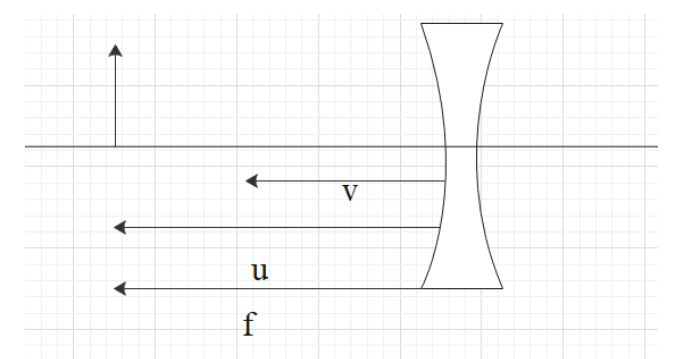
From the descriptions given in the question, we can surely say that the person is suffering from the condition called myopia. In order to correct the condition of myopia, he must use a lens of concave nature. Therefore we can write that,
The object distance of the object from the lens will be equivalent to the distance up to which we want to see. Therefore as it is mentioned in the question, we can write that,
$u=-50cm$
The image distance from the lens will be equivalent to the distance up to which we can see. Therefore we can write that,
$v=-25cm$
Lens equation can be written as,
$\dfrac{1}{f}=\dfrac{1}{v}-\dfrac{1}{u}$
Substituting the values in the equation will give,
$\begin{align}
& \dfrac{1}{f}=\dfrac{1}{-25}-\dfrac{1}{-50} \\
& \Rightarrow f=-50cm \\
\end{align}$
Therefore the focal length of the lens used has been obtained. From this also as the sign is negative we can confirm that the lens used will be concave.
The power of the lens will be the reciprocal of the focal length of the lens. This can be shown as,
$P=\dfrac{1}{f}=\dfrac{100}{-50m}=-2D$
So, the correct answer is “Option C”.
Note: The reciprocal of the focal length of the lens will be equivalent to the difference between the reciprocal of the image distance and the reciprocal of the object distance. This is the lens equation. The sign convention is to be considered perfectly in order to solve this question.
Complete step by step solution:
From the descriptions given in the question, we can surely say that the person is suffering from the condition called myopia. In order to correct the condition of myopia, he must use a lens of concave nature. Therefore we can write that,
The object distance of the object from the lens will be equivalent to the distance up to which we want to see. Therefore as it is mentioned in the question, we can write that,
$u=-50cm$
The image distance from the lens will be equivalent to the distance up to which we can see. Therefore we can write that,
$v=-25cm$
Lens equation can be written as,
$\dfrac{1}{f}=\dfrac{1}{v}-\dfrac{1}{u}$
Substituting the values in the equation will give,
$\begin{align}
& \dfrac{1}{f}=\dfrac{1}{-25}-\dfrac{1}{-50} \\
& \Rightarrow f=-50cm \\
\end{align}$
Therefore the focal length of the lens used has been obtained. From this also as the sign is negative we can confirm that the lens used will be concave.
The power of the lens will be the reciprocal of the focal length of the lens. This can be shown as,
$P=\dfrac{1}{f}=\dfrac{100}{-50m}=-2D$
So, the correct answer is “Option C”.
Note: The reciprocal of the focal length of the lens will be equivalent to the difference between the reciprocal of the image distance and the reciprocal of the object distance. This is the lens equation. The sign convention is to be considered perfectly in order to solve this question.
Recently Updated Pages
Master Class 12 Economics: Engaging Questions & Answers for Success

Master Class 12 Physics: Engaging Questions & Answers for Success
Master Class 12 English: Engaging Questions & Answers for Success
Master Class 12 Social Science: Engaging Questions & Answers for Success
Master Class 12 Maths: Engaging Questions & Answers for Success
Master Class 12 Business Studies: Engaging Questions & Answers for Success
Trending doubts
Which are the Top 10 Largest Countries of the World?
What are the major means of transport Explain each class 12 social science CBSE
Draw a labelled sketch of the human eye class 12 physics CBSE
Why cannot DNA pass through cell membranes class 12 biology CBSE
Differentiate between insitu conservation and exsitu class 12 biology CBSE
Draw a neat and well labeled diagram of TS of ovary class 12 biology CBSE