




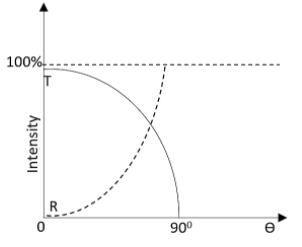
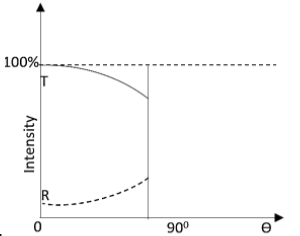
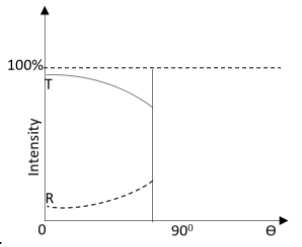
Let us assume that a light ray inside a glass medium falls on the glass-air interface at an angle of incidence $\theta $. The reflected $\left( R \right)$ and transmitted $\left( T \right)$ intensities, both as functions of $\theta $ are plotted. The correct graph will be given as,
A.
B.
C.
D. none of the above
Answer
 Verified
627k+ views
Hint: The critical angle is defined as the angle of incidence where the angle of refraction is perpendicular to the normal. The light should travel from an optically denser medium to an optically less dense medium. The angle of incidence is found to be equal to the critical angle when the angle of refraction is equivalent to $90{}^\circ $. This all will help you in solving this question.
Complete answer:
As we all know, above the critical angle, there will be total internal reflection taking place where the refracted ray will get completely reflected. In this case the reflection will be $100%$ and transmission will be occurring at $0%$.
This condition has been satisfied in the options B and C. so now let us consider only these two options. When we look in to option B, the transmission has been shown as $100%$ at an angle given as,
$\theta =0{}^\circ $
This is not true. Therefore option B will not be the accurate answer for this question. From the options given, therefore we can say that the option C is the only one which is true.
Hence the answer is given as option C.
Note:
Total internal reflection is a phenomenon in physics where the complete reflection of a ray of light within a medium like the water or glass from the surrounding surfaces back into the medium. This phenomenon will be happening when the angle of incidence is higher than the critical angle of the whole system.
Complete answer:
As we all know, above the critical angle, there will be total internal reflection taking place where the refracted ray will get completely reflected. In this case the reflection will be $100%$ and transmission will be occurring at $0%$.
This condition has been satisfied in the options B and C. so now let us consider only these two options. When we look in to option B, the transmission has been shown as $100%$ at an angle given as,
$\theta =0{}^\circ $
This is not true. Therefore option B will not be the accurate answer for this question. From the options given, therefore we can say that the option C is the only one which is true.
Hence the answer is given as option C.
Note:
Total internal reflection is a phenomenon in physics where the complete reflection of a ray of light within a medium like the water or glass from the surrounding surfaces back into the medium. This phenomenon will be happening when the angle of incidence is higher than the critical angle of the whole system.
Recently Updated Pages
Explain the structure of megasporangium class 12 biology CBSE

Why is chloroform kept in dark coloured bottles class 12 chemistry CBSE
Derive the balancing condition of a Wheatstone bri class 12 physics CBSE
Draw VI characteristics of a pn junction diode Explain class 12 physics CBSE
Is it possible to carry pride in ones language too class 12 english CBSE
In a population at Hardy Weinberg equilibrium the allele class 12 biology CBSE
Trending doubts
Draw a labelled sketch of the human eye class 12 physics CBSE
Which are the Top 10 Largest Countries of the World?
Draw ray diagrams each showing i myopic eye and ii class 12 physics CBSE
Which is the correct genotypic ratio of mendel dihybrid class 12 biology CBSE
Differentiate between homogeneous and heterogeneous class 12 chemistry CBSE
Which animal never drinks water in its entire life class 12 biology CBSE