




Let $U$ be the universal set and $A \cup B \cup C = U$. Then $\left\{ {\left( {A - B} \right) \cup \left( {B - C} \right) \cup \left( {C - A} \right)} \right\}'$ is equal to
A.$A \cup B \cup C$
B.$A \cup \left( {B \cap C} \right)$
C.$A \cap B \cap C$
D.$A \cap \left( {B \cup C} \right)$
Answer
 Verified
526.2k+ views
Hint: In order to find the value of $\left\{ {\left( {A - B} \right) \cup \left( {B - C} \right) \cup \left( {C - A} \right)} \right\}'$, initiate with the drawing the Venn diagram of sets separately like for $\left( {A - B} \right)$, $\left( {B - C} \right)$ and $\left( {C - A} \right)$, find their union and then complement them. Complement will represent the part which is not covered by the unions. And, we will get the required results.
Complete answer:
We are given with three sets: A, B and C. And, some set equations are given, so we will use Venn diagrams to solve for $\left\{ {\left( {A - B} \right) \cup \left( {B - C} \right) \cup \left( {C - A} \right)} \right\}'$.
So, basically, we are given with $A \cup B \cup C = U$. Means all the elements of the sets combine to form the Universal set, which in diagram is represented as:
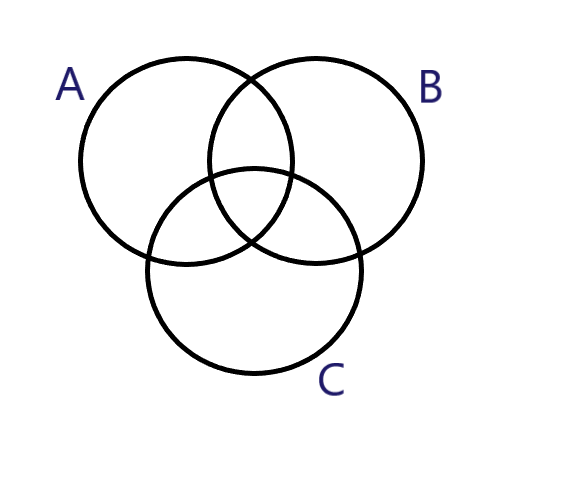
Now, we would start with finding the values separately in $\left\{ {\left( {A - B} \right) \cup \left( {B - C} \right) \cup \left( {C - A} \right)} \right\}'$,.
Starting with $\left( {A - B} \right)$. Basically, $\left( {A - B} \right)$ it depicts the region which has all A elements except the portion which has B elements, represented as:
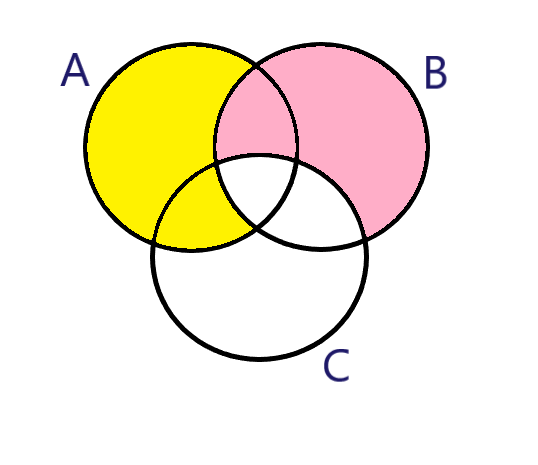
The Yellow portion shows $\left( {A - B} \right)$.
Now, for $\left( {B - C} \right)$, the Area’s which covers all elements of B but not C.
The pink color represents that:
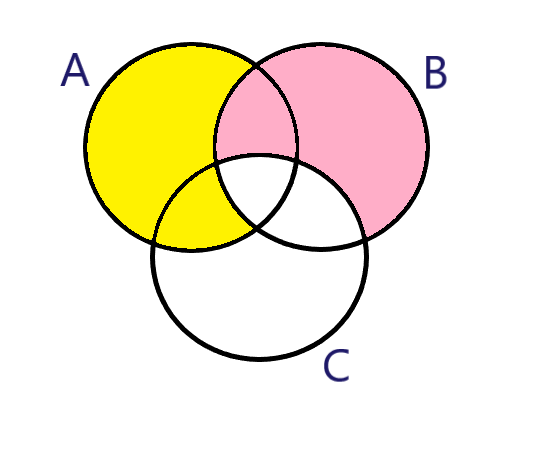
And, it gives $\left( {A - B} \right) \cup \left( {B - C} \right)$.
Now, for $\left( {C - A} \right)$.
The Area which has all elements of C but not the elements of A. Represented as green color:
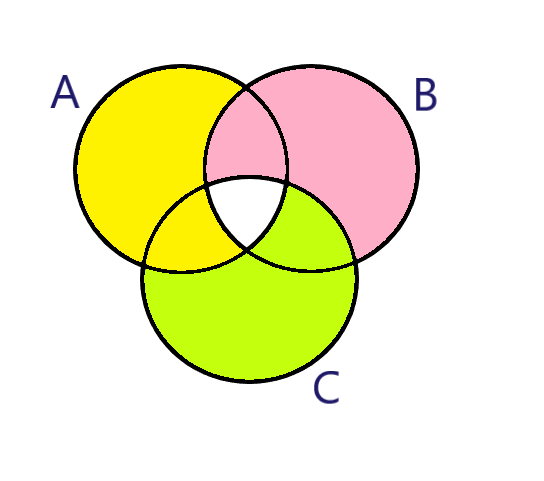
And, now it gives \[\left\{ {\left( {A - B} \right) \cup \left( {B - C} \right) \cup \left( {C - A} \right)} \right\}\].
But we need the complement of the value. Complement means the portion which are in Universal set but not in \[\left\{ {\left( {A - B} \right) \cup \left( {B - C} \right) \cup \left( {C - A} \right)} \right\}\].
So, the portion becomes:
\[\left\{ {\left( {A - B} \right) \cup \left( {B - C} \right) \cup \left( {C - A} \right)} \right\}' = U - \left\{ {\left( {A - B} \right) \cup \left( {B - C} \right) \cup \left( {C - A} \right)} \right\}\]
And, in the above diagram it is the white portion in the middle, which shows that. And, the portion is \[A \cap B \cap C\], the intersection of the three sets.
Therefore, $\left\{ {\left( {A - B} \right) \cup \left( {B - C} \right) \cup \left( {C - A} \right)} \right\}'$ is equal to \[A \cap B \cap C\].
Therefore, option (C) is the correct answer.
Note:
-Universal sets are always represented by capital U. And, complement is represented with a single quote, for example: A’ is the complement of A.
-Venn Diagram is the best method to find the intersection and union of sets. So, it is always preferred to use Venn diagrams.
Complete answer:
We are given with three sets: A, B and C. And, some set equations are given, so we will use Venn diagrams to solve for $\left\{ {\left( {A - B} \right) \cup \left( {B - C} \right) \cup \left( {C - A} \right)} \right\}'$.
So, basically, we are given with $A \cup B \cup C = U$. Means all the elements of the sets combine to form the Universal set, which in diagram is represented as:
Now, we would start with finding the values separately in $\left\{ {\left( {A - B} \right) \cup \left( {B - C} \right) \cup \left( {C - A} \right)} \right\}'$,.
Starting with $\left( {A - B} \right)$. Basically, $\left( {A - B} \right)$ it depicts the region which has all A elements except the portion which has B elements, represented as:
The Yellow portion shows $\left( {A - B} \right)$.
Now, for $\left( {B - C} \right)$, the Area’s which covers all elements of B but not C.
The pink color represents that:
And, it gives $\left( {A - B} \right) \cup \left( {B - C} \right)$.
Now, for $\left( {C - A} \right)$.
The Area which has all elements of C but not the elements of A. Represented as green color:
And, now it gives \[\left\{ {\left( {A - B} \right) \cup \left( {B - C} \right) \cup \left( {C - A} \right)} \right\}\].
But we need the complement of the value. Complement means the portion which are in Universal set but not in \[\left\{ {\left( {A - B} \right) \cup \left( {B - C} \right) \cup \left( {C - A} \right)} \right\}\].
So, the portion becomes:
\[\left\{ {\left( {A - B} \right) \cup \left( {B - C} \right) \cup \left( {C - A} \right)} \right\}' = U - \left\{ {\left( {A - B} \right) \cup \left( {B - C} \right) \cup \left( {C - A} \right)} \right\}\]
And, in the above diagram it is the white portion in the middle, which shows that. And, the portion is \[A \cap B \cap C\], the intersection of the three sets.
Therefore, $\left\{ {\left( {A - B} \right) \cup \left( {B - C} \right) \cup \left( {C - A} \right)} \right\}'$ is equal to \[A \cap B \cap C\].
Therefore, option (C) is the correct answer.
Note:
-Universal sets are always represented by capital U. And, complement is represented with a single quote, for example: A’ is the complement of A.
-Venn Diagram is the best method to find the intersection and union of sets. So, it is always preferred to use Venn diagrams.
Recently Updated Pages
Master Class 12 Business Studies: Engaging Questions & Answers for Success

Master Class 12 Biology: Engaging Questions & Answers for Success
Master Class 12 Chemistry: Engaging Questions & Answers for Success
Class 12 Question and Answer - Your Ultimate Solutions Guide
Master Class 11 Social Science: Engaging Questions & Answers for Success
Master Class 11 English: Engaging Questions & Answers for Success
Trending doubts
Which is more stable and why class 12 chemistry CBSE
Which are the Top 10 Largest Countries of the World?
Draw a labelled sketch of the human eye class 12 physics CBSE
Differentiate between homogeneous and heterogeneous class 12 chemistry CBSE
What are the major means of transport Explain each class 12 social science CBSE
Sulphuric acid is known as the king of acids State class 12 chemistry CBSE