




Let \[P\left( {asec\theta ,btan\theta } \right)\] and \[Q\left( {asec\phi ,btan\phi } \right),\] where $\theta + \Phi = \dfrac{\pi }{2}$ , be two points on the hyperbola $\dfrac{{{x^2}}}{{{a^2}}} - \dfrac{{{y^2}}}{{{b^2}}} = 1$ . If $(h,k)$ is the point of intersection of the normal at P & Q, then k is equal to
(A) $\dfrac{{{a^2} + {b^2}}}{a}$
(B) $ - \left( {\dfrac{{{a^2} + {b^2}}}{a}} \right)$
(C) $\dfrac{{{a^2} + {b^2}}}{b}$
(D) $ - \left( {\dfrac{{{a^2} + {b^2}}}{b}} \right)$
Answer
 Verified
619.8k+ views
Hint:The equation of normal at $(a\sec \theta ,b\tan \theta )$ to the hyperbola $\dfrac{{{x^2}}}{{{a^2}}} - \dfrac{{{y^2}}}{{{b^2}}} = 1$ is $ax\cos \theta + bycot\theta = {a^2} + {b^2}$ . If (h,k) the point of intersection of the normal. Then in the place x,y we will put (h,k). The equation of normal becomes $ah\cos \theta + bk\cot \theta = {a^2} + {b^2}$.
Complete step-by-step answer:
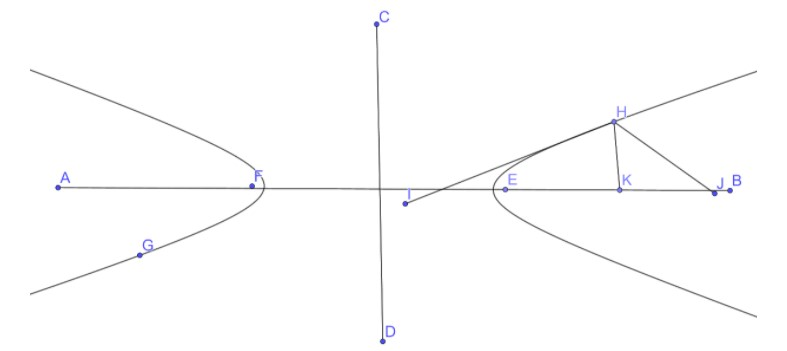
The normal of the Hyperbola is HK.
The equation of normal at $(a\sec \theta ,b\tan \theta )$ to the hyperbola $\dfrac{{{x^2}}}{{{a^2}}} - \dfrac{{{y^2}}}{{{b^2}}} = 1$ is$ax\cos \theta + bycot\theta = {a^2} + {b^2}$ .
Therefore, normal at $\theta ,\Phi $ are
$ax\cos \theta + by\cot \Phi = {a^2} + {b^2}$
$ax\cos \Phi + by\cot \Phi = {a^2} + {b^2}$
Given, $\theta + \Phi = \dfrac{\pi }{2}$
Therefore, $\Phi = \dfrac{\pi }{2} - \theta $ and these passes through (h,k)
Therefore, $ah\cos \theta + bk\cot \theta = {a^2} + {b^2}.........(1)$
Multiplying equation (1) by $\sin \theta $ , we get
$ah\operatorname{Cos} \theta \operatorname{Sin} \theta + bk\operatorname{Cos} \theta = ({a^2} + {b^2})\operatorname{Sin} \theta $
And,
$ah\sin \theta + bk\tan \theta = {a^2} + {b^2}...........(2)$
Multiplying equation (2) by $\operatorname{Cos} \theta $ , we get
$ah\operatorname{Sin} \theta \operatorname{Cos} \theta + bk\tan \theta \operatorname{Cos} \theta = ({a^2} + {b^2})\operatorname{Cos} \theta $
Subtract, Both the equations (1) and (2),
$
\Rightarrow (bk + {a^2} + {b^2})(\operatorname{Sin} \theta - \operatorname{Cos} \theta ) = 0 \\
\Rightarrow k = - \left( {\dfrac{{{a^2} + {b^2}}}{b}} \right)$
So, the correct answer is “Option D”.
Note:
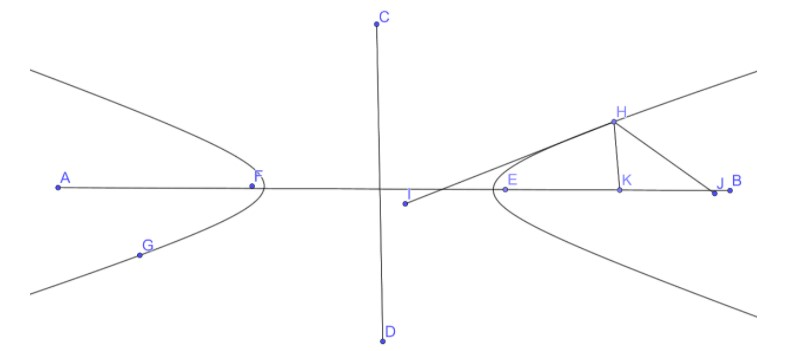
The Normal is HK.
For the hyperbola $\dfrac{{{x^2}}}{{{a^2}}} - \dfrac{{{y^2}}}{{{b^2}}} = 1$, The equation of normal in different forms are-
In the cartesian form equation of normal at point \[({x_1},{y_1})\] is $y - {y_1} = \dfrac{{ - {y_1}{a^2}}}{{{x_1}{b^2}}}(x - {x_1}),{x_1} \ne 0$
In the parametric form, equation of normal at $(a\sec \theta ,b\tan \theta )$ is $ax\cos \theta + bycot\theta = {a^2} + {b^2}$
Complete step-by-step answer:
The normal of the Hyperbola is HK.
The equation of normal at $(a\sec \theta ,b\tan \theta )$ to the hyperbola $\dfrac{{{x^2}}}{{{a^2}}} - \dfrac{{{y^2}}}{{{b^2}}} = 1$ is$ax\cos \theta + bycot\theta = {a^2} + {b^2}$ .
Therefore, normal at $\theta ,\Phi $ are
$ax\cos \theta + by\cot \Phi = {a^2} + {b^2}$
$ax\cos \Phi + by\cot \Phi = {a^2} + {b^2}$
Given, $\theta + \Phi = \dfrac{\pi }{2}$
Therefore, $\Phi = \dfrac{\pi }{2} - \theta $ and these passes through (h,k)
Therefore, $ah\cos \theta + bk\cot \theta = {a^2} + {b^2}.........(1)$
Multiplying equation (1) by $\sin \theta $ , we get
$ah\operatorname{Cos} \theta \operatorname{Sin} \theta + bk\operatorname{Cos} \theta = ({a^2} + {b^2})\operatorname{Sin} \theta $
And,
$ah\sin \theta + bk\tan \theta = {a^2} + {b^2}...........(2)$
Multiplying equation (2) by $\operatorname{Cos} \theta $ , we get
$ah\operatorname{Sin} \theta \operatorname{Cos} \theta + bk\tan \theta \operatorname{Cos} \theta = ({a^2} + {b^2})\operatorname{Cos} \theta $
Subtract, Both the equations (1) and (2),
$
\Rightarrow (bk + {a^2} + {b^2})(\operatorname{Sin} \theta - \operatorname{Cos} \theta ) = 0 \\
\Rightarrow k = - \left( {\dfrac{{{a^2} + {b^2}}}{b}} \right)$
So, the correct answer is “Option D”.
Note:
The Normal is HK.
For the hyperbola $\dfrac{{{x^2}}}{{{a^2}}} - \dfrac{{{y^2}}}{{{b^2}}} = 1$, The equation of normal in different forms are-
In the cartesian form equation of normal at point \[({x_1},{y_1})\] is $y - {y_1} = \dfrac{{ - {y_1}{a^2}}}{{{x_1}{b^2}}}(x - {x_1}),{x_1} \ne 0$
In the parametric form, equation of normal at $(a\sec \theta ,b\tan \theta )$ is $ax\cos \theta + bycot\theta = {a^2} + {b^2}$
Recently Updated Pages
Master Class 12 Economics: Engaging Questions & Answers for Success

Master Class 12 English: Engaging Questions & Answers for Success
Master Class 12 Social Science: Engaging Questions & Answers for Success
Master Class 12 Maths: Engaging Questions & Answers for Success
Master Class 12 Physics: Engaging Questions & Answers for Success
Master Class 9 General Knowledge: Engaging Questions & Answers for Success
Trending doubts
Which are the Top 10 Largest Countries of the World?
Draw a labelled sketch of the human eye class 12 physics CBSE
Differentiate between homogeneous and heterogeneous class 12 chemistry CBSE
Sulphuric acid is known as the king of acids State class 12 chemistry CBSE
Why is the cell called the structural and functional class 12 biology CBSE
Draw ray diagrams each showing i myopic eye and ii class 12 physics CBSE