




Let \[f(x) = x + 2\left| {x + 1} \right| + 2\left| {x - 1} \right|\].If \[f(x) = k\] has exactly one real solution, then the value of k is
A. 3
B. 0
C. 1
D. 2
Answer
 Verified
575.4k+ views
Hint: We use the concept of modulus and open both the terms having modulus. Divide the function into three parts on the basis of values obtained by equating both the modulus functions to zero. Calculate the value of function by substitution of values in three different parts. Plot the graph of the function using three equations formed.
* Modulus of a function ‘x’ opens up as \[\left| x \right| = \left\{ {\begin{array}{*{20}{c}}
x&{;x \geqslant 0} \\
{ - x}&{;x < 0}
\end{array}} \right.\]
Complete step-by-step answer:
Step-by-step answer:
We are given the function\[f(x) = x + 2\left| {x + 1} \right| + 2\left| {x - 1} \right|\]
We first solve both modulus terms
(a) \[\left| {x + 1} \right|\]:
If \[(x + 1) \geqslant 0\]
\[ \Rightarrow \left| {x + 1} \right| = x + 1\]
Now we find the value of ‘x’ by equating it to zero.
\[ \Rightarrow x + 1 = 0\]
Shift 1 to RHS
\[ \Rightarrow x = - 1\]
If \[(x + 1) < 0\]
\[ \Rightarrow \left| {x + 1} \right| = - x - 1\]
Now we find the value of ‘x’ by equating it to zero.
\[ \Rightarrow - x - 1 = 0\]
Shift -1 to RHS
\[ \Rightarrow - x = 1\]
\[ \Rightarrow x = - 1\]
So, the value of x is -1.
(a)\[\left| {x - 1} \right|\]:
If \[(x - 1) \geqslant 0\]
\[ \Rightarrow \left| {x - 1} \right| = x - 1\]
Now we find the value of ‘x’ by equating it to zero.
\[ \Rightarrow x - 1 = 0\]
Shift 1 to RHS
\[ \Rightarrow x = 1\]
If \[(x - 1) < 0\]
\[ \Rightarrow \left| {x - 1} \right| = - x + 1\]
Now we find the value of ‘x’ by equating it to zero.
\[ \Rightarrow - x + 1 = 0\]
Shift 1 to RHS
\[ \Rightarrow - x = - 1\]
\[ \Rightarrow x = 1\]
So, the value of x is 1.
From (a) and (b) we have values of x as -1 and 1.
We can divide the functions into three parts \[x < 1;x \in \left[ { - 1,1} \right);x \geqslant 1\]
CASE 1: \[x < 1\]
When \[x < 1\] then \[\left| {x + 1} \right| = - x - 1;\left| {x - 1} \right| = - x + 1\]
Substitute the values in \[f(x) = x + 2\left| {x + 1} \right| + 2\left| {x - 1} \right|\]
\[ \Rightarrow f(x) = x + 2( - x - 1) + 2( - x + 1)\]
Multiply terms in the bracket
\[ \Rightarrow f(x) = x - 2x - 2 - 2x + 2\]
Add like terms
\[ \Rightarrow f(x) = - 3x\]..............… (1)
CASE 2: \[x \in \left[ { - 1,1} \right)\]
When \[x \in \left[ { - 1,1} \right)\] then \[\left| {x + 1} \right| = (x + 1);\left| {x - 1} \right| = - x + 1\]
Substitute the values in \[f(x) = x + 2\left| {x + 1} \right| + 2\left| {x - 1} \right|\]
\[ \Rightarrow f(x) = x + 2(x + 1) + 2( - x + 1)\]
Multiply terms in the bracket
\[ \Rightarrow f(x) = x + 2x + 2 - 2x + 2\]
Add like terms
\[ \Rightarrow f(x) = x + 4\]..............… (2)
CASE 3: \[x \geqslant 1\]
When \[x \geqslant 1\] then \[\left| {x + 1} \right| = x + 1;\left| {x - 1} \right| = x - 1\]
Substitute the values in \[f(x) = x + 2\left| {x + 1} \right| + 2\left| {x - 1} \right|\]
\[ \Rightarrow f(x) = x + 2(x + 1) + 2(x - 1)\]
Multiply terms in the bracket
\[ \Rightarrow f(x) = x + 2x + 2 + 2x - 2\]
Add like terms
\[ \Rightarrow f(x) = 5x\].............… (3)
We can write the function collectively as \[f(x) = \left\{
\begin{array}{*{20}{c}}
{ - 3x}&{,x < - 1}
\end{array} \\
\begin{array}{*{20}{c}}
{x + 4}&{,x \in \left[ { - 1,1} \right)}
\end{array} \\
\begin{array}{*{20}{c}}
{5x}&{x \geqslant 1}
\end{array} \\
\right.\]
Now we will plot the three equations (1), (2) and (3) on graph
Write \[f(x) = y\]
From \[\left( { - \infty , - 1} \right)\] we have the equation of line \[y = - 3x\]
When \[x = 1,y = - 3\]
From \[\left[ { - 1,1} \right)\] we have the equation of line \[y = x + 4\]
When \[x = - 1,y = 3\] and \[x = 1,y = 5\]
From \[\left[ {1,\infty } \right)\] we have the equation of line \[y = 5x\]
When \[x = 1,y = 5\]
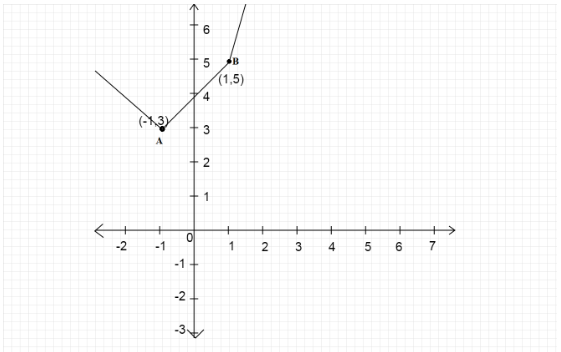
We draw a line intersecting the graph of the function at only one point.
From the figure we can see there is only one point through which we can draw a straight line that cuts the graph only at one point i.e. \[y = 3\].
Since \[f(x) = y\]
\[ \Rightarrow f(x) = 3\]
Comparing with the function \[f(x) = k\]
\[k = 3\]
\[\therefore \]Value of k is 3
\[\therefore \]Correct option is A.
Note: Students are likely to make the mistake of finding only one real solution as they confuse the word real with a positive and write solution by only looking at the positive x-axis. Keep in mind real solutions of the function means the value should be real (not complex). Also, when plotting the graph carefully, draw equations of lines to that point only till where the limit extends, many students draw lines beyond the end points.
* Modulus of a function ‘x’ opens up as \[\left| x \right| = \left\{ {\begin{array}{*{20}{c}}
x&{;x \geqslant 0} \\
{ - x}&{;x < 0}
\end{array}} \right.\]
Complete step-by-step answer:
Step-by-step answer:
We are given the function\[f(x) = x + 2\left| {x + 1} \right| + 2\left| {x - 1} \right|\]
We first solve both modulus terms
(a) \[\left| {x + 1} \right|\]:
If \[(x + 1) \geqslant 0\]
\[ \Rightarrow \left| {x + 1} \right| = x + 1\]
Now we find the value of ‘x’ by equating it to zero.
\[ \Rightarrow x + 1 = 0\]
Shift 1 to RHS
\[ \Rightarrow x = - 1\]
If \[(x + 1) < 0\]
\[ \Rightarrow \left| {x + 1} \right| = - x - 1\]
Now we find the value of ‘x’ by equating it to zero.
\[ \Rightarrow - x - 1 = 0\]
Shift -1 to RHS
\[ \Rightarrow - x = 1\]
\[ \Rightarrow x = - 1\]
So, the value of x is -1.
(a)\[\left| {x - 1} \right|\]:
If \[(x - 1) \geqslant 0\]
\[ \Rightarrow \left| {x - 1} \right| = x - 1\]
Now we find the value of ‘x’ by equating it to zero.
\[ \Rightarrow x - 1 = 0\]
Shift 1 to RHS
\[ \Rightarrow x = 1\]
If \[(x - 1) < 0\]
\[ \Rightarrow \left| {x - 1} \right| = - x + 1\]
Now we find the value of ‘x’ by equating it to zero.
\[ \Rightarrow - x + 1 = 0\]
Shift 1 to RHS
\[ \Rightarrow - x = - 1\]
\[ \Rightarrow x = 1\]
So, the value of x is 1.
From (a) and (b) we have values of x as -1 and 1.
We can divide the functions into three parts \[x < 1;x \in \left[ { - 1,1} \right);x \geqslant 1\]
CASE 1: \[x < 1\]
When \[x < 1\] then \[\left| {x + 1} \right| = - x - 1;\left| {x - 1} \right| = - x + 1\]
Substitute the values in \[f(x) = x + 2\left| {x + 1} \right| + 2\left| {x - 1} \right|\]
\[ \Rightarrow f(x) = x + 2( - x - 1) + 2( - x + 1)\]
Multiply terms in the bracket
\[ \Rightarrow f(x) = x - 2x - 2 - 2x + 2\]
Add like terms
\[ \Rightarrow f(x) = - 3x\]..............… (1)
CASE 2: \[x \in \left[ { - 1,1} \right)\]
When \[x \in \left[ { - 1,1} \right)\] then \[\left| {x + 1} \right| = (x + 1);\left| {x - 1} \right| = - x + 1\]
Substitute the values in \[f(x) = x + 2\left| {x + 1} \right| + 2\left| {x - 1} \right|\]
\[ \Rightarrow f(x) = x + 2(x + 1) + 2( - x + 1)\]
Multiply terms in the bracket
\[ \Rightarrow f(x) = x + 2x + 2 - 2x + 2\]
Add like terms
\[ \Rightarrow f(x) = x + 4\]..............… (2)
CASE 3: \[x \geqslant 1\]
When \[x \geqslant 1\] then \[\left| {x + 1} \right| = x + 1;\left| {x - 1} \right| = x - 1\]
Substitute the values in \[f(x) = x + 2\left| {x + 1} \right| + 2\left| {x - 1} \right|\]
\[ \Rightarrow f(x) = x + 2(x + 1) + 2(x - 1)\]
Multiply terms in the bracket
\[ \Rightarrow f(x) = x + 2x + 2 + 2x - 2\]
Add like terms
\[ \Rightarrow f(x) = 5x\].............… (3)
We can write the function collectively as \[f(x) = \left\{
\begin{array}{*{20}{c}}
{ - 3x}&{,x < - 1}
\end{array} \\
\begin{array}{*{20}{c}}
{x + 4}&{,x \in \left[ { - 1,1} \right)}
\end{array} \\
\begin{array}{*{20}{c}}
{5x}&{x \geqslant 1}
\end{array} \\
\right.\]
Now we will plot the three equations (1), (2) and (3) on graph
Write \[f(x) = y\]
From \[\left( { - \infty , - 1} \right)\] we have the equation of line \[y = - 3x\]
When \[x = 1,y = - 3\]
From \[\left[ { - 1,1} \right)\] we have the equation of line \[y = x + 4\]
When \[x = - 1,y = 3\] and \[x = 1,y = 5\]
From \[\left[ {1,\infty } \right)\] we have the equation of line \[y = 5x\]
When \[x = 1,y = 5\]
We draw a line intersecting the graph of the function at only one point.
From the figure we can see there is only one point through which we can draw a straight line that cuts the graph only at one point i.e. \[y = 3\].
Since \[f(x) = y\]
\[ \Rightarrow f(x) = 3\]
Comparing with the function \[f(x) = k\]
\[k = 3\]
\[\therefore \]Value of k is 3
\[\therefore \]Correct option is A.
Note: Students are likely to make the mistake of finding only one real solution as they confuse the word real with a positive and write solution by only looking at the positive x-axis. Keep in mind real solutions of the function means the value should be real (not complex). Also, when plotting the graph carefully, draw equations of lines to that point only till where the limit extends, many students draw lines beyond the end points.
Recently Updated Pages
Master Class 12 Economics: Engaging Questions & Answers for Success

Master Class 12 Physics: Engaging Questions & Answers for Success
Master Class 12 English: Engaging Questions & Answers for Success
Master Class 12 Social Science: Engaging Questions & Answers for Success
Master Class 12 Maths: Engaging Questions & Answers for Success
Master Class 12 Business Studies: Engaging Questions & Answers for Success
Trending doubts
Which are the Top 10 Largest Countries of the World?
What are the major means of transport Explain each class 12 social science CBSE
Draw a labelled sketch of the human eye class 12 physics CBSE
Why cannot DNA pass through cell membranes class 12 biology CBSE
Differentiate between insitu conservation and exsitu class 12 biology CBSE
Draw a neat and well labeled diagram of TS of ovary class 12 biology CBSE