




Let $f\left( x \right){\text{ }} = {\text{ }}\left| {{\text{ }}cos{\text{ }}x{\text{ }}} \right|$ . Then,
A. $f$ is everywhere differentiable
B. $f$ is everywhere continuous but not differentiable at $n = n\pi ,n \in Z$
C. $f$ is everywhere continuous but not differentiable at $x = (2n + 1)\dfrac{\pi }{2},n \in Z$
D. None of these
Answer
 Verified
511.5k+ views
Hint:The function $\left| {{\text{ }}cos{\text{ }}x{\text{ }}} \right|$ is given in mod which implies that it can be also written as $\cos x, - \cos x$ . The best method to solve this question is using the graph method in which we plot $\left| {{\text{ }}cos{\text{ }}x{\text{ }}} \right|$ as function and solve it . If while plotting a graph the tip of the pen is not held up then you can say it is continuous
Complete step by step answer:
Given : $\left| {{\text{ }}cos{\text{ }}x{\text{ }}} \right| = \cos x, - \cos x$ , on plotting graph of $\left| {{\text{ }}cos{\text{ }}x{\text{ }}} \right|$ , we get
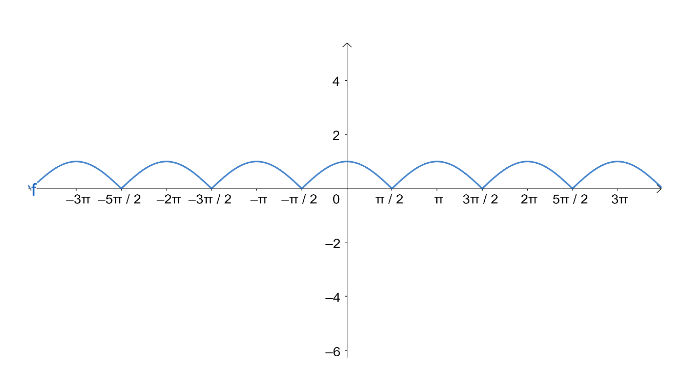
From the graph drawn we find that the function $\left| {{\text{ }}cos{\text{ }}x{\text{ }}} \right|$ is continuous everywhere as :
$f\left( x \right) = \left| {cos{\text{ }}x} \right|\;$
$\Rightarrow h\left( x \right) = \left| x \right|$
Let $g\left( x \right)$ be the function for $cos{\text{ }}x$ , therefore
$g\left( x \right) = cos{\text{ }}x$ , now solving the function for $h \circ g\left( x \right)$ , we get
$h \circ g\left( x \right) = \left| {\cos x} \right|$
Since , $cos{\text{ }}x$ is a continuous function f(c) must be defined . For the differentiability of $cos{\text{ }}x$ , the limit of the function as $x$ approaches the right hand limit ( RHL ) and left hand limit ( LHL ) there must exist a value $c$ . The function's value at c and the limit as $x$ approaches $c$ must be the same.The function $cos{\text{ }}x$ is every continuous and differentiable in its domain.
Therefore $\left| {{\text{ }}cos{\text{ }}x{\text{ }}} \right|$ is also continuous . Now , for differentiability we draw a tangent to the curve ,
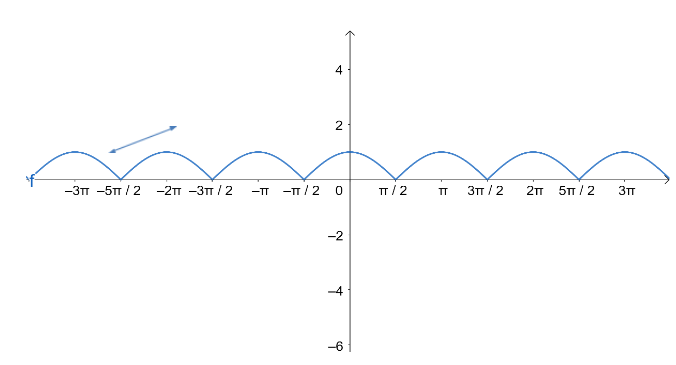
At $\left| {{\text{ }}cos{\text{ }}x{\text{ }}} \right|$$ = - 2\pi $ , therefore we can say that $\left| {{\text{ }}cos{\text{ }}x{\text{ }}} \right|$ is differentiable at $ = - 2\pi $ . But at $\left| {{\text{ }}cos{\text{ }}x{\text{ }}} \right|$ $ = \dfrac{\pi }{2}$ , we were not able to draw a tangent at that point.Therefore , the function is not differentiable at $x = (2n + 1)\dfrac{\pi }{2},n \in Z$.
Therefore the correct answer is option C.
Note:The continuity and differentiability of a function can be easily solved using the graph method but remember how to plot graphs of different functions . The polynomial functions are continuous and differentiable . Therefore , you can directly use them as such.
Complete step by step answer:
Given : $\left| {{\text{ }}cos{\text{ }}x{\text{ }}} \right| = \cos x, - \cos x$ , on plotting graph of $\left| {{\text{ }}cos{\text{ }}x{\text{ }}} \right|$ , we get
From the graph drawn we find that the function $\left| {{\text{ }}cos{\text{ }}x{\text{ }}} \right|$ is continuous everywhere as :
$f\left( x \right) = \left| {cos{\text{ }}x} \right|\;$
$\Rightarrow h\left( x \right) = \left| x \right|$
Let $g\left( x \right)$ be the function for $cos{\text{ }}x$ , therefore
$g\left( x \right) = cos{\text{ }}x$ , now solving the function for $h \circ g\left( x \right)$ , we get
$h \circ g\left( x \right) = \left| {\cos x} \right|$
Since , $cos{\text{ }}x$ is a continuous function f(c) must be defined . For the differentiability of $cos{\text{ }}x$ , the limit of the function as $x$ approaches the right hand limit ( RHL ) and left hand limit ( LHL ) there must exist a value $c$ . The function's value at c and the limit as $x$ approaches $c$ must be the same.The function $cos{\text{ }}x$ is every continuous and differentiable in its domain.
Therefore $\left| {{\text{ }}cos{\text{ }}x{\text{ }}} \right|$ is also continuous . Now , for differentiability we draw a tangent to the curve ,
At $\left| {{\text{ }}cos{\text{ }}x{\text{ }}} \right|$$ = - 2\pi $ , therefore we can say that $\left| {{\text{ }}cos{\text{ }}x{\text{ }}} \right|$ is differentiable at $ = - 2\pi $ . But at $\left| {{\text{ }}cos{\text{ }}x{\text{ }}} \right|$ $ = \dfrac{\pi }{2}$ , we were not able to draw a tangent at that point.Therefore , the function is not differentiable at $x = (2n + 1)\dfrac{\pi }{2},n \in Z$.
Therefore the correct answer is option C.
Note:The continuity and differentiability of a function can be easily solved using the graph method but remember how to plot graphs of different functions . The polynomial functions are continuous and differentiable . Therefore , you can directly use them as such.
Recently Updated Pages
Master Class 12 Economics: Engaging Questions & Answers for Success

Master Class 12 Physics: Engaging Questions & Answers for Success
Master Class 12 English: Engaging Questions & Answers for Success
Master Class 12 Social Science: Engaging Questions & Answers for Success
Master Class 12 Maths: Engaging Questions & Answers for Success
Master Class 12 Business Studies: Engaging Questions & Answers for Success
Trending doubts
Which are the Top 10 Largest Countries of the World?
What are the major means of transport Explain each class 12 social science CBSE
Draw a labelled sketch of the human eye class 12 physics CBSE
Why cannot DNA pass through cell membranes class 12 biology CBSE
Differentiate between insitu conservation and exsitu class 12 biology CBSE
Draw a neat and well labeled diagram of TS of ovary class 12 biology CBSE