




Let ${A_0},{A_1},{A_2},{A_3},{A_4},{A_5}$ be a regular hexagon inscribed in a circle of unit radius. Then the product of the length of the line segment ${A_0}{A_1},{A_0}{A_2}$ and ${A_0}{A_4}$ is
Answer
 Verified
586.8k+ views
Hint:
Here it is given that ${A_0},{A_1},{A_2},{A_3},{A_4},{A_5}$ be a regular hexagon inscribed in a circle of unit radius. We are required to find the product of the length of the line segment ${A_0}{A_1},{A_0}{A_2}$ and ${A_0}{A_4}$ .
We know that all the sides of the regular hexagon are equal.
Now, find the coordinates of the points ${A_0},{A_1},{A_2},{A_3},{A_4},{A_5}$ of the Hexagon.
Thus, using the distance formula, find the distance between any two consecutive points.
Finally, find the required product.
Complete step by step solution:
Here it is given that ${A_0},{A_1},{A_2},{A_3},{A_4},{A_5}$ be a regular hexagon inscribed in a circle of unit radius. We are required to find the product of the length of the line segment ${A_0}{A_1},{A_0}{A_2}$ and ${A_0}{A_4}$.
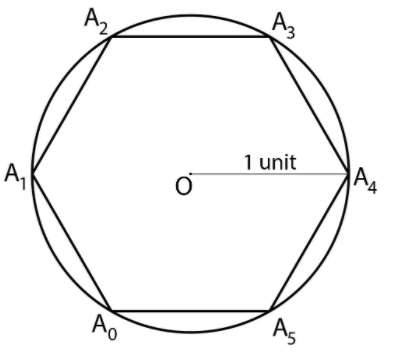
Here from the figure it is clear that $O{A_4} = 1$
Here, it is given that it is a regular hexagon
$ \Rightarrow $ All sides of a regular hexagon are equal.
Then,
$O{A_1} = O{A_2} = O{A_3} = O{A_4} = O{A_5} = 1$
$ \Rightarrow $ Each sides of regular hexagon makes an angle of ${60^ \circ }$at the centre O of circle coordinates of ${A_1},{A_2},{A_4},{A_5}$ are $\left( {\cos {{60}^ \circ },\sin {{60}^ \circ }} \right),\left( {\cos {{120}^ \circ },\sin {{120}^ \circ }} \right),\left( { - \cos {{60}^ \circ }, - \sin {{60}^ \circ }} \right),\left( { - \cos {{120}^ \circ }, - \sin {{120}^ \circ }} \right)$ respectively
${A_1} = \left( {\dfrac{1}{2},\dfrac{{\sqrt 3 }}{2}} \right)$
${A_2} = \left( { - \dfrac{1}{2},\dfrac{{\sqrt 3 }}{2}} \right)$
${A_4} = \left( { - \dfrac{1}{2}, - \dfrac{{\sqrt 3 }}{2}} \right)$
${A_5} = \left( {\dfrac{1}{2}, - \dfrac{{\sqrt 3 }}{2}} \right)$
And,
${A_3} = \left( { - 1,0} \right)$ and ${A_0} = \left( {1,0} \right)$ (given circle is of radius)
Now, By distance formula
$\sqrt {{{\left( {{x_2} - {x_1}} \right)}^2} + {{\left( {{y_2} - {y_1}} \right)}^2}} $
${\left( {{A_0}{A_1}} \right)^2} = {\left( {\dfrac{1}{2} - 1} \right)^2} + {\left( {\dfrac{{\sqrt 3 }}{2} - 0} \right)^2}$
$ \Rightarrow \left( {{A_0}{A_1}} \right) = 1$
Now, same with as $\left( {{A_0}{A_2}} \right)$
${\left( {{A_0}{A_2}} \right)^2} = {\left( { - \dfrac{1}{2}, - 1} \right)^2} + {\left( {\dfrac{{\sqrt 3 }}{2} - 0} \right)^2}$
$\left( {{A_0}{A_2}} \right) = \sqrt 3 $
Similarly, find the value of $\left( {{A_0}{A_4}} \right)$
${\left( {{A_0}{A_4}} \right)^2} = {\left( { - \dfrac{1}{2} - 1} \right)^2} + {\left( { - \dfrac{{\sqrt 3 }}{2} - 0} \right)^2}$
$\left( {{A_0}{A_4}} \right) = \sqrt 3 $
Now, product of line segment of $\left( {{A_0}{A_1}} \right),\left( {{A_0}{A_2}} \right)$ and $\left( {{A_0}{A_4}} \right)$ is
$ = 1 \times \sqrt 3 \times \sqrt 3 \\
=3$
Hence, the product is 3.
Note:
Regular polygon: In geometry, a regular polygon is a polygon that is equiangular and equilateral. Regular polygon may be either convex or star.
Regular Hexagon: A regular hexagon is defined as a hexagon that is both equilateral and equiangular. It is bicentric, meaning that it is both cyclic (has a circumscribed circle) and tangential (has an inscribed circle)
Here it is given that ${A_0},{A_1},{A_2},{A_3},{A_4},{A_5}$ be a regular hexagon inscribed in a circle of unit radius. We are required to find the product of the length of the line segment ${A_0}{A_1},{A_0}{A_2}$ and ${A_0}{A_4}$ .
We know that all the sides of the regular hexagon are equal.
Now, find the coordinates of the points ${A_0},{A_1},{A_2},{A_3},{A_4},{A_5}$ of the Hexagon.
Thus, using the distance formula, find the distance between any two consecutive points.
Finally, find the required product.
Complete step by step solution:
Here it is given that ${A_0},{A_1},{A_2},{A_3},{A_4},{A_5}$ be a regular hexagon inscribed in a circle of unit radius. We are required to find the product of the length of the line segment ${A_0}{A_1},{A_0}{A_2}$ and ${A_0}{A_4}$.
Here from the figure it is clear that $O{A_4} = 1$
Here, it is given that it is a regular hexagon
$ \Rightarrow $ All sides of a regular hexagon are equal.
Then,
$O{A_1} = O{A_2} = O{A_3} = O{A_4} = O{A_5} = 1$
$ \Rightarrow $ Each sides of regular hexagon makes an angle of ${60^ \circ }$at the centre O of circle coordinates of ${A_1},{A_2},{A_4},{A_5}$ are $\left( {\cos {{60}^ \circ },\sin {{60}^ \circ }} \right),\left( {\cos {{120}^ \circ },\sin {{120}^ \circ }} \right),\left( { - \cos {{60}^ \circ }, - \sin {{60}^ \circ }} \right),\left( { - \cos {{120}^ \circ }, - \sin {{120}^ \circ }} \right)$ respectively
${A_1} = \left( {\dfrac{1}{2},\dfrac{{\sqrt 3 }}{2}} \right)$
${A_2} = \left( { - \dfrac{1}{2},\dfrac{{\sqrt 3 }}{2}} \right)$
${A_4} = \left( { - \dfrac{1}{2}, - \dfrac{{\sqrt 3 }}{2}} \right)$
${A_5} = \left( {\dfrac{1}{2}, - \dfrac{{\sqrt 3 }}{2}} \right)$
And,
${A_3} = \left( { - 1,0} \right)$ and ${A_0} = \left( {1,0} \right)$ (given circle is of radius)
Now, By distance formula
$\sqrt {{{\left( {{x_2} - {x_1}} \right)}^2} + {{\left( {{y_2} - {y_1}} \right)}^2}} $
${\left( {{A_0}{A_1}} \right)^2} = {\left( {\dfrac{1}{2} - 1} \right)^2} + {\left( {\dfrac{{\sqrt 3 }}{2} - 0} \right)^2}$
$ \Rightarrow \left( {{A_0}{A_1}} \right) = 1$
Now, same with as $\left( {{A_0}{A_2}} \right)$
${\left( {{A_0}{A_2}} \right)^2} = {\left( { - \dfrac{1}{2}, - 1} \right)^2} + {\left( {\dfrac{{\sqrt 3 }}{2} - 0} \right)^2}$
$\left( {{A_0}{A_2}} \right) = \sqrt 3 $
Similarly, find the value of $\left( {{A_0}{A_4}} \right)$
${\left( {{A_0}{A_4}} \right)^2} = {\left( { - \dfrac{1}{2} - 1} \right)^2} + {\left( { - \dfrac{{\sqrt 3 }}{2} - 0} \right)^2}$
$\left( {{A_0}{A_4}} \right) = \sqrt 3 $
Now, product of line segment of $\left( {{A_0}{A_1}} \right),\left( {{A_0}{A_2}} \right)$ and $\left( {{A_0}{A_4}} \right)$ is
$ = 1 \times \sqrt 3 \times \sqrt 3 \\
=3$
Hence, the product is 3.
Note:
Regular polygon: In geometry, a regular polygon is a polygon that is equiangular and equilateral. Regular polygon may be either convex or star.
Regular Hexagon: A regular hexagon is defined as a hexagon that is both equilateral and equiangular. It is bicentric, meaning that it is both cyclic (has a circumscribed circle) and tangential (has an inscribed circle)

Recently Updated Pages
Basicity of sulphurous acid and sulphuric acid are

Master Class 11 Business Studies: Engaging Questions & Answers for Success
Master Class 11 Computer Science: Engaging Questions & Answers for Success
Master Class 11 Economics: Engaging Questions & Answers for Success
Master Class 12 English: Engaging Questions & Answers for Success
Master Class 12 Social Science: Engaging Questions & Answers for Success
Trending doubts
Fill the blanks with the suitable prepositions 1 The class 9 english CBSE
Difference Between Plant Cell and Animal Cell
What is the color of ferrous sulphate crystals? How does this color change after heating? Name the products formed on strongly heating ferrous sulphate crystals. What type of chemical reaction occurs in this type of change.
What is the Full Form of ICSE / ISC ?
Find the mode and median of the data 13 16 12 14 1-class-9-maths-CBSE
What is pollution? How many types of pollution? Define it
Fill the blanks with the suitable prepositions 1 The class 9 english CBSE
Difference Between Plant Cell and Animal Cell
What is the color of ferrous sulphate crystals? How does this color change after heating? Name the products formed on strongly heating ferrous sulphate crystals. What type of chemical reaction occurs in this type of change.