




Let $A = \left\{ {1,2,3} \right\},B = \left\{ {4,5,6,7} \right\}$ and let $f = \left\{ {\left( {1,4} \right),\left( {2,5} \right),\left( {3,6} \right)} \right\}$ be a function from A to B. State whether f is one-one.
Answer
 Verified
578.7k+ views
Hint: First draw the mapping of the function $f$. After that check whether the function $f$ follows the definition of a one-one function or not. If it follows it is a one-one function else it is not a one-one function.
Complete step-by-step solution:
First, let us know that it is a one-one function.
One to one function denotes the mapping of two sets. A function g is one-to-one if every element of the range of g corresponds to exactly one element of the domain of g. One-to-one is also written as 1-1. A function f() is a method, which relates elements/values of one variable to the elements/values of another variable, in such a way that the elements of the first variable identically determine the elements of the second variable.
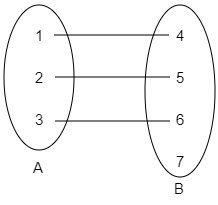
The mapping of the function $f$ is given below.
According to the question,
$f:A \to B$ is defined as $f = \left\{ {\left( {1,4} \right),\left( {2,5} \right),\left( {3,6} \right)} \right\}$
Which means,
$ \Rightarrow f\left( 1 \right) = 4,f\left( 2 \right) = 5,f\left( 3 \right) = 6$
As, It is seen that the images of distinct elements of A under f are distinct, which follows the definition of the one-one function.
Hence, the function $f$ is one-one.
Note: A function is a relation that describes that there should be only one output for each input. OR we can say that a special kind of relation (a set of ordered pairs) which follows a rule i.e every X-value should be associated with only one y-value is called a Function.
To recall, a function is something, which relates elements/values of one set to the elements/values of another set, in such a way that elements of the second set are identically determined by the elements of the first set. A function has many types that define the relationship between two sets in a different pattern. There are various types of functions as one to one function, onto function, many to one function, etc.
A function has many types and one of the most common functions used is the one-to-one function or injective function. Also, we will be learning here the inverse of this function.
Complete step-by-step solution:
First, let us know that it is a one-one function.
One to one function denotes the mapping of two sets. A function g is one-to-one if every element of the range of g corresponds to exactly one element of the domain of g. One-to-one is also written as 1-1. A function f() is a method, which relates elements/values of one variable to the elements/values of another variable, in such a way that the elements of the first variable identically determine the elements of the second variable.
The mapping of the function $f$ is given below.
According to the question,
$f:A \to B$ is defined as $f = \left\{ {\left( {1,4} \right),\left( {2,5} \right),\left( {3,6} \right)} \right\}$
Which means,
$ \Rightarrow f\left( 1 \right) = 4,f\left( 2 \right) = 5,f\left( 3 \right) = 6$
As, It is seen that the images of distinct elements of A under f are distinct, which follows the definition of the one-one function.
Hence, the function $f$ is one-one.
Note: A function is a relation that describes that there should be only one output for each input. OR we can say that a special kind of relation (a set of ordered pairs) which follows a rule i.e every X-value should be associated with only one y-value is called a Function.
To recall, a function is something, which relates elements/values of one set to the elements/values of another set, in such a way that elements of the second set are identically determined by the elements of the first set. A function has many types that define the relationship between two sets in a different pattern. There are various types of functions as one to one function, onto function, many to one function, etc.
A function has many types and one of the most common functions used is the one-to-one function or injective function. Also, we will be learning here the inverse of this function.
Recently Updated Pages
Master Class 12 Social Science: Engaging Questions & Answers for Success

Master Class 12 Physics: Engaging Questions & Answers for Success
Master Class 12 Maths: Engaging Questions & Answers for Success
Master Class 12 Economics: Engaging Questions & Answers for Success
Master Class 12 Chemistry: Engaging Questions & Answers for Success
Master Class 12 Business Studies: Engaging Questions & Answers for Success
Trending doubts
Which are the Top 10 Largest Countries of the World?
Draw a labelled sketch of the human eye class 12 physics CBSE
Explain the structure of megasporangium class 12 biology CBSE
What are the major means of transport Explain each class 12 social science CBSE
How many chromosomes are found in human ovum a 46 b class 12 biology CBSE
The diagram of the section of a maize grain is given class 12 biology CBSE