




Let A and B are two events such that the probability that exactly one of them occurs is $\dfrac{2}{5}$ and the probability that A or B occurs is $\dfrac{1}{2}$. Find the probability of both of them occurring together.
A. 0.01
B. 0.10
C. 0.20
D. 0.02
Answer
 Verified
574.5k+ views
Hint: We first define the events and describe them in both set theory forms and Venn diagram. The individual events are independent of each other. We use the given values and use them in the formula $p\left( A\cup B \right)=p\left( A\cap {{B}^{c}} \right)+p\left( B\cap {{A}^{c}} \right)+p\left( A\cap B \right)$ to find the solution of the problem.
Complete step-by-step answer:
There are two events A and B. it’s given that the probability that exactly one of them occurs is $\dfrac{2}{5}$ and the probability that A or B occurs is $\dfrac{1}{2}$.
We try to express the given conditions in the form of Venn’s diagram and then in set theory.
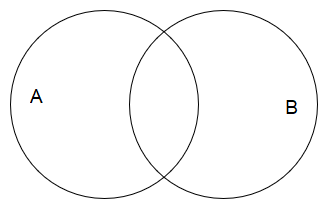
The notion of one of them occurring is the sum of the probabilities of A happening and B happening. In set theory we express it as $p\left( A\cap {{B}^{c}} \right)+p\left( B\cap {{A}^{c}} \right)$. Here ${{A}^{c}},{{B}^{c}}$ defines the complement set of A and B respectively.
The notion of A or B occurring is the probability of either A happening or B happening. In set theory we express it as $p\left( A\cup B \right)$.
The total set described is the universal set. The event containing both A and B happening at least one is defined as $p\left( A\cup B \right)$.
The notion of A and B occurring together is the probability of A and B happening at the same time. In set theory we express it as $p\left( A\cap B \right)$.
So, $p\left( A\cap {{B}^{c}} \right)+p\left( B\cap {{A}^{c}} \right)=\dfrac{2}{5}$ and $p\left( A\cup B \right)=\dfrac{1}{2}$.
In set theory we have the formula $p\left( A\cup B \right)=p\left( A\cap {{B}^{c}} \right)+p\left( B\cap {{A}^{c}} \right)+p\left( A\cap B \right)$.
Putting the values, we get $\dfrac{1}{2}=\dfrac{2}{5}+p\left( A\cap B \right)$.
This gives us $p\left( A\cap B \right)=\dfrac{1}{2}-\dfrac{2}{5}=\dfrac{5-4}{10}=\dfrac{1}{10}=0.1$.
The probability of both of them occurring together is 0.1. The correct option is B.
So, the correct answer is “Option B”.
Note: The difference between $p\left( A\cap {{B}^{c}} \right)+p\left( B\cap {{A}^{c}} \right)$ and $p\left( A \right)+p\left( B \right)$ is that the later one describes the whole event where the intersection part of both events are also considered in each cases. But in the first case we are only taking the events happening in solo form.
Complete step-by-step answer:
There are two events A and B. it’s given that the probability that exactly one of them occurs is $\dfrac{2}{5}$ and the probability that A or B occurs is $\dfrac{1}{2}$.
We try to express the given conditions in the form of Venn’s diagram and then in set theory.
The notion of one of them occurring is the sum of the probabilities of A happening and B happening. In set theory we express it as $p\left( A\cap {{B}^{c}} \right)+p\left( B\cap {{A}^{c}} \right)$. Here ${{A}^{c}},{{B}^{c}}$ defines the complement set of A and B respectively.
The notion of A or B occurring is the probability of either A happening or B happening. In set theory we express it as $p\left( A\cup B \right)$.
The total set described is the universal set. The event containing both A and B happening at least one is defined as $p\left( A\cup B \right)$.
The notion of A and B occurring together is the probability of A and B happening at the same time. In set theory we express it as $p\left( A\cap B \right)$.
So, $p\left( A\cap {{B}^{c}} \right)+p\left( B\cap {{A}^{c}} \right)=\dfrac{2}{5}$ and $p\left( A\cup B \right)=\dfrac{1}{2}$.
In set theory we have the formula $p\left( A\cup B \right)=p\left( A\cap {{B}^{c}} \right)+p\left( B\cap {{A}^{c}} \right)+p\left( A\cap B \right)$.
Putting the values, we get $\dfrac{1}{2}=\dfrac{2}{5}+p\left( A\cap B \right)$.
This gives us $p\left( A\cap B \right)=\dfrac{1}{2}-\dfrac{2}{5}=\dfrac{5-4}{10}=\dfrac{1}{10}=0.1$.
The probability of both of them occurring together is 0.1. The correct option is B.
So, the correct answer is “Option B”.
Note: The difference between $p\left( A\cap {{B}^{c}} \right)+p\left( B\cap {{A}^{c}} \right)$ and $p\left( A \right)+p\left( B \right)$ is that the later one describes the whole event where the intersection part of both events are also considered in each cases. But in the first case we are only taking the events happening in solo form.
Recently Updated Pages
Master Class 12 Economics: Engaging Questions & Answers for Success

Master Class 12 Physics: Engaging Questions & Answers for Success
Master Class 12 English: Engaging Questions & Answers for Success
Master Class 12 Social Science: Engaging Questions & Answers for Success
Master Class 12 Maths: Engaging Questions & Answers for Success
Master Class 12 Business Studies: Engaging Questions & Answers for Success
Trending doubts
Which are the Top 10 Largest Countries of the World?
What are the major means of transport Explain each class 12 social science CBSE
Draw a labelled sketch of the human eye class 12 physics CBSE
Why cannot DNA pass through cell membranes class 12 biology CBSE
Differentiate between insitu conservation and exsitu class 12 biology CBSE
Draw a neat and well labeled diagram of TS of ovary class 12 biology CBSE