




$ {\left[ {Cr{{\left( {N{H_3}} \right)}_6}} \right]^{3 + }} $ is paramagnetic while $ {\left[ {Ni{{\left( {CN} \right)}_4}} \right]^{2 - }} $ is diamagnetic. Explain why?
Answer
 Verified
558.9k+ views
Hint :We solve this using valence bond theory. Before solving this we need to know the type of ligand that is weak field ligand or strong field ligand. If it is a weak field ligand then it cannot pair up the electron and if it is a strong field ligand then it can pair up the electron. In the central metal atom if we have an unpaired electron then it is paramagnetic. In the central metal atom if we have paired electrons then it is diamagnetic.
Complete step by step solution:
We have,
$ {\left[ {Cr{{\left( {N{H_3}} \right)}_6}} \right]^{3 + }} $
We need the oxidation state of Chromium $ Cr $ .
We know that $ N{H_3} $ is a neutral ligand so that the oxidation state is zero.
$ Cr + 6(0) = + 3 $
$ Cr = + 3 $
That is the oxidation state is 3.
We know that the atomic number of Chromium is 24.
The electronic configuration of $ Cr $ is given by
$ \left[ {Ar} \right]3{d^5}4{s^1}4{p^0}4{d^0} $ .

(these cannot be done in latex form)
The electronic configuration of $ C{r^{ + 3}} $ is given by
$ \left[ {Ar} \right]3{d^3}4{s^0}4{p^0}4{d^0} $ . That is loss of one ‘4s’ electron and two ‘3d’ electrons. Thus the resulting $ C{r^{ + 3}} $ ion has outer electronic configuration of $ 3{d^3} $ .

Now we can see the hybridization
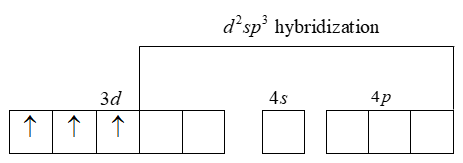
Thus we have two vacant 3d-orbital, one 4s-orbital and three 4p-orbitals hybridise to give six equivalent $ {d^2}s{p^3} $ hybrid orbitals. Six pairs of electrons, one from each $ N{H_3} $ molecule occupy the six vacant hybrid orbitals which are produced.
Now let’s see electronic configuration of $ {\left[ {Cr{{\left( {N{H_3}} \right)}_6}} \right]^{3 + }} $ complex.
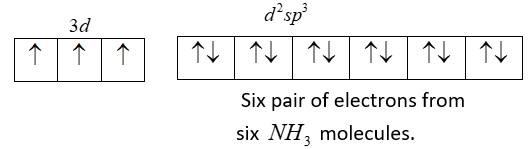
We can see that we have unpaired electrons so it is paramagnetic.
Now $ {\left[ {Ni{{\left( {CN} \right)}_4}} \right]^{2 - }} $
We need the oxidation state of Nickel $ Ni $ .
We know that $ CN $ is a strong ligand so that the oxidation state is $ - 1 $ .
$ Ni + 4( - 1) = - 2 $
$ Ni = + 2 $
That is the oxidation state is 2.
We know that the atomic number of Chromium is 27.
The electronic configuration of $ Ni $ is given by
$ \left[ {Ar} \right]3{d^8}4{s^2}4{p^0}4{d^0} $ .

The electronic configuration of $ N{i^{ + 2}} $ is given by
$ \left[ {Ar} \right]3{d^8}4{s^0}4{p^0} $ . That is the loss of two ‘4s’ electrons. Thus the resulting $ N{i^{ + 2}} $ ion has outer electronic configuration of $ 3{d^3} $ .

Also that $ CN $ is a strong ligand and pairing of electrons takes place. That is the two unpaired 3d-electrons are forced to pair up.

Since we have four $ CN $ ligands which donate 4 pairs of electrons resulting in $ ds{p^2} $ hybrid orbitals and from each cyanide ion occupy the four vacant hybrid orbitals.
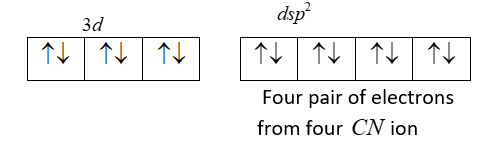
We can see that there is no unpaired electron. So it is diamagnetic.
Note:
$ {\left[ {Cr{{\left( {N{H_3}} \right)}_6}} \right]^{3 + }} $ is $ {d^2}s{p^3} $ hybridization hence the geometry of the complex ion is octahedral. $ {\left[ {Ni{{\left( {CN} \right)}_4}} \right]^{2 - }} $ is $ ds{p^2} $ hybridization hence the geometry of complex ion is square planar. Similarly if we have $ sp $ hybridization then the geometry is linear. If we have $ s{p^2} $ hybridization then the geometry is triangular planar. If we have $ s{p^3} $ hybridization then the geometry is tetrahedral.
Complete step by step solution:
We have,
$ {\left[ {Cr{{\left( {N{H_3}} \right)}_6}} \right]^{3 + }} $
We need the oxidation state of Chromium $ Cr $ .
We know that $ N{H_3} $ is a neutral ligand so that the oxidation state is zero.
$ Cr + 6(0) = + 3 $
$ Cr = + 3 $
That is the oxidation state is 3.
We know that the atomic number of Chromium is 24.
The electronic configuration of $ Cr $ is given by
$ \left[ {Ar} \right]3{d^5}4{s^1}4{p^0}4{d^0} $ .
(these cannot be done in latex form)
The electronic configuration of $ C{r^{ + 3}} $ is given by
$ \left[ {Ar} \right]3{d^3}4{s^0}4{p^0}4{d^0} $ . That is loss of one ‘4s’ electron and two ‘3d’ electrons. Thus the resulting $ C{r^{ + 3}} $ ion has outer electronic configuration of $ 3{d^3} $ .
Now we can see the hybridization
Thus we have two vacant 3d-orbital, one 4s-orbital and three 4p-orbitals hybridise to give six equivalent $ {d^2}s{p^3} $ hybrid orbitals. Six pairs of electrons, one from each $ N{H_3} $ molecule occupy the six vacant hybrid orbitals which are produced.
Now let’s see electronic configuration of $ {\left[ {Cr{{\left( {N{H_3}} \right)}_6}} \right]^{3 + }} $ complex.
We can see that we have unpaired electrons so it is paramagnetic.
Now $ {\left[ {Ni{{\left( {CN} \right)}_4}} \right]^{2 - }} $
We need the oxidation state of Nickel $ Ni $ .
We know that $ CN $ is a strong ligand so that the oxidation state is $ - 1 $ .
$ Ni + 4( - 1) = - 2 $
$ Ni = + 2 $
That is the oxidation state is 2.
We know that the atomic number of Chromium is 27.
The electronic configuration of $ Ni $ is given by
$ \left[ {Ar} \right]3{d^8}4{s^2}4{p^0}4{d^0} $ .
The electronic configuration of $ N{i^{ + 2}} $ is given by
$ \left[ {Ar} \right]3{d^8}4{s^0}4{p^0} $ . That is the loss of two ‘4s’ electrons. Thus the resulting $ N{i^{ + 2}} $ ion has outer electronic configuration of $ 3{d^3} $ .
Also that $ CN $ is a strong ligand and pairing of electrons takes place. That is the two unpaired 3d-electrons are forced to pair up.
Since we have four $ CN $ ligands which donate 4 pairs of electrons resulting in $ ds{p^2} $ hybrid orbitals and from each cyanide ion occupy the four vacant hybrid orbitals.
We can see that there is no unpaired electron. So it is diamagnetic.
Note:
$ {\left[ {Cr{{\left( {N{H_3}} \right)}_6}} \right]^{3 + }} $ is $ {d^2}s{p^3} $ hybridization hence the geometry of the complex ion is octahedral. $ {\left[ {Ni{{\left( {CN} \right)}_4}} \right]^{2 - }} $ is $ ds{p^2} $ hybridization hence the geometry of complex ion is square planar. Similarly if we have $ sp $ hybridization then the geometry is linear. If we have $ s{p^2} $ hybridization then the geometry is triangular planar. If we have $ s{p^3} $ hybridization then the geometry is tetrahedral.
Recently Updated Pages
Master Class 12 Social Science: Engaging Questions & Answers for Success

Master Class 12 Physics: Engaging Questions & Answers for Success
Master Class 12 Maths: Engaging Questions & Answers for Success
Master Class 12 Economics: Engaging Questions & Answers for Success
Master Class 12 Chemistry: Engaging Questions & Answers for Success
Master Class 12 Business Studies: Engaging Questions & Answers for Success
Trending doubts
Which are the Top 10 Largest Countries of the World?
Draw a labelled sketch of the human eye class 12 physics CBSE
Explain the structure of megasporangium class 12 biology CBSE
What are the major means of transport Explain each class 12 social science CBSE
How many chromosomes are found in human ovum a 46 b class 12 biology CBSE
The diagram of the section of a maize grain is given class 12 biology CBSE