




What is known as electrostatic repulsion?
A) When two positively or two negatively charged particles come closer to each other then they repel from each other
B) When two charged particles come closer to each other then repel from each other
C) When positively and negatively charged particles come closer to each other then they repel from each other
D) None
Answer
 Verified
606.3k+ views
Hint: In this question, we have to identify that option which describes the repulsion force between two which have the same type of property. This property may be either the same pole (in magnetism) or the same charges (in electrostatic).
Complete step by step answer:
Two particles feel a repulsion force when they are having the same property.
There are two types of charges which are positive charge and negative charge.
So, when two same types of charges come closer to each other then they both feel a repulsion force.
The same can be observed from the below figure:
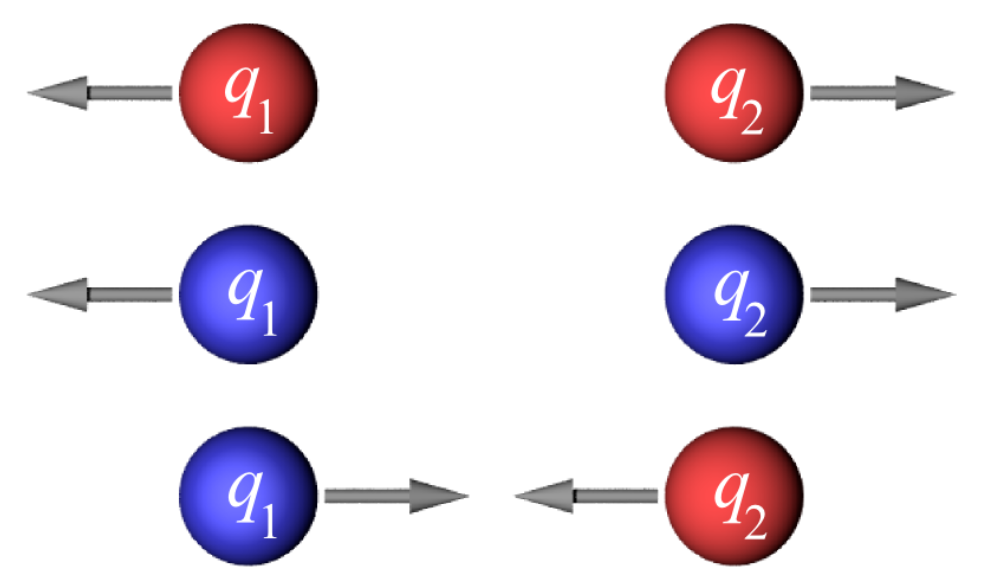
Hence, when two positively or two negatively charged particles come closer to each other then they repel from each other, then it is known as electrostatic repulsion.
Therefore, option (A) is correct.
Additional Information:
When the particles are electrostatically charged then they feel two types of forces- electrostatic attraction and electrostatic repulsion. In electrostatic attraction, both the charges are opposite and in electrostatic repulsion, both the charges are the same.
For example, we have two types of paper pieces. One is torn paper pieces and the other is cut papers. When we rub a comb on our hair and take it close to the torn paper pieces and cut paper pieces one by one. We observe that torn paper pieces are attracted towards the comb while the cut paper pieces are not attracted towards the comb.
Note:
In this question, we have to remember the difference between attraction force and repulsion force in electrostatics. Both types of forces have charges but in attraction force, charges are opposite while in repulsion forces, charges are the same.
Complete step by step answer:
Two particles feel a repulsion force when they are having the same property.
There are two types of charges which are positive charge and negative charge.
So, when two same types of charges come closer to each other then they both feel a repulsion force.
The same can be observed from the below figure:
Hence, when two positively or two negatively charged particles come closer to each other then they repel from each other, then it is known as electrostatic repulsion.
Therefore, option (A) is correct.
Additional Information:
When the particles are electrostatically charged then they feel two types of forces- electrostatic attraction and electrostatic repulsion. In electrostatic attraction, both the charges are opposite and in electrostatic repulsion, both the charges are the same.
For example, we have two types of paper pieces. One is torn paper pieces and the other is cut papers. When we rub a comb on our hair and take it close to the torn paper pieces and cut paper pieces one by one. We observe that torn paper pieces are attracted towards the comb while the cut paper pieces are not attracted towards the comb.
Note:
In this question, we have to remember the difference between attraction force and repulsion force in electrostatics. Both types of forces have charges but in attraction force, charges are opposite while in repulsion forces, charges are the same.
Recently Updated Pages
Master Class 12 Business Studies: Engaging Questions & Answers for Success

Master Class 12 Chemistry: Engaging Questions & Answers for Success
Master Class 12 Biology: Engaging Questions & Answers for Success
Class 12 Question and Answer - Your Ultimate Solutions Guide
Master Class 11 English: Engaging Questions & Answers for Success
Master Class 11 Maths: Engaging Questions & Answers for Success
Trending doubts
Which is more stable and why class 12 chemistry CBSE
Which are the Top 10 Largest Countries of the World?
Draw a labelled sketch of the human eye class 12 physics CBSE
Differentiate between homogeneous and heterogeneous class 12 chemistry CBSE
What are the major means of transport Explain each class 12 social science CBSE
Sulphuric acid is known as the king of acids State class 12 chemistry CBSE