




\[\text{KMn}{{\text{O}}_{4}}\](acidic/alkaline) is not decolourised by:
A. Mohr salt
B. Oxalic acid
C. Benzene
D. Propene
Answer
 Verified
672.9k+ views
Hint: Potassium permanganate consists of two ions i.e. potassium ion and permanganate ion that's why it is an ionic compound. Potassium permanganate comes in a category of the strongest oxidizing agents. Double bond and triple bonds on the side chain and not in the ring are necessary for the decolourisation of the potassium permanganate.
Complete step by step solution:
-We all know that benzene has a molecular formula of ${{\text{C}}_{6}}{{\text{H}}_{6}}$ and it consists of a double bond in a 6-membered ring structure.
-Also, benzene has a ∏-electron which undergoes the delocalisation process.
-So, it is not possible for benzene to decolourise the \[\text{KMn}{{\text{O}}_{4}}\] .
-Hence, option C. is the correct answer.
-Mohr salt or commonly called Ferrous Ammonium Sulphate consists of a double bond which has the ability to decolourise the potassium permanganate.
-The chemical reaction is:
$\text{2KMn}{{\text{O}}_{4}}\text{ + 10FeS}{{\text{O}}_{4}}\text{ + 8}{{\text{H}}_{2}}\text{S}{{\text{O}}_{4}}\text{ }{{\text{K}}_{2}}\text{S}{{\text{O}}_{4}}\text{ + 2MnS}{{\text{O}}_{4}}\text{ + 5F}{{\text{e}}_{2}}{{\left( \text{S}{{\text{O}}_{4}} \right)}_{3}}\text{ + 8}{{\text{H}}_{2}}\text{O}$
-So, option A. is not the correct answer.
-Similarly, oxalic acid can also react with the potassium permanganate and decolourise the solution from pink to colourless.
-The chemical reaction is:
$\text{2KMn}{{\text{O}}_{4}}\text{ + 5}{{\text{C}}_{2}}{{\text{H}}_{2}}{{\text{O}}_{4}}\text{ + 3}{{\text{H}}_{2}}\text{S}{{\text{O}}_{4}}$→ ${{\text{K}}_{2}}\text{S}{{\text{O}}_{4}}\text{ + 2MnS}{{\text{O}}_{4}}\text{ + 10C}{{\text{O}}_{2}}\text{ + 8}{{\text{H}}_{2}}\text{O}$
-So, option B. is also an incorrect answer.
-In propene, there is a presence of a double bond as we can see in the below-given structure:
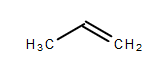
-So, due to the presence of a double bond in propene, it can decolourise the potassium permanganate.
So, the correct answer is “Option C”.
Note: Potassium permanganate can be used to test the presence of unsaturated compounds because potassium permanganate does not react with the alkanes and hence, no change in the colour takes place.
Complete step by step solution:
-We all know that benzene has a molecular formula of ${{\text{C}}_{6}}{{\text{H}}_{6}}$ and it consists of a double bond in a 6-membered ring structure.
-Also, benzene has a ∏-electron which undergoes the delocalisation process.
-So, it is not possible for benzene to decolourise the \[\text{KMn}{{\text{O}}_{4}}\] .
-Hence, option C. is the correct answer.
-Mohr salt or commonly called Ferrous Ammonium Sulphate consists of a double bond which has the ability to decolourise the potassium permanganate.
-The chemical reaction is:
$\text{2KMn}{{\text{O}}_{4}}\text{ + 10FeS}{{\text{O}}_{4}}\text{ + 8}{{\text{H}}_{2}}\text{S}{{\text{O}}_{4}}\text{ }{{\text{K}}_{2}}\text{S}{{\text{O}}_{4}}\text{ + 2MnS}{{\text{O}}_{4}}\text{ + 5F}{{\text{e}}_{2}}{{\left( \text{S}{{\text{O}}_{4}} \right)}_{3}}\text{ + 8}{{\text{H}}_{2}}\text{O}$
-So, option A. is not the correct answer.
-Similarly, oxalic acid can also react with the potassium permanganate and decolourise the solution from pink to colourless.
-The chemical reaction is:
$\text{2KMn}{{\text{O}}_{4}}\text{ + 5}{{\text{C}}_{2}}{{\text{H}}_{2}}{{\text{O}}_{4}}\text{ + 3}{{\text{H}}_{2}}\text{S}{{\text{O}}_{4}}$→ ${{\text{K}}_{2}}\text{S}{{\text{O}}_{4}}\text{ + 2MnS}{{\text{O}}_{4}}\text{ + 10C}{{\text{O}}_{2}}\text{ + 8}{{\text{H}}_{2}}\text{O}$
-So, option B. is also an incorrect answer.
-In propene, there is a presence of a double bond as we can see in the below-given structure:
-So, due to the presence of a double bond in propene, it can decolourise the potassium permanganate.
So, the correct answer is “Option C”.
Note: Potassium permanganate can be used to test the presence of unsaturated compounds because potassium permanganate does not react with the alkanes and hence, no change in the colour takes place.
Recently Updated Pages
Explain the structure of megasporangium class 12 biology CBSE

Why is chloroform kept in dark coloured bottles class 12 chemistry CBSE
Derive the balancing condition of a Wheatstone bri class 12 physics CBSE
Draw VI characteristics of a pn junction diode Explain class 12 physics CBSE
Is it possible to carry pride in ones language too class 12 english CBSE
In a population at Hardy Weinberg equilibrium the allele class 12 biology CBSE
Trending doubts
Draw a labelled sketch of the human eye class 12 physics CBSE
Which are the Top 10 Largest Countries of the World?
Draw ray diagrams each showing i myopic eye and ii class 12 physics CBSE
One megawatt is equal to how many units of electri class 12 physics CBSE
Which is the correct genotypic ratio of mendel dihybrid class 12 biology CBSE
Give 10 examples of unisexual and bisexual flowers