




Karyotype is
a)Division of the nucleus
b)Chromosome complement specific for each species
c)All organisms possessing some type of chromosomes
d)None of the above
Answer
 Verified
601.5k+ views
Hint: The disengagement and minute perception of chromosomes structure the premise of cytogenetics and is the essential strategy by which clinicians distinguish chromosomal anomalies in people. A karyotype can be characterized as the precise association (coordinating and arrangement) of the chromosomal substance of some random cell type.
Complete answer:
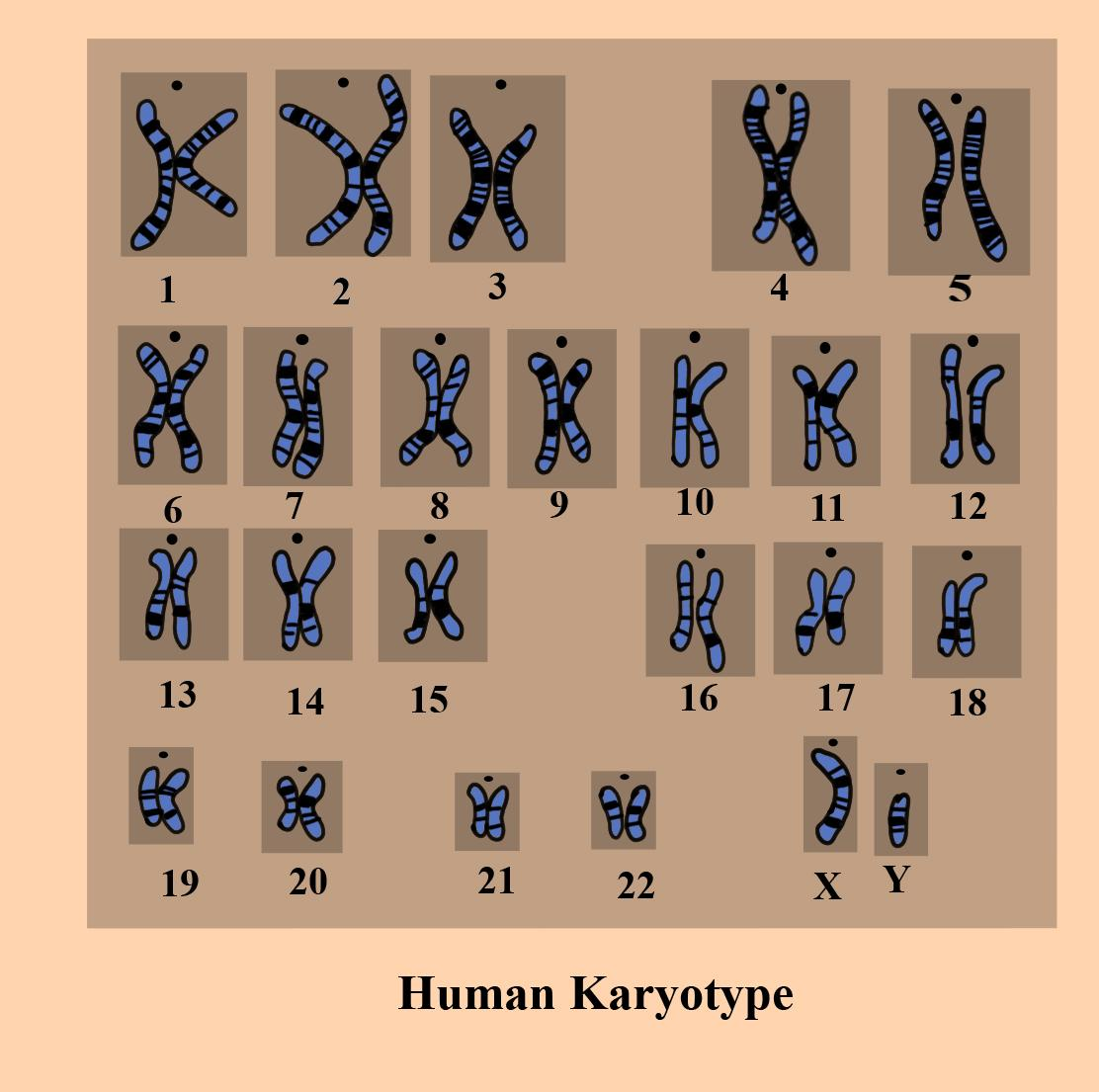
A karyotype is the number and presence of chromosomes and incorporates their length, banding example, and centromere position. To acquire a perspective on a person's karyotype, cytologists photo the chromosomes and afterward reorder every chromosome into a graph, or karyogram, otherwise called an ideogram.
In every species, chromosomes can be recognized by their number, size, centromere position, and banding design. In a human karyotype, autosomes or "body chromosomes" (the entirety of the non–sex chromosomes) are commonly sorted out in the surmised requests of size from biggest (chromosome 1) to littlest (chromosome 22). There are 22 numbered sets of chromosomes called autosomes. The sex chromosome is the 23rd pair of chromosomes. They decide on a person's sex. Females have two X chromosomes, and guys have an X and a Y chromosome.
Every chromosome has been allocated a number dependent on its size. The biggest chromosome will be on chromosome 1. Hence chromosome 18 is perhaps the littlest chromosome in people.
Additional Information: The chromosome "arms" anticipating from either end of the centromere might be assigned as short or long, contingent upon their relative lengths. The short arm is truncated p (for "dainty"), while the long arm is shortened q (since it follows "p" sequentially). Each arm is additionally partitioned and meant by a number. Utilizing this naming framework, areas on chromosomes can be portrayed reliably in logical writing.
So the correct answer is 'chromosome complement specific for each species'.
Note: Karyotypes can uncover changes in chromosome numbers related to aneuploid conditions, for example, trisomy 21 (Down disorder). Cautious examination of karyotypes can likewise uncover more unpretentious auxiliary changes, for example, chromosomal cancellations, duplications, movements, or reversals.
Complete answer:
A karyotype is the number and presence of chromosomes and incorporates their length, banding example, and centromere position. To acquire a perspective on a person's karyotype, cytologists photo the chromosomes and afterward reorder every chromosome into a graph, or karyogram, otherwise called an ideogram.
In every species, chromosomes can be recognized by their number, size, centromere position, and banding design. In a human karyotype, autosomes or "body chromosomes" (the entirety of the non–sex chromosomes) are commonly sorted out in the surmised requests of size from biggest (chromosome 1) to littlest (chromosome 22). There are 22 numbered sets of chromosomes called autosomes. The sex chromosome is the 23rd pair of chromosomes. They decide on a person's sex. Females have two X chromosomes, and guys have an X and a Y chromosome.
Every chromosome has been allocated a number dependent on its size. The biggest chromosome will be on chromosome 1. Hence chromosome 18 is perhaps the littlest chromosome in people.
Additional Information: The chromosome "arms" anticipating from either end of the centromere might be assigned as short or long, contingent upon their relative lengths. The short arm is truncated p (for "dainty"), while the long arm is shortened q (since it follows "p" sequentially). Each arm is additionally partitioned and meant by a number. Utilizing this naming framework, areas on chromosomes can be portrayed reliably in logical writing.
So the correct answer is 'chromosome complement specific for each species'.
Note: Karyotypes can uncover changes in chromosome numbers related to aneuploid conditions, for example, trisomy 21 (Down disorder). Cautious examination of karyotypes can likewise uncover more unpretentious auxiliary changes, for example, chromosomal cancellations, duplications, movements, or reversals.
Recently Updated Pages
Master Class 11 Economics: Engaging Questions & Answers for Success

Master Class 11 English: Engaging Questions & Answers for Success
Master Class 11 Maths: Engaging Questions & Answers for Success
Class 11 Question and Answer - Your Ultimate Solutions Guide
Master Class 11 Social Science: Engaging Questions & Answers for Success
Master Class 11 Business Studies: Engaging Questions & Answers for Success
Trending doubts
Differentiate between an exothermic and an endothermic class 11 chemistry CBSE
One Metric ton is equal to kg A 10000 B 1000 C 100 class 11 physics CBSE
There are 720 permutations of the digits 1 2 3 4 5 class 11 maths CBSE
In what year Guru Nanak Dev ji was born A15 April 1469 class 11 social science CBSE
Difference Between Prokaryotic Cells and Eukaryotic Cells
Draw a diagram of a plant cell and label at least eight class 11 biology CBSE