




What is Kaleidoscope?
A. A cylinder with mirrors containing loose colored objects such as beads, pebbles and bits of glass
B. A cylinder with mirrors
C. A cylinder containing loose colored objects such as beads, pebbles and bits of glass
D. None of these
Answer
 Verified
620.7k+ views
Hint: We all have watched inside a Kaleidoscope and observed very beautiful patterns. We have to know the mechanism behind it. After knowing how a Kaleidoscope works, we can answer this question.
Complete step by step answer:
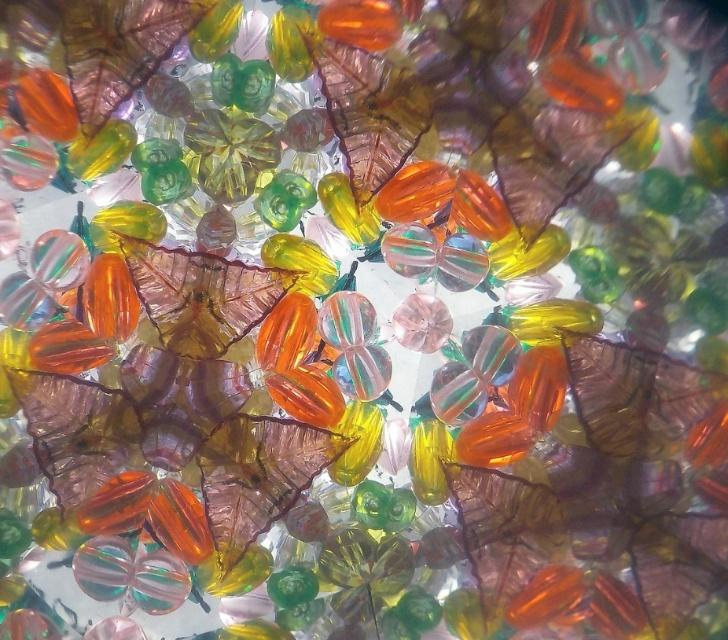
When we look inside a Kaleidoscope, we see symmetrical patterns and colorful structures. It’s true that there are pebbles, beads and bits of colorful glass on the other side of the tube. But they are not so symmetrical at all. What we see is just a reflection of a few asymmetric colorful objects. Actually, there are multiple reflections of a few objects. Some mirrors are kept inside the cylindrical tube at certain angles to each other. So, they can produce a large number of reflections. Moreover, there are reflections as well.
Also, we can rotate these Kaleidoscopes to see the structures changing. This implies that the objects inside are loose.
Hence, option A is the correct answer.
Additional information:
If we keep two mirrors at an angle of $\theta$, then the number of reflections of a single object is, $(\dfrac{360}{\theta}-1)$. This is a general formula. But, in practical terms, there probably is not an accurate formula for making a Kaleidoscope. The values of the angles were experimentally found by David Brewster. He was trying to observe the polarization of light and accidentally discovered some multiple reflections by a set of mirrors.
Note:
Remember the following things:
1. If there were no mirrors inside the cylindrical tube, there would be no reflections. And the thing would not be called Kaleidoscope.
2. If there were only mirrors and no pebbles and beads, no symmetrical structure would be observed.
Complete step by step answer:
When we look inside a Kaleidoscope, we see symmetrical patterns and colorful structures. It’s true that there are pebbles, beads and bits of colorful glass on the other side of the tube. But they are not so symmetrical at all. What we see is just a reflection of a few asymmetric colorful objects. Actually, there are multiple reflections of a few objects. Some mirrors are kept inside the cylindrical tube at certain angles to each other. So, they can produce a large number of reflections. Moreover, there are reflections as well.
Also, we can rotate these Kaleidoscopes to see the structures changing. This implies that the objects inside are loose.
Hence, option A is the correct answer.
Additional information:
If we keep two mirrors at an angle of $\theta$, then the number of reflections of a single object is, $(\dfrac{360}{\theta}-1)$. This is a general formula. But, in practical terms, there probably is not an accurate formula for making a Kaleidoscope. The values of the angles were experimentally found by David Brewster. He was trying to observe the polarization of light and accidentally discovered some multiple reflections by a set of mirrors.
Note:
Remember the following things:
1. If there were no mirrors inside the cylindrical tube, there would be no reflections. And the thing would not be called Kaleidoscope.
2. If there were only mirrors and no pebbles and beads, no symmetrical structure would be observed.
Recently Updated Pages
Master Class 12 Economics: Engaging Questions & Answers for Success

Master Class 12 English: Engaging Questions & Answers for Success
Master Class 12 Social Science: Engaging Questions & Answers for Success
Master Class 12 Maths: Engaging Questions & Answers for Success
Master Class 12 Physics: Engaging Questions & Answers for Success
Master Class 12 Business Studies: Engaging Questions & Answers for Success
Trending doubts
Which are the Top 10 Largest Countries of the World?
Draw a labelled sketch of the human eye class 12 physics CBSE
Differentiate between homogeneous and heterogeneous class 12 chemistry CBSE
Why is the cell called the structural and functional class 12 biology CBSE
Draw ray diagrams each showing i myopic eye and ii class 12 physics CBSE
Which is the correct genotypic ratio of mendel dihybrid class 12 biology CBSE