



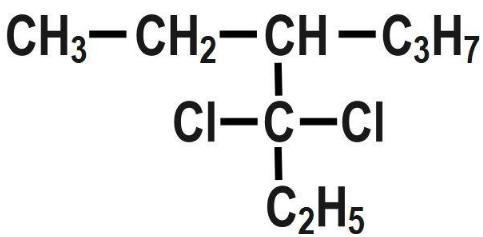
What is the IUPAC name of the given compounds?
A.\[4-Ethyl-3,3-dichloroheptane.\]
B.\[4-Ethyl-3,3-dichlorohexane.\]
C.\[4-Ethyl-3-chlorohexane.\]
D.\[3,3-dichloro-4-ethylheptane.\]
Answer
 Verified
513k+ views
Hint: We know that the IUPAC devised a set of instructions or rules that helped in naming the organic molecules. This helped scientists to derive names of the molecules which were not even discovered. These rules have been revised from time to time to improve the quality of nomenclature.
Complete answer:
In chemistry, a symbol is used as an abbreviation to describe an element. The IUPAC stands for International Union of Pure and Applied Chemistry. It has formulated some rules for the systematic nomenclature of organic compounds which are even revised later on for the uniform naming of compounds. The IUPAC has laid down some rules which govern the naming of all the organic compounds. This is necessary so that there is uniform nomenclature to be followed world-wide. The IUPAC name of any molecule consists of three parts Prefix, stem name and suffix. The rules for nomenclature are as follow as:
-The longest chain in the molecule will be the parent chain. So, the first thing one should do is to find the longest carbon chain in the molecule.
-Find out all the substituents present on the carbon chain. It can be any- from methyl to any alcohol substituent.
-Start numbering the parent chain from the end such that the substituent gets the lowest number. This is called the lowest location rule.
-If the substituent occurs more than one time, then the prefix di, tri or tetra is being used with the location of the carbon on which it is present.
-If more than one substituents are present and they are different. So, these will be named in alphabetical order.
-Here, their red line contains the main chain, so in third position two chlorine groups and at fourth position one ethyl group is present. Thus the IUPAC of Compound is \[3,3-dichloro-4-ethylheptane.\]
Note:
Remember that IUPAC nomenclature is needed because earlier every chemist gave its own new name to the molecule it discovered. As a result, one molecule had different names at different places. It was difficult to study them. No one knows whether the molecule discovered by him/her is the new one or the one that has already been discovered. So, the scientist devised some formulations to uniform the naming of compounds.
Complete answer:
In chemistry, a symbol is used as an abbreviation to describe an element. The IUPAC stands for International Union of Pure and Applied Chemistry. It has formulated some rules for the systematic nomenclature of organic compounds which are even revised later on for the uniform naming of compounds. The IUPAC has laid down some rules which govern the naming of all the organic compounds. This is necessary so that there is uniform nomenclature to be followed world-wide. The IUPAC name of any molecule consists of three parts Prefix, stem name and suffix. The rules for nomenclature are as follow as:
-The longest chain in the molecule will be the parent chain. So, the first thing one should do is to find the longest carbon chain in the molecule.
-Find out all the substituents present on the carbon chain. It can be any- from methyl to any alcohol substituent.
-Start numbering the parent chain from the end such that the substituent gets the lowest number. This is called the lowest location rule.
-If the substituent occurs more than one time, then the prefix di, tri or tetra is being used with the location of the carbon on which it is present.
-If more than one substituents are present and they are different. So, these will be named in alphabetical order.
-Here, their red line contains the main chain, so in third position two chlorine groups and at fourth position one ethyl group is present. Thus the IUPAC of Compound is \[3,3-dichloro-4-ethylheptane.\]
Note:
Remember that IUPAC nomenclature is needed because earlier every chemist gave its own new name to the molecule it discovered. As a result, one molecule had different names at different places. It was difficult to study them. No one knows whether the molecule discovered by him/her is the new one or the one that has already been discovered. So, the scientist devised some formulations to uniform the naming of compounds.
Recently Updated Pages
Master Class 12 Economics: Engaging Questions & Answers for Success

Master Class 12 Physics: Engaging Questions & Answers for Success
Master Class 12 English: Engaging Questions & Answers for Success
Master Class 12 Social Science: Engaging Questions & Answers for Success
Master Class 12 Maths: Engaging Questions & Answers for Success
Master Class 12 Business Studies: Engaging Questions & Answers for Success
Trending doubts
Which are the Top 10 Largest Countries of the World?
What are the major means of transport Explain each class 12 social science CBSE
Draw a labelled sketch of the human eye class 12 physics CBSE
Why cannot DNA pass through cell membranes class 12 biology CBSE
Differentiate between insitu conservation and exsitu class 12 biology CBSE
Draw a neat and well labeled diagram of TS of ovary class 12 biology CBSE