




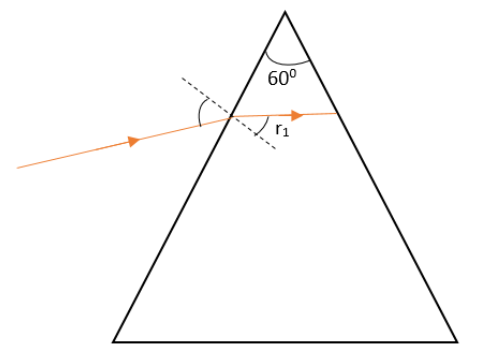
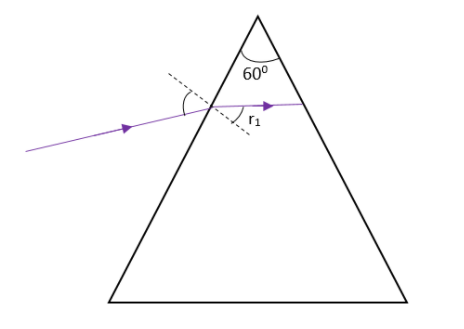
It has been mentioned that two beams of red and violet colours are produced to pass separately through a prism (angle of the prism will be $60{}^\circ $). What will be the angle of refraction in the position of minimum deviation?
A. $30{}^\circ $ for both the colours.
B. greater for the violet colour.
C. greater for the red colour.
D. equivalent but not $30{}^\circ $for both the colours.
Answer
 Verified
570k+ views
Hint: The angle of minimum deviation can be defined as the smallest angle through which the light will be bent by an optical instrument or a system. In the case of a prism, the angle of deviation will be a minimum when the incident and emerging rays form identical angles with the faces of the prism. This will help you in answering this question.
Complete step by step answer:
The angle of minimum deviation can be defined as the smallest angle through which the light will be bent by an optical instrument or a system. In the case of a prism, the angle of deviation will be a minimum when the incident and emerging rays form identical angles with the faces of prism. During the minimum deviation, we can write that,
${{r}_{1}}={{r}_{2}}=\dfrac{A}{2}$
It has been already given in the question that, the angle of the prism will be,
$A=60{}^\circ $
Substituting this values in the equation can be shown as,
\[{{r}_{1}}={{r}_{2}}=\dfrac{60}{2}=30{}^\circ \]
Therefore the angle of refraction will be independent of the colour and $30{}^\circ $for both the colours.
So, the correct answer is “Option A”.
Note: The angle of incidence will be identical to the angle of refraction only when the angle the deviation is zero. This will be practically impossible because if the light enters a medium from another medium it must undergo the process of refraction. Therefore the angle of minimum deviation will never be zero even though it can be a very small value.
Complete step by step answer:
The angle of minimum deviation can be defined as the smallest angle through which the light will be bent by an optical instrument or a system. In the case of a prism, the angle of deviation will be a minimum when the incident and emerging rays form identical angles with the faces of prism. During the minimum deviation, we can write that,
${{r}_{1}}={{r}_{2}}=\dfrac{A}{2}$
It has been already given in the question that, the angle of the prism will be,
$A=60{}^\circ $
Substituting this values in the equation can be shown as,
\[{{r}_{1}}={{r}_{2}}=\dfrac{60}{2}=30{}^\circ \]
Therefore the angle of refraction will be independent of the colour and $30{}^\circ $for both the colours.
So, the correct answer is “Option A”.
Note: The angle of incidence will be identical to the angle of refraction only when the angle the deviation is zero. This will be practically impossible because if the light enters a medium from another medium it must undergo the process of refraction. Therefore the angle of minimum deviation will never be zero even though it can be a very small value.
Recently Updated Pages
Master Class 12 Economics: Engaging Questions & Answers for Success

Master Class 12 Physics: Engaging Questions & Answers for Success
Master Class 12 English: Engaging Questions & Answers for Success
Master Class 12 Social Science: Engaging Questions & Answers for Success
Master Class 12 Maths: Engaging Questions & Answers for Success
Master Class 12 Business Studies: Engaging Questions & Answers for Success
Trending doubts
Which are the Top 10 Largest Countries of the World?
What are the major means of transport Explain each class 12 social science CBSE
Draw a labelled sketch of the human eye class 12 physics CBSE
Why cannot DNA pass through cell membranes class 12 biology CBSE
Differentiate between insitu conservation and exsitu class 12 biology CBSE
Draw a neat and well labeled diagram of TS of ovary class 12 biology CBSE