




Is ${\text{V}}$ the reference vector for parallel ${\text{RC}}$ circuits?
Answer
 Verified
487.2k+ views
Hint: Try to obtain a circuit diagram in your mind containing Resistance ${\text{R}}$ and Capacitance ${\text{C}}$ and analyse voltage across resistance and capacitor. You will find that the voltage across the resistance and capacitor is the same.
Complete step by step solution:
As the voltage across the resistance and capacitor is the same.
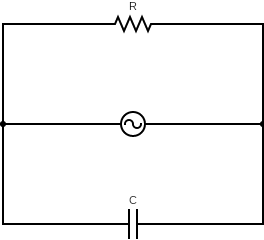
This is so because voltage is connected in parallel with resistance and the capacitor. The current through the individual elements the resistance and the capacitor differs. Through these elements there is also a phase difference of $\dfrac{\pi }{2}$.
Since the voltage is the common factor, the vector diagram will have $2\,{\text{currents}}$ relative to the voltage reference vector.
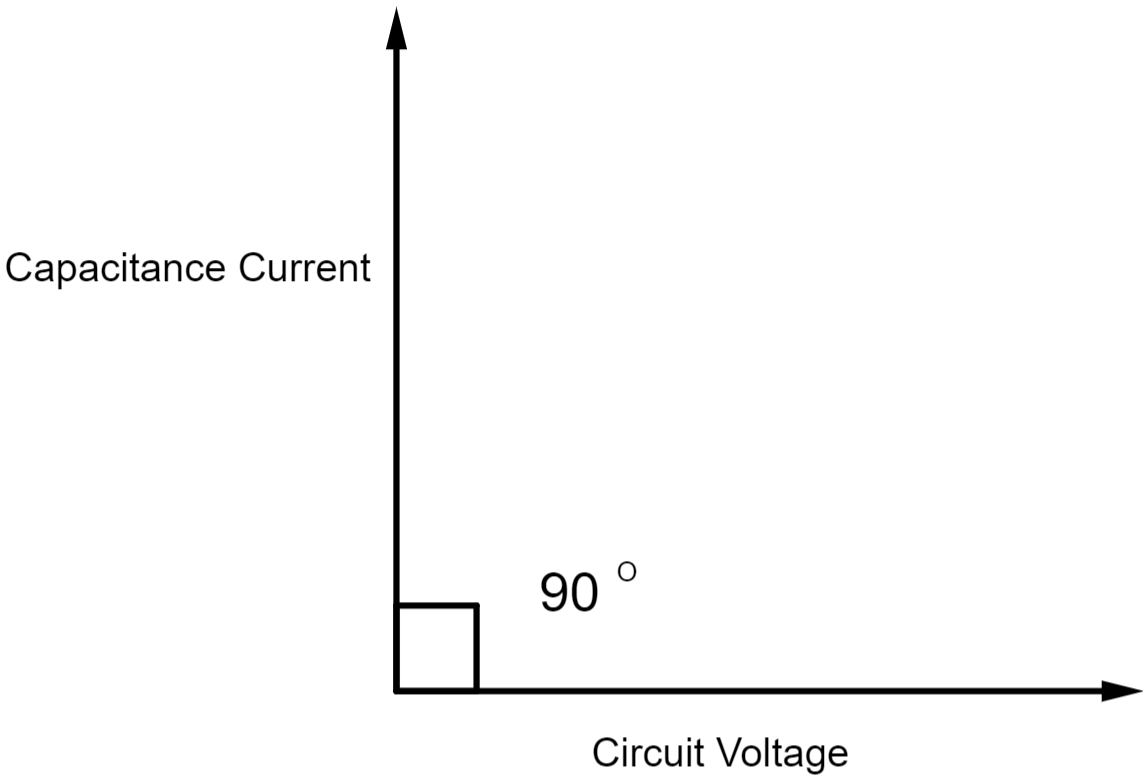
We can make phase diagrams to observe this phase difference between the current of the two elements.
Note:
The parallel RLC circuit is the exact opposite to the series circuit of LCR. The analysis of parallel RLC circuits can be more mathematically difficult than series RLC circuits. Instead of current being common to all so we need to find the individual branch currents through each element. Common between the three is voltage in this case.
Complete step by step solution:
As the voltage across the resistance and capacitor is the same.
This is so because voltage is connected in parallel with resistance and the capacitor. The current through the individual elements the resistance and the capacitor differs. Through these elements there is also a phase difference of $\dfrac{\pi }{2}$.
Since the voltage is the common factor, the vector diagram will have $2\,{\text{currents}}$ relative to the voltage reference vector.
We can make phase diagrams to observe this phase difference between the current of the two elements.
Note:
The parallel RLC circuit is the exact opposite to the series circuit of LCR. The analysis of parallel RLC circuits can be more mathematically difficult than series RLC circuits. Instead of current being common to all so we need to find the individual branch currents through each element. Common between the three is voltage in this case.
Recently Updated Pages
Master Class 12 Economics: Engaging Questions & Answers for Success

Master Class 12 Physics: Engaging Questions & Answers for Success
Master Class 12 English: Engaging Questions & Answers for Success
Master Class 12 Social Science: Engaging Questions & Answers for Success
Master Class 12 Maths: Engaging Questions & Answers for Success
Master Class 12 Business Studies: Engaging Questions & Answers for Success
Trending doubts
Which are the Top 10 Largest Countries of the World?
What are the major means of transport Explain each class 12 social science CBSE
Draw a labelled sketch of the human eye class 12 physics CBSE
Why cannot DNA pass through cell membranes class 12 biology CBSE
Differentiate between insitu conservation and exsitu class 12 biology CBSE
Draw a neat and well labeled diagram of TS of ovary class 12 biology CBSE