




Is transistor a diode?
Answer
 Verified
540.3k+ views
Hint: A transistor is a semiconductor device made of three parts; emitter, base and collector and each part plays an important function. The transistor has two junctions; emitter-base and collector-base and their doping is done according to the type of transistor.
Complete answer:
A transistor is a semiconductor device which is used as a switch or an amplifier. A transistor has three parts; emitter, base, collector.
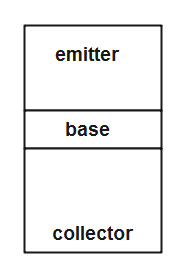
The collector is the largest part while the base is the smallest part. The base is the junction between the emitter and the collector. The emitters are known as to emit the charge carriers while the collector is known to collect the charge carriers. A transistor can be considered as two P-N junctions or two diodes placed back to back. The base collector junction is made to be reverse biased while the emitter base junction is made to be forward biased. A large current flow through the collector-base junction even though it is reverse biased.
Since the transistor has two junctions instead of one, it is not a diode as a diode has only one P-N junction.
Therefore, a transistor is a triode as it has three parts hence, it is not a diode.
Note:
Forward bias means that the p-type semiconductor is connected to the positive voltage while the n-type is connected to the negative voltage while in reverse bias the p-type is connected to negative and the n-type is connected to positive. A transistor can be of two types; P-N-P or N-P-N.
Complete answer:
A transistor is a semiconductor device which is used as a switch or an amplifier. A transistor has three parts; emitter, base, collector.
The collector is the largest part while the base is the smallest part. The base is the junction between the emitter and the collector. The emitters are known as to emit the charge carriers while the collector is known to collect the charge carriers. A transistor can be considered as two P-N junctions or two diodes placed back to back. The base collector junction is made to be reverse biased while the emitter base junction is made to be forward biased. A large current flow through the collector-base junction even though it is reverse biased.
Since the transistor has two junctions instead of one, it is not a diode as a diode has only one P-N junction.
Therefore, a transistor is a triode as it has three parts hence, it is not a diode.
Note:
Forward bias means that the p-type semiconductor is connected to the positive voltage while the n-type is connected to the negative voltage while in reverse bias the p-type is connected to negative and the n-type is connected to positive. A transistor can be of two types; P-N-P or N-P-N.
Recently Updated Pages
Master Class 12 Economics: Engaging Questions & Answers for Success

Master Class 12 Physics: Engaging Questions & Answers for Success
Master Class 12 English: Engaging Questions & Answers for Success
Master Class 12 Social Science: Engaging Questions & Answers for Success
Master Class 12 Maths: Engaging Questions & Answers for Success
Master Class 12 Business Studies: Engaging Questions & Answers for Success
Trending doubts
Which are the Top 10 Largest Countries of the World?
What are the major means of transport Explain each class 12 social science CBSE
Draw a labelled sketch of the human eye class 12 physics CBSE
Why cannot DNA pass through cell membranes class 12 biology CBSE
Differentiate between insitu conservation and exsitu class 12 biology CBSE
Draw a neat and well labeled diagram of TS of ovary class 12 biology CBSE