



Is the point \[(1,4)\] on the line represented by the equation \[x + 2y = 5\]?
Answer
 Verified
554.1k+ views
Hint: We have to find the point \[(1,4)\] lie on the line represented by the equation \[x + 2y = 5\].
As we know that if a point lies on a line then it satisfies its equation i.e., on putting the point on the given equation we will have LHS equals to RHS. So, we will put the given point in the equation of the line and if it satisfies the equation then it lies on the given line.
Complete step-by-step answer:
We have to find whether the point \[(1,4)\] lies on the line represented by the equation \[x + 2y = 5\].
For this, we should first know that to determine if a point is on a line or not, we can simply substitute the \[x\] and \[y\] coordinates into the equation.
We have equation of line \[x + 2y = 5\], putting \[(1,4)\] in left hand side of the above equation we get
\[ \Rightarrow x + 2y = 1 + \left( {2 \times 4} \right)\]
On simplifying, we get
\[ \Rightarrow x + 2y = 1 + 8\]
On further simplification we get
\[ \Rightarrow x + 2y = 9\]
Here, we can see that on putting \[(1,4)\] in \[x + 2y\], we get \[9\]. But, for the point to lie on the line \[x + 2y = 5\], \[x + 2y\] should be equal to \[5\].
Therefore, point \[(1,4)\] does not lie on the line represented by the equation \[x + 2y = 5\].
Note: Another way to solve this problem would be to graph the line and see if it falls on the line. There are infinite numbers of lines that can pass the same given point and also there will be infinite numbers of points that will lie on the given line \[x + 2y = 5\]. We can simply substitute the \[x\] and \[y\] coordinates into the equation to check whether the point lies on the line or not.
This can be seen in the following graph
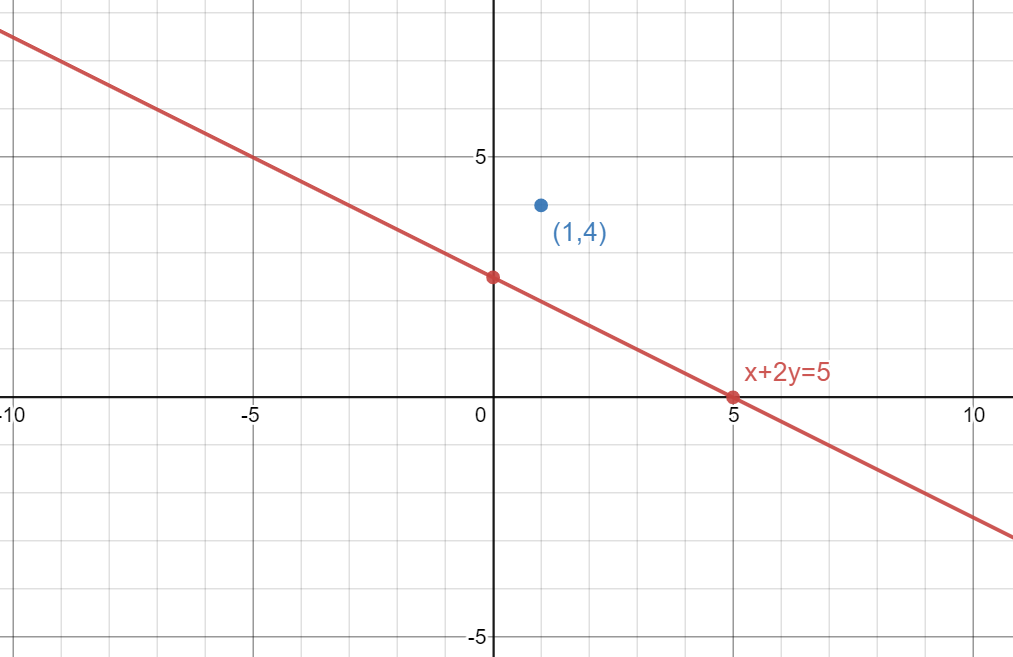
If we observe the above graph, it is clear that the point $(1,4)$ is not lying on the line $x+2y=5$.
As we know that if a point lies on a line then it satisfies its equation i.e., on putting the point on the given equation we will have LHS equals to RHS. So, we will put the given point in the equation of the line and if it satisfies the equation then it lies on the given line.
Complete step-by-step answer:
We have to find whether the point \[(1,4)\] lies on the line represented by the equation \[x + 2y = 5\].
For this, we should first know that to determine if a point is on a line or not, we can simply substitute the \[x\] and \[y\] coordinates into the equation.
We have equation of line \[x + 2y = 5\], putting \[(1,4)\] in left hand side of the above equation we get
\[ \Rightarrow x + 2y = 1 + \left( {2 \times 4} \right)\]
On simplifying, we get
\[ \Rightarrow x + 2y = 1 + 8\]
On further simplification we get
\[ \Rightarrow x + 2y = 9\]
Here, we can see that on putting \[(1,4)\] in \[x + 2y\], we get \[9\]. But, for the point to lie on the line \[x + 2y = 5\], \[x + 2y\] should be equal to \[5\].
Therefore, point \[(1,4)\] does not lie on the line represented by the equation \[x + 2y = 5\].
Note: Another way to solve this problem would be to graph the line and see if it falls on the line. There are infinite numbers of lines that can pass the same given point and also there will be infinite numbers of points that will lie on the given line \[x + 2y = 5\]. We can simply substitute the \[x\] and \[y\] coordinates into the equation to check whether the point lies on the line or not.
This can be seen in the following graph
If we observe the above graph, it is clear that the point $(1,4)$ is not lying on the line $x+2y=5$.
Recently Updated Pages
Which will be the least stable resonating structure class 11 chemistry CBSE

Explain the structure of megasporangium class 12 biology CBSE
Differentiate between voluntary action and reflex class 10 biology CBSE
How many 5 digit telephone numbers can be construc-class-11-maths-CBSE
How do you find the angle of the resultant vector class 11 physics CBSE
Why is chloroform kept in dark coloured bottles class 12 chemistry CBSE
Trending doubts
How many sides does a circle have a 10 sides b 20 sides class 8 maths CBSE
What is BLO What is the full form of BLO class 8 social science CBSE
Citizens of India can vote at the age of A 18 years class 8 social science CBSE
Full form of STD, ISD and PCO
One cusec is equal to how many liters class 8 maths CBSE
10 slogans on organ donation class 8 english CBSE