




Is light converging or diverging when reflected off a concave mirror?
Answer
 Verified
561.3k+ views
Hint: This question is based on the concept of reflection of light. Reflection of light is the phenomenon of bouncing back of light in the same medium on striking the surface of any object. It can also be said that reflection occurs when light travelling through one material bounces off a different material.
Complete step by step answer:
To understand the reflection of light, we need to understand the laws of reflection. There are two laws of reflection:
(1) The first law of reflection states that the incident ray, reflected ray and the normal, all lie in the same plane.
(2) The second law of reflection states that the angle of incidence is equal to the angle of reflection.
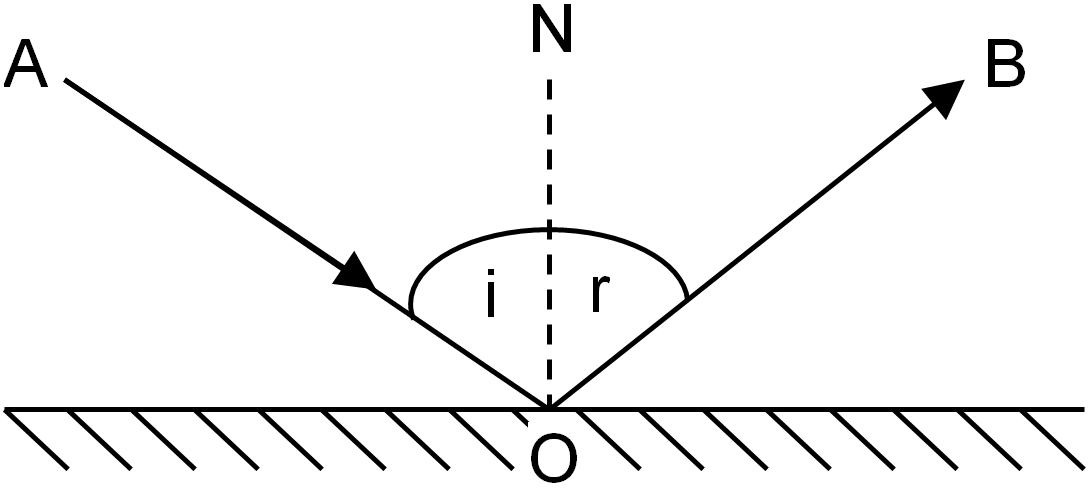
There are basically two types of mirror on the basis of reflection of light, namely, concave mirror and convex mirror.
A concave mirror has a reflective surface that is curved inward and away from the light source. The concave mirror is also known as a converging mirror as it converges the ray of light. A convex mirror has a reflective surface that is curved inward and towards the light source. The concave mirror is also known as a diverging mirror as it diverges the ray of light.
So, we can say that a concave mirror is a converging mirror as it converges the incoming ray of light as it passes through a mirror.
Additional information:
There are two types of reflection on the basis of the angle of reflection of incident light after it gets reflected:
Specular reflection is a type of reflection in which the incident ray is reflected at one single angle. In specular reflection, the incident light is reflected into a single outgoing direction. Diffuse reflection is a type of reflection of light from a surface in which an incident ray is reflected at many angles, rather than at just one angle as in the case of specular reflection.
Note: As we know that a concave mirror is known as a converging mirror, similarly a concave mirror is known as a diverging mirror as it diverges the incident ray of light on passing through the mirror. In convex mirrors also, both specular and diffused reflection takes place.
Complete step by step answer:
To understand the reflection of light, we need to understand the laws of reflection. There are two laws of reflection:
(1) The first law of reflection states that the incident ray, reflected ray and the normal, all lie in the same plane.
(2) The second law of reflection states that the angle of incidence is equal to the angle of reflection.
There are basically two types of mirror on the basis of reflection of light, namely, concave mirror and convex mirror.
A concave mirror has a reflective surface that is curved inward and away from the light source. The concave mirror is also known as a converging mirror as it converges the ray of light. A convex mirror has a reflective surface that is curved inward and towards the light source. The concave mirror is also known as a diverging mirror as it diverges the ray of light.
So, we can say that a concave mirror is a converging mirror as it converges the incoming ray of light as it passes through a mirror.
Additional information:
There are two types of reflection on the basis of the angle of reflection of incident light after it gets reflected:
Specular reflection is a type of reflection in which the incident ray is reflected at one single angle. In specular reflection, the incident light is reflected into a single outgoing direction. Diffuse reflection is a type of reflection of light from a surface in which an incident ray is reflected at many angles, rather than at just one angle as in the case of specular reflection.
Note: As we know that a concave mirror is known as a converging mirror, similarly a concave mirror is known as a diverging mirror as it diverges the incident ray of light on passing through the mirror. In convex mirrors also, both specular and diffused reflection takes place.
Recently Updated Pages
Which of the following graphs shows the variation of class 12 physics CBSE

Draw a labelled diagram of the human male reproductive class 12 biology CBSE
Describe the experiment to compare the emf of two cells class 12 physics CBSE
What is standard hydrogen electrode
What is conventional current and electric current class 12 physics CBSE
2Bromopentane is treated with an alcoholic KOH solution class 12 chemistry CBSE
Trending doubts
Draw a labelled sketch of the human eye class 12 physics CBSE
Which are the Top 10 Largest Countries of the World?
Differentiate between homogeneous and heterogeneous class 12 chemistry CBSE
Draw ray diagrams each showing i myopic eye and ii class 12 physics CBSE
Which is the correct genotypic ratio of mendel dihybrid class 12 biology CBSE
What is the Full Form of PVC, PET, HDPE, LDPE, PP and PS ?