




Is Color Blindness permanent?
Answer
 Verified
597.3k+ views
Hint: It is a very common hereditary disorder where a person sees the color but differently. It leads to difficulty in differentiating certain colors as the person cannot see them clearly. It can be reduced by certain medicines pr lenses but cannot be cured completely.
Complete answer:
Colour blindness is a hereditary (inherited) condition that is very common and thus passes through generation to generation from parents to their offsprings. Color blindness usually occurs in the 23 chromosomes which is a sex chromosome as it helps in determining the sex of an individual resulting in the blindness of Red/green color. It mostly occurs in males when passed from their mother.
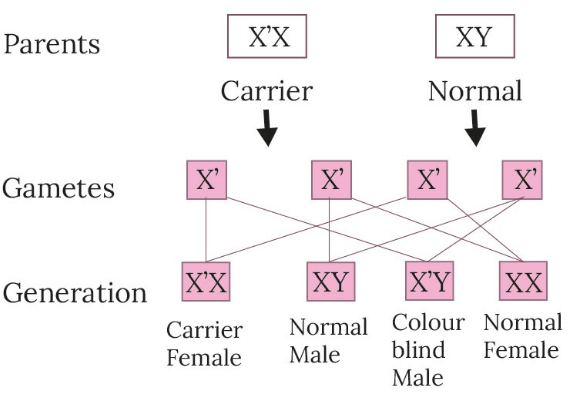
Color blindness is an X-linked recessive disorder. In the case of males, one gene of the X chromosome is affected as shown (${ X }^{ c }{ Y }$) that causes this disorder while in the case of females both the copies of X chromosomes must be affected as shown (${ X }^{ c }{ X }^{ c }$) then only it will cause color blindness. But if the female has only one X chromosomes affected and the condition of the chromosomes is heterozygous as shown (${ X }^{ c }{ X }$) then it will be a carrier of the disease although their eyes will function normally. Thus, it can be concluded that the females are responsible for the passing of this disease. The carrier mother for color blindness will inherit the disease to $50\%$ sons (${ X }^{ c }{ Y }$) but the daughter will have a normal vision is $100\%$.
Most often color blindness is a recessive trait on the X chromosome which is inherited. In genetics, this type of disease is called X-linked recessive inheritance. Therefore, the disease tends to affect men more than women ($8\%$ men, $0.5\%$ women). If both the father and the grandfather from the maternal side are color blind then only the girl will be color blind. The mother's genotype was to be either ${ X }^{ c }{ X }^{ c }$ or ${ X }^{ c }{ X }$, and the father's genotype was to be ${ X }^{ c }Y$ in order to make the daughter color blind.
Note:
Physical or chemical damage to the retina, the optic nerve, or parts of the brain may also result in color blindness. To diagnose this disease several tests are taken out of which genetic testing and the Ishihara color test are commonly taken. It is observed that men are more colorblind than females. This means that there are about 3 million color-blind people in Britain (about 4.5 percent of the entire population), most of whom are male.
Complete answer:
Colour blindness is a hereditary (inherited) condition that is very common and thus passes through generation to generation from parents to their offsprings. Color blindness usually occurs in the 23 chromosomes which is a sex chromosome as it helps in determining the sex of an individual resulting in the blindness of Red/green color. It mostly occurs in males when passed from their mother.
Color blindness is an X-linked recessive disorder. In the case of males, one gene of the X chromosome is affected as shown (${ X }^{ c }{ Y }$) that causes this disorder while in the case of females both the copies of X chromosomes must be affected as shown (${ X }^{ c }{ X }^{ c }$) then only it will cause color blindness. But if the female has only one X chromosomes affected and the condition of the chromosomes is heterozygous as shown (${ X }^{ c }{ X }$) then it will be a carrier of the disease although their eyes will function normally. Thus, it can be concluded that the females are responsible for the passing of this disease. The carrier mother for color blindness will inherit the disease to $50\%$ sons (${ X }^{ c }{ Y }$) but the daughter will have a normal vision is $100\%$.
Most often color blindness is a recessive trait on the X chromosome which is inherited. In genetics, this type of disease is called X-linked recessive inheritance. Therefore, the disease tends to affect men more than women ($8\%$ men, $0.5\%$ women). If both the father and the grandfather from the maternal side are color blind then only the girl will be color blind. The mother's genotype was to be either ${ X }^{ c }{ X }^{ c }$ or ${ X }^{ c }{ X }$, and the father's genotype was to be ${ X }^{ c }Y$ in order to make the daughter color blind.
Note:
Physical or chemical damage to the retina, the optic nerve, or parts of the brain may also result in color blindness. To diagnose this disease several tests are taken out of which genetic testing and the Ishihara color test are commonly taken. It is observed that men are more colorblind than females. This means that there are about 3 million color-blind people in Britain (about 4.5 percent of the entire population), most of whom are male.
Recently Updated Pages
Master Class 12 Economics: Engaging Questions & Answers for Success

Master Class 12 Social Science: Engaging Questions & Answers for Success
Master Class 12 English: Engaging Questions & Answers for Success
Master Class 12 Maths: Engaging Questions & Answers for Success
Master Class 12 Physics: Engaging Questions & Answers for Success
Master Class 12 Biology: Engaging Questions & Answers for Success
Trending doubts
What is the Full Form of PVC, PET, HDPE, LDPE, PP and PS ?
Draw a ray diagram of compound microscope when the class 12 physics CBSE
Derive an expression for the electric field intensity class 12 physics CBSE
Ethylidene chloride and ethylene dichloride are A Chain class 12 chemistry CBSE
Calculate the equivalent resistance between a and b class 12 physics CBSE
Derive an expression of the magnetic field at the center class 12 physics CBSE