




Is ${B_2}{H_6}$ an electrophile?
Answer
 Verified
576k+ views
Hint: Electrophile is an electron loving species. Electrophile is an electron deficient molecule or ion and can accept the pair of electrons easily from a nucleophile (electron rich molecule or ion) to make a covalent bond. Hence to find out whether ${B_2}{H_6}$ is an electrophile or not, we have to see its electronic configuration.
Complete answer:
Now, we know that an electrophile is a molecule or ion which is electron deficient in nature and hence, we can say that, these species can easily accept lone pairs of electrons from a nucleophile and form a covalent bond.
Atoms with less than octet rule electrons are considered as electron deficient in nature.
Now, if we look at the diborane molecule, ${B_2}{H_6}$ , it requires $14$ electrons to follow the octet rule, but only $12$ electrons are present in this molecule. Hence, we can say that this molecule is an electron deficient molecule.
Let, us see the structure of diborane:
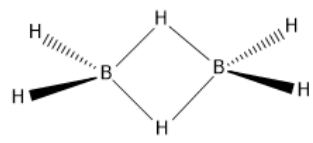
Each bond formation ideally requires two electrons. But, in the above diborane structure, we can see that both the B-H-B bonds are $3 - centre,2 - electron$ bond, hence, it is an electron deficient compound and can easily accept electrons. This type of bonding is also known as banana bonding.
Hence, we can say that diborane is a strong electrophile.
Note:
The compounds which have less number of electrons than eighteen are called electron deficient compounds or hypervalent compounds in nature whereas the compounds which have more number of electrons than eighteen are called hypervalent compounds or electron rich compounds in nature.
Complete answer:
Now, we know that an electrophile is a molecule or ion which is electron deficient in nature and hence, we can say that, these species can easily accept lone pairs of electrons from a nucleophile and form a covalent bond.
Atoms with less than octet rule electrons are considered as electron deficient in nature.
Now, if we look at the diborane molecule, ${B_2}{H_6}$ , it requires $14$ electrons to follow the octet rule, but only $12$ electrons are present in this molecule. Hence, we can say that this molecule is an electron deficient molecule.
Let, us see the structure of diborane:
Each bond formation ideally requires two electrons. But, in the above diborane structure, we can see that both the B-H-B bonds are $3 - centre,2 - electron$ bond, hence, it is an electron deficient compound and can easily accept electrons. This type of bonding is also known as banana bonding.
Hence, we can say that diborane is a strong electrophile.
Note:
The compounds which have less number of electrons than eighteen are called electron deficient compounds or hypervalent compounds in nature whereas the compounds which have more number of electrons than eighteen are called hypervalent compounds or electron rich compounds in nature.
Recently Updated Pages
Which of the following graphs shows the variation of class 12 physics CBSE

Draw a labelled diagram of the human male reproductive class 12 biology CBSE
Describe the experiment to compare the emf of two cells class 12 physics CBSE
What is standard hydrogen electrode
What is conventional current and electric current class 12 physics CBSE
2Bromopentane is treated with an alcoholic KOH solution class 12 chemistry CBSE
Trending doubts
Draw a labelled sketch of the human eye class 12 physics CBSE
Which are the Top 10 Largest Countries of the World?
Differentiate between homogeneous and heterogeneous class 12 chemistry CBSE
Draw ray diagrams each showing i myopic eye and ii class 12 physics CBSE
Which is the correct genotypic ratio of mendel dihybrid class 12 biology CBSE
What is the Full Form of PVC, PET, HDPE, LDPE, PP and PS ?