




Interphalangeal joints are also called as
A. Fixed joints
B. Hinge joints
C. Movable joints
D. Straight joints
Answer
 Verified
611.7k+ views
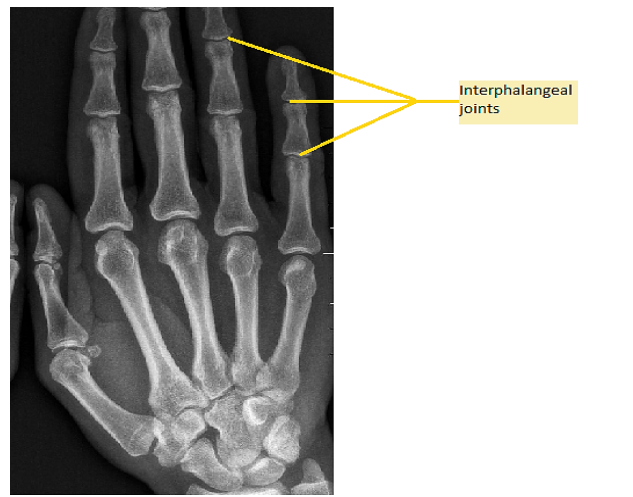
Hint: A joint in a human body is the connection between two bones. It is of three main types (immovable, slightly movable, and freely movable) based on whether it allows movement or not. Interphalangeal joints are present between the phalanges (bones in the thumb and fingers).
Complete answer:
Option (A) is incorrect. Fixed joints, as the name indicates, are joints that do not allow the movement of bones. These joints are present between the bones of the skull and the position where the radius and ulna bones of the lower part of the arm meet. Thus, permitting stability to these areas of the body.
Option (B) is correct. Hinge joints function much like the hinge of the door thereby allowing movement of the bones only in one direction back and forth further restricting the movement in other planes. These joints are present in fingers, toes, elbows, knees, and ankles. Since interphalangeal joints are known to be present in fingers and toes (made of phalanges) that provide movement of the bones towards the palm and foot therefore these interphalangeal joints are also called hinge joints.
Option (C) is incorrect. Movable joints are those joints that allow the most movement. They are the most common types of joints in the human body. These joints are also known as synovial joints.
Option (D) is incorrect. Straight joints are not present in the human body.
Hence, the correct option is (B).
Note: The hinge joint is that joint in which the two bones are connected by these joints that allow movement only in one direction. The interphalangeal joints are called hinge joints because these allow movement of the phalanges only in one direction.
Complete answer:
Option (A) is incorrect. Fixed joints, as the name indicates, are joints that do not allow the movement of bones. These joints are present between the bones of the skull and the position where the radius and ulna bones of the lower part of the arm meet. Thus, permitting stability to these areas of the body.
Option (B) is correct. Hinge joints function much like the hinge of the door thereby allowing movement of the bones only in one direction back and forth further restricting the movement in other planes. These joints are present in fingers, toes, elbows, knees, and ankles. Since interphalangeal joints are known to be present in fingers and toes (made of phalanges) that provide movement of the bones towards the palm and foot therefore these interphalangeal joints are also called hinge joints.
Option (C) is incorrect. Movable joints are those joints that allow the most movement. They are the most common types of joints in the human body. These joints are also known as synovial joints.
Option (D) is incorrect. Straight joints are not present in the human body.
Hence, the correct option is (B).
Note: The hinge joint is that joint in which the two bones are connected by these joints that allow movement only in one direction. The interphalangeal joints are called hinge joints because these allow movement of the phalanges only in one direction.
Recently Updated Pages
Master Class 12 Economics: Engaging Questions & Answers for Success

Master Class 12 English: Engaging Questions & Answers for Success
Master Class 12 Social Science: Engaging Questions & Answers for Success
Master Class 12 Maths: Engaging Questions & Answers for Success
Master Class 12 Physics: Engaging Questions & Answers for Success
Master Class 12 Business Studies: Engaging Questions & Answers for Success
Trending doubts
Which are the Top 10 Largest Countries of the World?
Draw a labelled sketch of the human eye class 12 physics CBSE
Differentiate between homogeneous and heterogeneous class 12 chemistry CBSE
Sulphuric acid is known as the king of acids State class 12 chemistry CBSE
Why is the cell called the structural and functional class 12 biology CBSE
Draw ray diagrams each showing i myopic eye and ii class 12 physics CBSE