




Insect tolerant gene from Bacillus thuringiensis is introduced using Ti plasmid of
(a) Escherichia coli
(b) Haemophilus influenzae
(c) Agrobacterium tumefaciens
(d) Arabidopsis thaliana
Answer
 Verified
600k+ views
Hint: It is a Gram-negative, non-sporing, motile, rod-shaped bacterium, closely related to Rhizobium which forms nitrogen-fixing nodules on clover and other leguminous plants. Commonly, it is found around the root surfaces, it is the region called the rhizosphere where it appears to survive due by utilizing nutrients that spills from the root tissues.
Complete step by step answer:
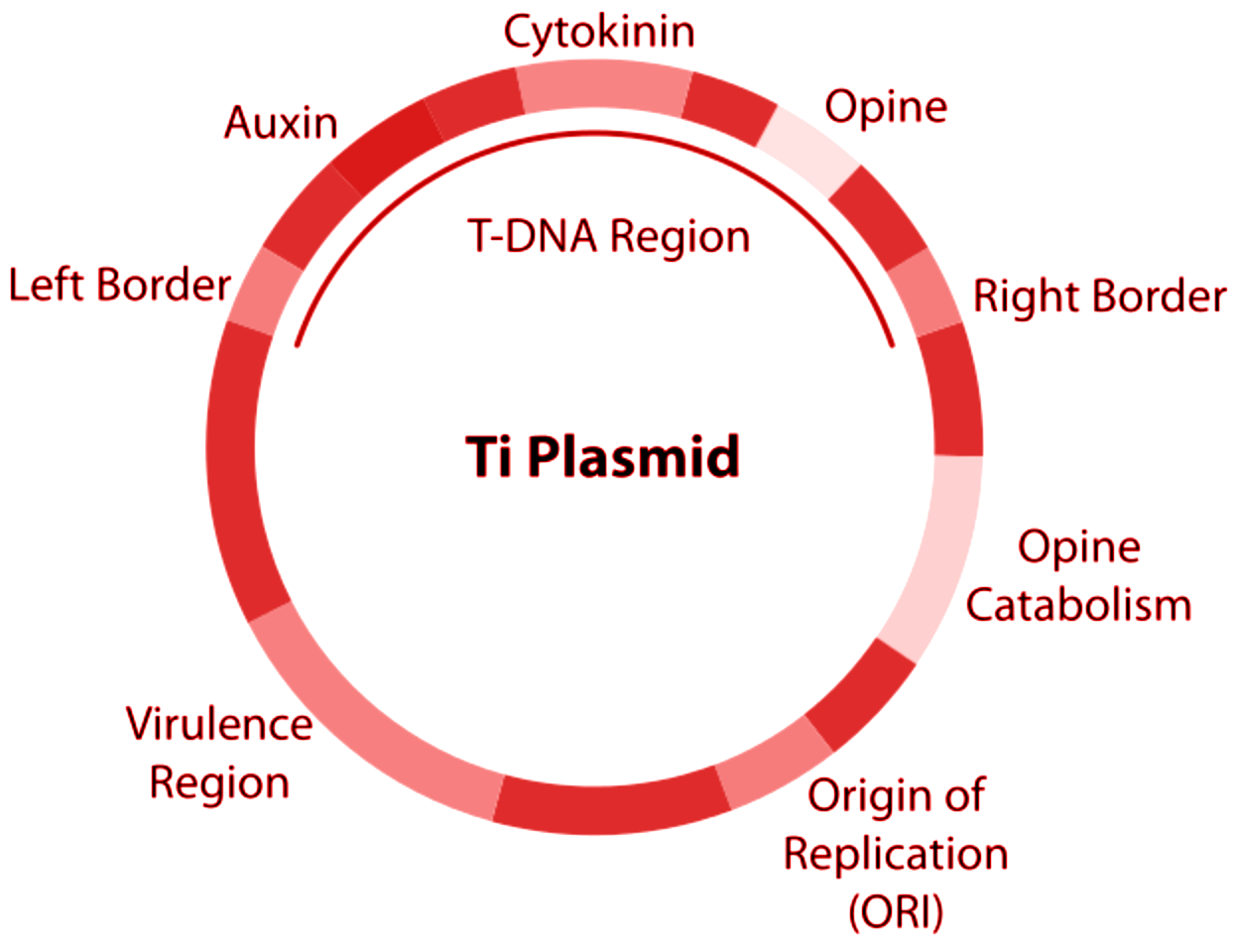
By the help of Ti plasmid of Agrobacterium tumefaciens the Bacillus thuringiensis is introduced and it have a great effect in producing pest-resistant plant and it is widely used in cotton called as Bt cotton that assists with shielding cotton plants from insect-like coleopterans, lepidopterans, and dipterans.
So the correct answer is ‘Agrobacterium tumefaciens’.
Additional information: Agrobacterium tumefaciens causes crown gall infection of a wide scope of dicotyledonous plants, particularly individuals from the rose family, for example, apple, pear, peach, cherry, almond, raspberry, and roses. A different strain, named biovar 3, causes the crown nerve of the grapevine.
The ailment picks up its name from the huge tumor-like swellings that ordinarily happen at the crown of the plant, simply above soil level. Despite the fact that it diminishes the marketability of nursery stock, it generally doesn't make genuine harm to more established plants. In any case, this disease is one of the most broadly known, on account of its noteworthy science. Generally, a small portion of DNA is incorporated into the plant genome that results in the formation of tumors and leads to a change in metabolism.
Note: The A. tumefaciens interceded plant genetic transformation measure requires the presence of two genetic segments situated on the bacterial Ti-plasmid.Basically, the main basic part is the T-DNA, which is characterized by conserved 25-base pair imperfect repeats at the closures of the T-region known as a border sequence. The second is the virulence (vir) region, which is made out of in any event seven significant loci (virA, virB, virC, virD, virE, virF, and virG) encoding parts of the bacterial protein machinery which is mediating the T-DNA processing and transfer.
Complete step by step answer:
By the help of Ti plasmid of Agrobacterium tumefaciens the Bacillus thuringiensis is introduced and it have a great effect in producing pest-resistant plant and it is widely used in cotton called as Bt cotton that assists with shielding cotton plants from insect-like coleopterans, lepidopterans, and dipterans.
So the correct answer is ‘Agrobacterium tumefaciens’.
Additional information: Agrobacterium tumefaciens causes crown gall infection of a wide scope of dicotyledonous plants, particularly individuals from the rose family, for example, apple, pear, peach, cherry, almond, raspberry, and roses. A different strain, named biovar 3, causes the crown nerve of the grapevine.
The ailment picks up its name from the huge tumor-like swellings that ordinarily happen at the crown of the plant, simply above soil level. Despite the fact that it diminishes the marketability of nursery stock, it generally doesn't make genuine harm to more established plants. In any case, this disease is one of the most broadly known, on account of its noteworthy science. Generally, a small portion of DNA is incorporated into the plant genome that results in the formation of tumors and leads to a change in metabolism.
Note: The A. tumefaciens interceded plant genetic transformation measure requires the presence of two genetic segments situated on the bacterial Ti-plasmid.Basically, the main basic part is the T-DNA, which is characterized by conserved 25-base pair imperfect repeats at the closures of the T-region known as a border sequence. The second is the virulence (vir) region, which is made out of in any event seven significant loci (virA, virB, virC, virD, virE, virF, and virG) encoding parts of the bacterial protein machinery which is mediating the T-DNA processing and transfer.
Recently Updated Pages
Three beakers labelled as A B and C each containing 25 mL of water were taken A small amount of NaOH anhydrous CuSO4 and NaCl were added to the beakers A B and C respectively It was observed that there was an increase in the temperature of the solutions contained in beakers A and B whereas in case of beaker C the temperature of the solution falls Which one of the following statements isarecorrect i In beakers A and B exothermic process has occurred ii In beakers A and B endothermic process has occurred iii In beaker C exothermic process has occurred iv In beaker C endothermic process has occurred

Master Class 12 Social Science: Engaging Questions & Answers for Success
Master Class 12 Physics: Engaging Questions & Answers for Success
Master Class 12 Maths: Engaging Questions & Answers for Success
Master Class 12 Economics: Engaging Questions & Answers for Success
Master Class 12 Chemistry: Engaging Questions & Answers for Success
Three beakers labelled as A B and C each containing 25 mL of water were taken A small amount of NaOH anhydrous CuSO4 and NaCl were added to the beakers A B and C respectively It was observed that there was an increase in the temperature of the solutions contained in beakers A and B whereas in case of beaker C the temperature of the solution falls Which one of the following statements isarecorrect i In beakers A and B exothermic process has occurred ii In beakers A and B endothermic process has occurred iii In beaker C exothermic process has occurred iv In beaker C endothermic process has occurred
Master Class 12 Social Science: Engaging Questions & Answers for Success
Master Class 12 Physics: Engaging Questions & Answers for Success
Trending doubts
Which are the Top 10 Largest Countries of the World?
Draw a labelled sketch of the human eye class 12 physics CBSE
Differentiate between homogeneous and heterogeneous class 12 chemistry CBSE
What are the major means of transport Explain each class 12 social science CBSE
Sulphuric acid is known as the king of acids State class 12 chemistry CBSE
Why should a magnesium ribbon be cleaned before burning class 12 chemistry CBSE