




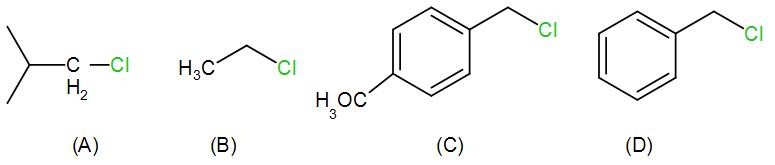
Increasing order of reactivity of the following compounds for ${{S}_{N}}1$ substitution is:
[i] B < C < D < A
[ii] A < B < D < C
[iii] B < A < D < C
[iv] B < C < A < D
Answer
 Verified
579k+ views
HINT: To answer this, you must know that ${{S}_{N}}1$ is nucleophilic substitution unimolecular reaction. Remember that reactivity towards ${{S}_{N}}1$ reaction depends upon stability of the carbocation and also the rate of leaving of the leaving groups. Here, you need to consider the first factor.
COMPLETE STEP BY STEP SOLUTION:
-We know that ${{S}_{N}}1$ mechanism is nucleophilic substitution unimolecular reaction. To answer the given question, we need to discuss what ${{S}_{N}}1$ is.
-In ${{S}_{N}}1$ reaction, SN basically stands for nucleophilic substitution and 1 stands for unimolecular. In ${{S}_{N}}1$ , the first step i.e. leaving of the leaving group and formation of the carbocation is the slow step and thus the rate determining step and the second step i.e. the attack of the nucleophile is the fast step.
-In the first step of the mechanism, the leaving group leaves the substrate and this leads to the formation of a carbocation. We can write the reaction as-

-Then, the nucleophile attacks the carbocation and gives us the product.
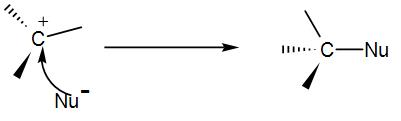
-This is a two-step process. The reactivity of compounds undergoing ${{S}_{N}}1$ depends upon 2 factors. How effectively the leaving group leaves and whether or not the carbocation formed is stable.
-Now, let us see the question given to us. Here, we will start by drawing the possible carbocation that will be formed upon the removal of the leaving group that is chlorine in each case here and we will compare the stability of the corresponding carbocations.
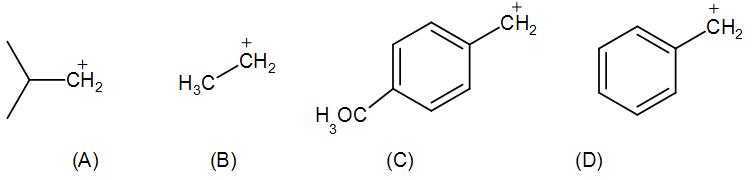
-Here we can see that all the carbocation are secondary but we have to compare their stability.
-The two rings will form more stable carbocation due to charge delocalisation but in (C), due to the presence of –OMe group the carbocation will be more stable.
-And, between (A) and (B), the carbocation formed by (A) will be more stable due to the presence of more substituted alkyl. Hence the order of stability of carbocation stands out to be C > D > A > B
Therefore, the correct answer is option [iii] B < A < D < C.
NOTE: Like the nucleophilic substitution we discussed above, there are more substitution reactions. We know that electrophiles are electron deficient species i.e. they can accept a pair of electrons readily and nucleophiles are electron rich species i.e. they can donate a pair of electrons. Electrophilic substitution is a reaction where the leaving group is substituted by an electrophile and nucleophilic substitution is a substitution reaction where the leaving group is replaced by the nucleophile by attacking on the positively charged atom to which the leaving group is attached. Tertiary carbocations are more reactive towards substitution nucleophilic unimolecular whereas primary carbocations are more reactive towards nucleophilic substitution bimolecular.
COMPLETE STEP BY STEP SOLUTION:
-We know that ${{S}_{N}}1$ mechanism is nucleophilic substitution unimolecular reaction. To answer the given question, we need to discuss what ${{S}_{N}}1$ is.
-In ${{S}_{N}}1$ reaction, SN basically stands for nucleophilic substitution and 1 stands for unimolecular. In ${{S}_{N}}1$ , the first step i.e. leaving of the leaving group and formation of the carbocation is the slow step and thus the rate determining step and the second step i.e. the attack of the nucleophile is the fast step.
-In the first step of the mechanism, the leaving group leaves the substrate and this leads to the formation of a carbocation. We can write the reaction as-
-Then, the nucleophile attacks the carbocation and gives us the product.
-This is a two-step process. The reactivity of compounds undergoing ${{S}_{N}}1$ depends upon 2 factors. How effectively the leaving group leaves and whether or not the carbocation formed is stable.
-Now, let us see the question given to us. Here, we will start by drawing the possible carbocation that will be formed upon the removal of the leaving group that is chlorine in each case here and we will compare the stability of the corresponding carbocations.
-Here we can see that all the carbocation are secondary but we have to compare their stability.
-The two rings will form more stable carbocation due to charge delocalisation but in (C), due to the presence of –OMe group the carbocation will be more stable.
-And, between (A) and (B), the carbocation formed by (A) will be more stable due to the presence of more substituted alkyl. Hence the order of stability of carbocation stands out to be C > D > A > B
Therefore, the correct answer is option [iii] B < A < D < C.
NOTE: Like the nucleophilic substitution we discussed above, there are more substitution reactions. We know that electrophiles are electron deficient species i.e. they can accept a pair of electrons readily and nucleophiles are electron rich species i.e. they can donate a pair of electrons. Electrophilic substitution is a reaction where the leaving group is substituted by an electrophile and nucleophilic substitution is a substitution reaction where the leaving group is replaced by the nucleophile by attacking on the positively charged atom to which the leaving group is attached. Tertiary carbocations are more reactive towards substitution nucleophilic unimolecular whereas primary carbocations are more reactive towards nucleophilic substitution bimolecular.
Recently Updated Pages
Master Class 12 Economics: Engaging Questions & Answers for Success

Master Class 12 Physics: Engaging Questions & Answers for Success
Master Class 12 English: Engaging Questions & Answers for Success
Master Class 12 Social Science: Engaging Questions & Answers for Success
Master Class 12 Maths: Engaging Questions & Answers for Success
Master Class 12 Business Studies: Engaging Questions & Answers for Success
Trending doubts
Which are the Top 10 Largest Countries of the World?
What are the major means of transport Explain each class 12 social science CBSE
Draw a labelled sketch of the human eye class 12 physics CBSE
Why cannot DNA pass through cell membranes class 12 biology CBSE
Differentiate between insitu conservation and exsitu class 12 biology CBSE
Draw a neat and well labeled diagram of TS of ovary class 12 biology CBSE