




How many inactivated hetero-chromatinised X-chromosome are present in 44+XXX female?
A. 4
B. 3
C. 2
D. 1
Answer
 Verified
556.8k+ views
Hint: The inactivated X chromosomes can be counted easily and determined as it is always present one lesser in number than the total number of X chromosomes that is subtract one from the total number of X chromosomes.
Complete answer:
X-inactivation is the process where one copy of the X chromosome of a female is not activated. It is inactivated as it has a transcriptionally inactive heterochromatin. During the crossing of gene expression the output of X-inactivation is that all normal females are mosaics to this chromosome. So a barr body is an inactive X chromosome in a cell with more than one X chromosome which is not active and is known as lyonization. It is discovered by Murray Bar.
It states that in the cell with multiple X chromosomes, one is inactivated during the time of mammalian embryogenesis. This happens in some extra-embryonic tissues of placental mammals. But in the case of human beings it is inactivated either from male or female. So after zygote if it is male then no bar body if female then one barr body.
The bar body consists of an inactivated X chromosome in a cell with more than one X chromosome. The female with two X chromosomes has one barr body. For example- females chromosomes are XX therefore they have one bar body whereas someone with one X chromosome has no barr body, for example males have XY chromosome so there are no barr bodies in males. The barr body is calculated as one less than the total number of X chromosomes present. If we calculate the bar body in females which have XX chromosomes the bar body will be one.
In the question of the bar body of XXX female is asked which means that female has three chromosomes therefore the bar body will be one less than the total number of chromosomes present. The total number of chromosomes are three so the bar body will be two as one can express and two will not be active.
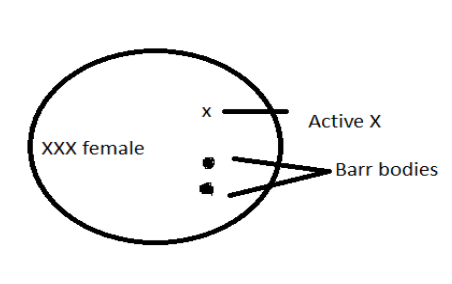
Hence, the correct answer is option (C).
Note: The barr bodies are regarded as diagnostic of genetic femaleness. The inactive chromosome can be seen under the microscope which is seen as a shapeless, dark stained bar body.
Complete answer:
X-inactivation is the process where one copy of the X chromosome of a female is not activated. It is inactivated as it has a transcriptionally inactive heterochromatin. During the crossing of gene expression the output of X-inactivation is that all normal females are mosaics to this chromosome. So a barr body is an inactive X chromosome in a cell with more than one X chromosome which is not active and is known as lyonization. It is discovered by Murray Bar.
It states that in the cell with multiple X chromosomes, one is inactivated during the time of mammalian embryogenesis. This happens in some extra-embryonic tissues of placental mammals. But in the case of human beings it is inactivated either from male or female. So after zygote if it is male then no bar body if female then one barr body.
The bar body consists of an inactivated X chromosome in a cell with more than one X chromosome. The female with two X chromosomes has one barr body. For example- females chromosomes are XX therefore they have one bar body whereas someone with one X chromosome has no barr body, for example males have XY chromosome so there are no barr bodies in males. The barr body is calculated as one less than the total number of X chromosomes present. If we calculate the bar body in females which have XX chromosomes the bar body will be one.
In the question of the bar body of XXX female is asked which means that female has three chromosomes therefore the bar body will be one less than the total number of chromosomes present. The total number of chromosomes are three so the bar body will be two as one can express and two will not be active.
Hence, the correct answer is option (C).
Note: The barr bodies are regarded as diagnostic of genetic femaleness. The inactive chromosome can be seen under the microscope which is seen as a shapeless, dark stained bar body.
Recently Updated Pages
Master Class 12 Economics: Engaging Questions & Answers for Success

Master Class 12 Physics: Engaging Questions & Answers for Success
Master Class 12 English: Engaging Questions & Answers for Success
Master Class 12 Social Science: Engaging Questions & Answers for Success
Master Class 12 Maths: Engaging Questions & Answers for Success
Master Class 12 Business Studies: Engaging Questions & Answers for Success
Trending doubts
Which are the Top 10 Largest Countries of the World?
What are the major means of transport Explain each class 12 social science CBSE
Draw a labelled sketch of the human eye class 12 physics CBSE
Why cannot DNA pass through cell membranes class 12 biology CBSE
Differentiate between insitu conservation and exsitu class 12 biology CBSE
Draw a neat and well labeled diagram of TS of ovary class 12 biology CBSE