




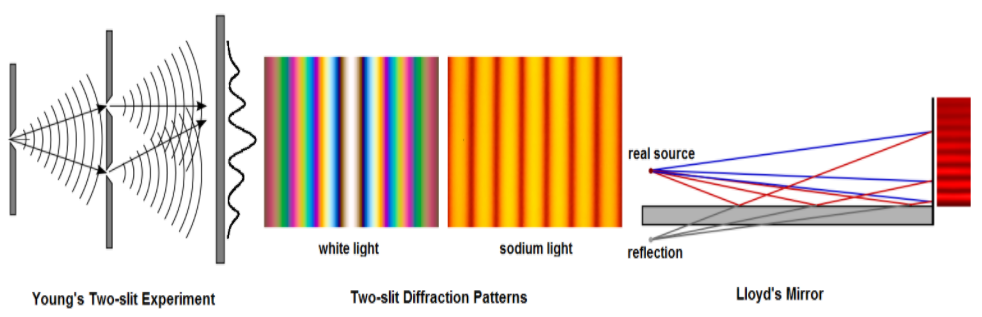
In Young’s double slit experiment, the two slits act as coherent sources of equal amplitude and wavelength $\lambda $. In another experiment with the same setup the two slits are sources of equal amplitude ${\rm A}$ and wavelength $\lambda $ but are incoherent. The ratio of the intensity of light at the midpoint of the screen in the first case to that in the second case is
(A) $1:1$
(B) $2:1$
(C) $4:1$
(D) None of these
Answer
 Verified
608.7k+ views
Hint:Use the formula for the intensity of the coherent and the incoherent light sources to calculate the intensity of the conditions given. From the obtained intensities, calculate the ratio between them by dividing the intensities in the first case to that of the second.
Useful formula:
(1) The intensity of the light in midpoint coherent sources are
$I = {\left( {\sqrt {{I_1}} + \sqrt {{I_2}} } \right)^2}$
Where $I$ is the intensity of the experiment, ${I_1}$ is the intensity of the one of the first slit and the ${I_2}$ is the intensity of the second slit.
(2) The intensity of the light in the midpoint incoherent sources are
$I = {I_1} + {I_2}$
Complete step by step solution:
It is given that
The slits in the Young double slits experiment allows equal amplitude and the wavelength and are coherent in nature.
The other Young double slits experiment have the slits that allow equal amplitude and the wavelength and are coherent in nature.
For calculating the intensity of the young’s double slit experiment with the coherent sources, the formula (1) is used.
$I = {\left( {\sqrt {{I_1}} + \sqrt {{I_2}} } \right)^2}$
$\Rightarrow I = \left( {I + I + 2\left( I \right)\left( I \right)} \right)$
$\Rightarrow I = 2I + 2I$
$\Rightarrow I = 4I$ --------(1)
For calculating the intensity of the Young’s double slit experiment with the incoherent sources, the formula (2) is used.
$I = {I_1} + {I_2}$
$\Rightarrow I = I + I$
$\Rightarrow I = 2I$ --------(2)
In order to find the ratio of the intensity,
$\dfrac{{4I}}{{2I}}$
$ratio = 2:1$.
Thus the option (B) is correct.
Note:The intensity of the light that is emerging from the coherent sources are always greater than that of the intensity of the light from the incoherent sources of the same amplitude and the wavelength. This is because the coherent source maintains the constant phase but the incoherent source emits light with the random phase.
Useful formula:
(1) The intensity of the light in midpoint coherent sources are
$I = {\left( {\sqrt {{I_1}} + \sqrt {{I_2}} } \right)^2}$
Where $I$ is the intensity of the experiment, ${I_1}$ is the intensity of the one of the first slit and the ${I_2}$ is the intensity of the second slit.
(2) The intensity of the light in the midpoint incoherent sources are
$I = {I_1} + {I_2}$
Complete step by step solution:
It is given that
The slits in the Young double slits experiment allows equal amplitude and the wavelength and are coherent in nature.
The other Young double slits experiment have the slits that allow equal amplitude and the wavelength and are coherent in nature.
For calculating the intensity of the young’s double slit experiment with the coherent sources, the formula (1) is used.
$I = {\left( {\sqrt {{I_1}} + \sqrt {{I_2}} } \right)^2}$
$\Rightarrow I = \left( {I + I + 2\left( I \right)\left( I \right)} \right)$
$\Rightarrow I = 2I + 2I$
$\Rightarrow I = 4I$ --------(1)
For calculating the intensity of the Young’s double slit experiment with the incoherent sources, the formula (2) is used.
$I = {I_1} + {I_2}$
$\Rightarrow I = I + I$
$\Rightarrow I = 2I$ --------(2)
In order to find the ratio of the intensity,
$\dfrac{{4I}}{{2I}}$
$ratio = 2:1$.
Thus the option (B) is correct.
Note:The intensity of the light that is emerging from the coherent sources are always greater than that of the intensity of the light from the incoherent sources of the same amplitude and the wavelength. This is because the coherent source maintains the constant phase but the incoherent source emits light with the random phase.
Recently Updated Pages
Master Class 12 Economics: Engaging Questions & Answers for Success

Master Class 12 English: Engaging Questions & Answers for Success
Master Class 12 Social Science: Engaging Questions & Answers for Success
Master Class 12 Maths: Engaging Questions & Answers for Success
Master Class 12 Physics: Engaging Questions & Answers for Success
Master Class 9 General Knowledge: Engaging Questions & Answers for Success
Trending doubts
Which are the Top 10 Largest Countries of the World?
Draw a labelled sketch of the human eye class 12 physics CBSE
Differentiate between homogeneous and heterogeneous class 12 chemistry CBSE
Sulphuric acid is known as the king of acids State class 12 chemistry CBSE
Why is the cell called the structural and functional class 12 biology CBSE
Draw ray diagrams each showing i myopic eye and ii class 12 physics CBSE