




In Young's double slit experiment the distance of the nth dark fringe from the centre is:
(A) $n\left( {\dfrac{{\lambda D}}{{2d}}} \right)$
(B) $n\left( {\dfrac{{2D}}{{\lambda d}}} \right)$
(C) $\left( {2n - 1} \right)\left( {\dfrac{{\lambda D}}{{2d}}} \right)$
(D) $\left( {n - 1} \right)\left( {\dfrac{{4D}}{{\lambda d}}} \right)$
Answer
 Verified
620.7k+ views
Hint: First, we can explain the structural set up of Young’s double slit experiment. Then, using the condition to obtain a dark fringe, we can find the solution.
Complete step by step answer:Let us consider the diagram below showing Young’s double slit experiment. Let ${S_1}$ and ${S_2}$ are the slits through which the monochromatic light of wavelength$\lambda $ is passed. Let $d$ be the distance between the slits and $D$ be the distance from the plane of the slits to the screen where the fringes are formed. We can take $y$ as the distance from the centre $O$ of the screen to the point $P$. Consider that the light waves coming out of the slits ${S_1}$ and ${S_2}$ interfere destructively at the point $P$. A dark fringe is formed when there is a destructive interference of the waves. We assume that the ${n^{th}}$ dark fringe is formed at the point $P$.
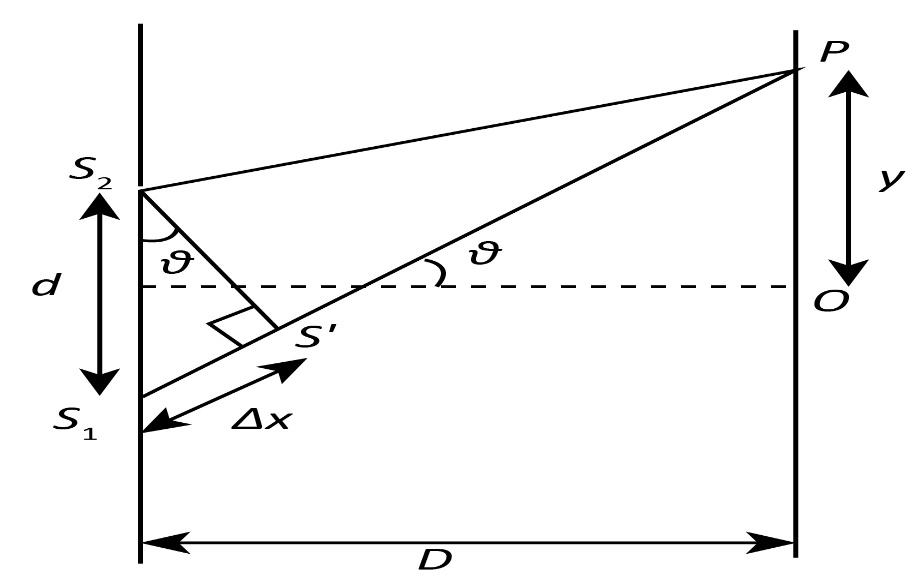
Now, the path difference of the waves can be written as
$\Delta x = {S_2}P - {S_1}P$
From the , we get
$\sin \theta = \dfrac{{\Delta x}}{d}$
Here $\theta $ is the angular position of the ${n^{th}}$ dark fringe.
Hence, we can write
$\Delta x = d\sin \theta $
Again, from the figure, we can write
$\sin \theta = \dfrac{y}{D}$
We can substitute $\dfrac{y}{D}$ for $\sin \theta $ in the equation $\Delta x = d\sin \theta $. Then,
$\begin{array}{c}
\Delta x = \dfrac{{dy}}{D}\\
\Rightarrow y = \dfrac{{\Delta xD}}{d}
\end{array}$
In Young’s double slit experiment, the condition to obtain a dark fringe can be written as
$\Delta x = \left( {2n - 1} \right)\dfrac{\lambda }{2}$
Now, we can use this condition in the equation $y = \dfrac{{\Delta xD}}{d}$. Therefore, we get
$y = \left( {2n - 1} \right)\dfrac{\lambda }{2}\dfrac{D}{d}$
So, the distance of the ${n^{th}}$ dark fringe from the centre is $\left( {2n - 1} \right)\dfrac{\lambda }{2}\dfrac{D}{d}$. Therefore, the option.
Note:We can get confused with the conditions for obtaining a bright fringe and a dark fringe. For obtaining a bright fringe, the path difference should be an integer multiple of the wavelength of light.
Complete step by step answer:Let us consider the diagram below showing Young’s double slit experiment. Let ${S_1}$ and ${S_2}$ are the slits through which the monochromatic light of wavelength$\lambda $ is passed. Let $d$ be the distance between the slits and $D$ be the distance from the plane of the slits to the screen where the fringes are formed. We can take $y$ as the distance from the centre $O$ of the screen to the point $P$. Consider that the light waves coming out of the slits ${S_1}$ and ${S_2}$ interfere destructively at the point $P$. A dark fringe is formed when there is a destructive interference of the waves. We assume that the ${n^{th}}$ dark fringe is formed at the point $P$.
Now, the path difference of the waves can be written as
$\Delta x = {S_2}P - {S_1}P$
From the , we get
$\sin \theta = \dfrac{{\Delta x}}{d}$
Here $\theta $ is the angular position of the ${n^{th}}$ dark fringe.
Hence, we can write
$\Delta x = d\sin \theta $
Again, from the figure, we can write
$\sin \theta = \dfrac{y}{D}$
We can substitute $\dfrac{y}{D}$ for $\sin \theta $ in the equation $\Delta x = d\sin \theta $. Then,
$\begin{array}{c}
\Delta x = \dfrac{{dy}}{D}\\
\Rightarrow y = \dfrac{{\Delta xD}}{d}
\end{array}$
In Young’s double slit experiment, the condition to obtain a dark fringe can be written as
$\Delta x = \left( {2n - 1} \right)\dfrac{\lambda }{2}$
Now, we can use this condition in the equation $y = \dfrac{{\Delta xD}}{d}$. Therefore, we get
$y = \left( {2n - 1} \right)\dfrac{\lambda }{2}\dfrac{D}{d}$
So, the distance of the ${n^{th}}$ dark fringe from the centre is $\left( {2n - 1} \right)\dfrac{\lambda }{2}\dfrac{D}{d}$. Therefore, the option.
Note:We can get confused with the conditions for obtaining a bright fringe and a dark fringe. For obtaining a bright fringe, the path difference should be an integer multiple of the wavelength of light.
Recently Updated Pages
Master Class 12 Business Studies: Engaging Questions & Answers for Success

Master Class 12 Chemistry: Engaging Questions & Answers for Success
Master Class 12 Biology: Engaging Questions & Answers for Success
Class 12 Question and Answer - Your Ultimate Solutions Guide
Master Class 11 English: Engaging Questions & Answers for Success
Master Class 11 Social Science: Engaging Questions & Answers for Success
Trending doubts
Which are the Top 10 Largest Countries of the World?
Draw a labelled sketch of the human eye class 12 physics CBSE
Differentiate between homogeneous and heterogeneous class 12 chemistry CBSE
Differentiate between Pyramid of energy and pyramid class 12 biology CBSE
Why is the cell called the structural and functional class 12 biology CBSE
Draw the diagram of the pyramid of energy Explain In class 12 biology CBSE