




In Young’s double slit experiment; a third slit is made in between the double slits. Then:
A. Intensity of fringes totally disappears
B. Only bright light is observed on the screen
C. Fringes of unequal width are formed.
D. Contrast between the bright and dark fringe is reduced.
Answer
 Verified
590.1k+ views
Hint: Young’s double slit experiment explains the wave nature of light using the interference of the light waves coming from two slits. The distance between the two slits is comparable to the magnitude of the wavelength.
Complete answer:
In Young's double slit experiment; two coherent sources are kept at a distance comparable to the wavelength. Due to the path difference between the light coming from both the slits, interference pattern is observed at the screen which is placed away from the sources.
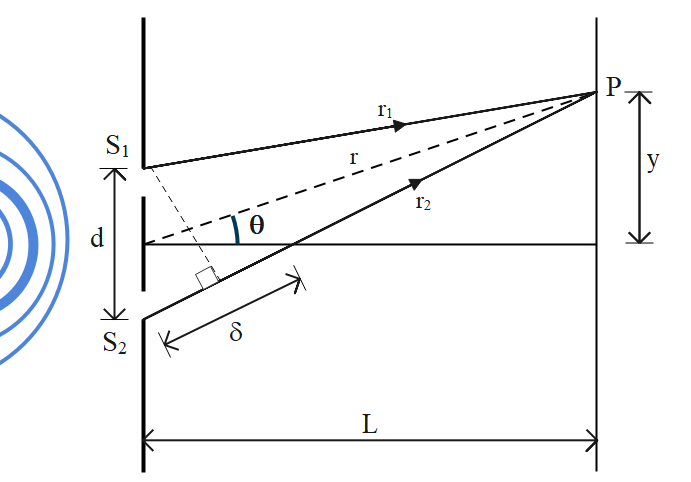
The path difference is given as $\Delta x=\dfrac{xd}{D}$, where $x$is the position of the fringe from the origin , $d$ is the distance between the fringes and $D$ is the distance between the slits and source.
Then during constructive interference,$\Delta x=n\lambda$.i.e. causes the bright fringe and during destructive interference $\Delta x=(2n+1)\dfrac{\lambda}{2}$.i.e. cause the dark fringe. Where $\lambda$ is the wavelength of the coherent source.
The fringe width, the distance between two adjacent bright or dark fringes is given by $\beta=\dfrac{\lambda D}{d}$
If a third slit is added in between the double slits, the distance between the slits reduces. The fringe width changes, i.e. increases. This reduces the contrast between the bright and the dark fringes observed at the screen. Or it causes extensive overlapping of the bright and dark fringe which reduces the distinction between them.
Hence the answer is D. contrast between the bright and dark fringe is reduced.
Note:
Constructive interference pattern occurs when the troughs or the crests of the two coherent sources interfere. These results in addition to their amplitude, hence the fringe is bright. Similarly, Destructive interference pattern occurs when one trough and one crest of the two coherent sources interfere. These result in decreasing their amplitude, hence the fringe is dark.
Complete answer:
In Young's double slit experiment; two coherent sources are kept at a distance comparable to the wavelength. Due to the path difference between the light coming from both the slits, interference pattern is observed at the screen which is placed away from the sources.
The path difference is given as $\Delta x=\dfrac{xd}{D}$, where $x$is the position of the fringe from the origin , $d$ is the distance between the fringes and $D$ is the distance between the slits and source.
Then during constructive interference,$\Delta x=n\lambda$.i.e. causes the bright fringe and during destructive interference $\Delta x=(2n+1)\dfrac{\lambda}{2}$.i.e. cause the dark fringe. Where $\lambda$ is the wavelength of the coherent source.
The fringe width, the distance between two adjacent bright or dark fringes is given by $\beta=\dfrac{\lambda D}{d}$
If a third slit is added in between the double slits, the distance between the slits reduces. The fringe width changes, i.e. increases. This reduces the contrast between the bright and the dark fringes observed at the screen. Or it causes extensive overlapping of the bright and dark fringe which reduces the distinction between them.
Hence the answer is D. contrast between the bright and dark fringe is reduced.
Note:
Constructive interference pattern occurs when the troughs or the crests of the two coherent sources interfere. These results in addition to their amplitude, hence the fringe is bright. Similarly, Destructive interference pattern occurs when one trough and one crest of the two coherent sources interfere. These result in decreasing their amplitude, hence the fringe is dark.
Recently Updated Pages
Master Class 12 Economics: Engaging Questions & Answers for Success

Master Class 12 English: Engaging Questions & Answers for Success
Master Class 12 Social Science: Engaging Questions & Answers for Success
Master Class 12 Maths: Engaging Questions & Answers for Success
Master Class 12 Physics: Engaging Questions & Answers for Success
Master Class 12 Business Studies: Engaging Questions & Answers for Success
Trending doubts
Which are the Top 10 Largest Countries of the World?
Draw a labelled sketch of the human eye class 12 physics CBSE
Differentiate between homogeneous and heterogeneous class 12 chemistry CBSE
Sulphuric acid is known as the king of acids State class 12 chemistry CBSE
Why is the cell called the structural and functional class 12 biology CBSE
Draw ray diagrams each showing i myopic eye and ii class 12 physics CBSE