




In YDSE, the intensity of the maxima is I. If the width of each slit is doubled the intensity of the maxima will be:
$\begin{align}
& \text{A}\text{. I/2} \\
& \text{B}\text{. I} \\
& \text{C}\text{. 4I} \\
& \text{D}\text{. 2I} \\
\end{align}$
Answer
 Verified
607.5k+ views
Hint: Young's double slit experiment is a demonstration of both the wave nature and the particle nature of light. Express how the intensity of light rays varies with the slit width. Then, find the central maxima using the acquired values. Take the ratio to find the final intensity of the central maxima.
Complete step by step answer:
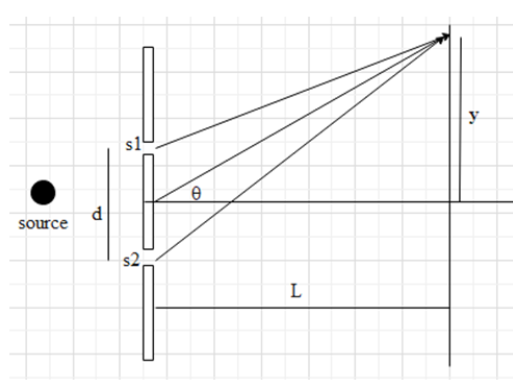
Let the intensity of light coming in from each slit in a young’s double slit experiment is ${{I}_{0}}$ .
Given that the intensity of the central maxima of the young’s double slit experiment is $I$ .
The total intensity of the interference pattern in a young’s double slit experiment is given as,
$I={{I}_{1}}+{{I}_{2}}+2\sqrt{{{I}_{1}}{{I}_{2}}}\cos \theta $
Here, we let that both the light rays from each slit have the same intensity ${{I}_{o}}$ and for the central maxima the value of $\cos \theta $ will be 1.
So, $\begin{align}
& I={{I}_{0}}+{{I}_{0}}+2\sqrt{{{I}_{0}}{{I}_{0}}} \\
& \Rightarrow I=4{{I}_{0}} \\
\end{align}$
Now, the intensity of the light ray coming from slits depends on the slit width. The intensity of the light ray is directly proportional to the slit width.
Given in the question, that the slit width of each slit in the young’s double slit experiment is doubled. Since, the intensity is proportional to the slit width, the intensity of the light ray will also be doubled.
So, now the intensity of the light ray from each slit will be, $2{{I}_{0}}$ .
So, the total intensity of the central maxima will be,
$\begin{align}
& {{I}_{f}}=2{{I}_{0}}+2{{I}_{0}}+2\sqrt{2{{I}_{0}}\times 2{{I}_{0}}} \\
& \Rightarrow {{I}_{f}}=8{{I}_{0}} \\
\end{align}$
Taking the ratio of the above two,
$\begin{align}
& \Rightarrow \dfrac{{{I}_{f}}}{I}=\dfrac{8{{I}_{0}}}{4{{I}_{0}}} \\
& \dfrac{\Rightarrow {{I}_{f}}}{I}=2 \\
& \therefore {{I}_{f}}=2I \\
\end{align}$
So, the correct answer is “Option D”.
Note:
In a young’s double slit experiment we get an interference pattern with constructive interference and destructive interference. For the central maxima we will get the maximum intensity and after that the intensity will gradually decrease in both sides of the central maxima.
Complete step by step answer:
Let the intensity of light coming in from each slit in a young’s double slit experiment is ${{I}_{0}}$ .
Given that the intensity of the central maxima of the young’s double slit experiment is $I$ .
The total intensity of the interference pattern in a young’s double slit experiment is given as,
$I={{I}_{1}}+{{I}_{2}}+2\sqrt{{{I}_{1}}{{I}_{2}}}\cos \theta $
Here, we let that both the light rays from each slit have the same intensity ${{I}_{o}}$ and for the central maxima the value of $\cos \theta $ will be 1.
So, $\begin{align}
& I={{I}_{0}}+{{I}_{0}}+2\sqrt{{{I}_{0}}{{I}_{0}}} \\
& \Rightarrow I=4{{I}_{0}} \\
\end{align}$
Now, the intensity of the light ray coming from slits depends on the slit width. The intensity of the light ray is directly proportional to the slit width.
Given in the question, that the slit width of each slit in the young’s double slit experiment is doubled. Since, the intensity is proportional to the slit width, the intensity of the light ray will also be doubled.
So, now the intensity of the light ray from each slit will be, $2{{I}_{0}}$ .
So, the total intensity of the central maxima will be,
$\begin{align}
& {{I}_{f}}=2{{I}_{0}}+2{{I}_{0}}+2\sqrt{2{{I}_{0}}\times 2{{I}_{0}}} \\
& \Rightarrow {{I}_{f}}=8{{I}_{0}} \\
\end{align}$
Taking the ratio of the above two,
$\begin{align}
& \Rightarrow \dfrac{{{I}_{f}}}{I}=\dfrac{8{{I}_{0}}}{4{{I}_{0}}} \\
& \dfrac{\Rightarrow {{I}_{f}}}{I}=2 \\
& \therefore {{I}_{f}}=2I \\
\end{align}$
So, the correct answer is “Option D”.
Note:
In a young’s double slit experiment we get an interference pattern with constructive interference and destructive interference. For the central maxima we will get the maximum intensity and after that the intensity will gradually decrease in both sides of the central maxima.
Recently Updated Pages
Master Class 12 Economics: Engaging Questions & Answers for Success

Master Class 12 English: Engaging Questions & Answers for Success
Master Class 12 Social Science: Engaging Questions & Answers for Success
Master Class 12 Maths: Engaging Questions & Answers for Success
Master Class 12 Physics: Engaging Questions & Answers for Success
Master Class 9 General Knowledge: Engaging Questions & Answers for Success
Trending doubts
Which are the Top 10 Largest Countries of the World?
Draw a labelled sketch of the human eye class 12 physics CBSE
Differentiate between homogeneous and heterogeneous class 12 chemistry CBSE
Why is the cell called the structural and functional class 12 biology CBSE
Draw ray diagrams each showing i myopic eye and ii class 12 physics CBSE
Which is the correct genotypic ratio of mendel dihybrid class 12 biology CBSE