




In tryptophan operon, a repressor consists of a co-repressor and apo-repressor. These two consist of
a) protein and tryptophan
b) RNA and protein
c)tryptophan and protein
d)RNA and tryptophan
Answer
 Verified
628.2k+ views
Hint The tryptophan operon codes for the production of the tryptophan. The operon is autoregulated which means when the amount of tryptophan present is less the operon switches on and if the tryptophan level is more than the required amount then it is turned off.
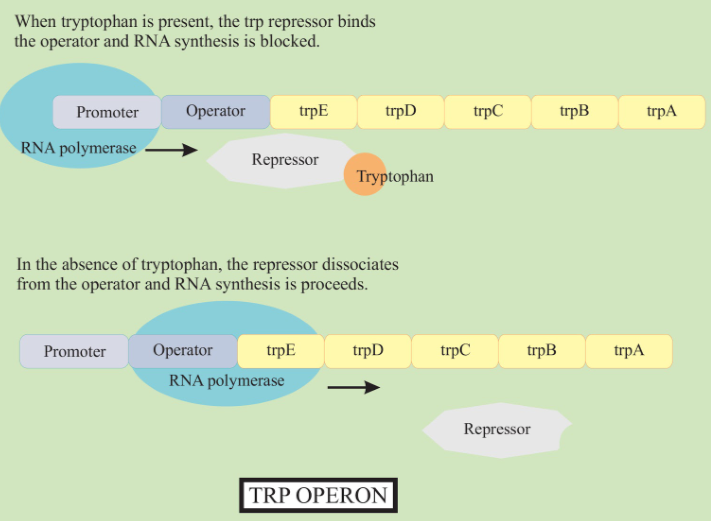
Complete answer: In the trp operon there are five coding regions present which code for the production of the tryptophan. The coding region is the DNA sequence that has codes for the protein to decode. The promoter sequence present in the operon is located upstream of the transcriptional site. The operon has a sequence from which the binding of the protein can take place and the regulation of the operon can be done easily. The first coding region of the operon consists of the DNA code onto which the repressor protein can bind to it. When the tryptophan is present in the cells then the two tryptophan molecules bind to the trp repressor and it changes the shape to bind to the trp operator. This binding prevents the attachment of the RNA polymerase and then stops the transcription of the operon. When the tryptophan is not present in the cells the repressor is unable to bind itself to the operon. The operon is switched on and then the transcription of the tryptophan takes place. without the tryptophan present in the cell then the operon can’t be switched off. Tryptophan acts as a corepressor in this operon model.
So, the answer is ‘tryptophan and protein’.
Note: The trp operon is the negatively regulated operon as it operates when the can’t tryptophan level is lowered or is not present at all. When the amount of the tryptophan increases then the operon is switched off automatically.
Complete answer: In the trp operon there are five coding regions present which code for the production of the tryptophan. The coding region is the DNA sequence that has codes for the protein to decode. The promoter sequence present in the operon is located upstream of the transcriptional site. The operon has a sequence from which the binding of the protein can take place and the regulation of the operon can be done easily. The first coding region of the operon consists of the DNA code onto which the repressor protein can bind to it. When the tryptophan is present in the cells then the two tryptophan molecules bind to the trp repressor and it changes the shape to bind to the trp operator. This binding prevents the attachment of the RNA polymerase and then stops the transcription of the operon. When the tryptophan is not present in the cells the repressor is unable to bind itself to the operon. The operon is switched on and then the transcription of the tryptophan takes place. without the tryptophan present in the cell then the operon can’t be switched off. Tryptophan acts as a corepressor in this operon model.
So, the answer is ‘tryptophan and protein’.
Note: The trp operon is the negatively regulated operon as it operates when the can’t tryptophan level is lowered or is not present at all. When the amount of the tryptophan increases then the operon is switched off automatically.
Recently Updated Pages
Explain the structure of megasporangium class 12 biology CBSE

Why is chloroform kept in dark coloured bottles class 12 chemistry CBSE
Derive the balancing condition of a Wheatstone bri class 12 physics CBSE
Draw VI characteristics of a pn junction diode Explain class 12 physics CBSE
Is it possible to carry pride in ones language too class 12 english CBSE
In a population at Hardy Weinberg equilibrium the allele class 12 biology CBSE
Trending doubts
Draw a labelled sketch of the human eye class 12 physics CBSE
Which are the Top 10 Largest Countries of the World?
Draw ray diagrams each showing i myopic eye and ii class 12 physics CBSE
Which is the correct genotypic ratio of mendel dihybrid class 12 biology CBSE
Differentiate between homogeneous and heterogeneous class 12 chemistry CBSE
Which animal never drinks water in its entire life class 12 biology CBSE