




In total reflection when the angle of incidence is equal to the critical angle then angle of refraction is?
$\begin{align}
& A.\,\,{{180}^{\circ }} \\
& B.\,\,{{0}^{\circ }} \\
& C.\,\,Equal\,to\,angle\,of\,incidence \\
& D.\,\,{{90}^{\circ }} \\
\end{align}$
Answer
 Verified
576.3k+ views
Hint: In general, the boundary considered for this type of question is water-air boundary, until anything is explicitly mentioned. Critical angle is an angle of incidence value. And for the answer to this question we should know the value for which angle of incidence is equal to the critical angle and also the value of angle of refraction in such cases.
Complete step by step answer:
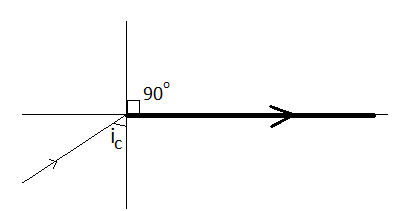
The critical angle is defined as the angle of incidence that provides an angle of refraction of ${{90}^{\circ }}$. For the water-air boundary, the critical angle is ${{48.6}^{\circ }}$.
When the angle of incidence in water reaches a certain critical value, the refracted ray lies along the boundary, having an angle of refraction of ${{90}^{\circ }}$. This angle of incidence is known as the critical angle; it is the largest angle of incidence for which refraction can still occur. For any angle of incidence greater than the critical angle, light will undergo total internal reflection.
Since, at $i={{i}_{c}}$, refracted ray grazes with the surface.
So, Angle of refraction in such a case is ${{90}^{\circ }}$.
So, the correct answer is “Option D”.
Note:
For the water-air boundary, the critical angle is ${{48.6}^{\circ }}$. For the crown glass-water boundary, the critical angle is ${{61}^{\circ }}$. The actual value of the critical angle is dependent upon the combination of materials present on each side of the boundary.
Complete step by step answer:
The critical angle is defined as the angle of incidence that provides an angle of refraction of ${{90}^{\circ }}$. For the water-air boundary, the critical angle is ${{48.6}^{\circ }}$.
When the angle of incidence in water reaches a certain critical value, the refracted ray lies along the boundary, having an angle of refraction of ${{90}^{\circ }}$. This angle of incidence is known as the critical angle; it is the largest angle of incidence for which refraction can still occur. For any angle of incidence greater than the critical angle, light will undergo total internal reflection.
Since, at $i={{i}_{c}}$, refracted ray grazes with the surface.
So, Angle of refraction in such a case is ${{90}^{\circ }}$.
So, the correct answer is “Option D”.
Note:
For the water-air boundary, the critical angle is ${{48.6}^{\circ }}$. For the crown glass-water boundary, the critical angle is ${{61}^{\circ }}$. The actual value of the critical angle is dependent upon the combination of materials present on each side of the boundary.
Recently Updated Pages
Master Class 12 Economics: Engaging Questions & Answers for Success

Master Class 12 Physics: Engaging Questions & Answers for Success
Master Class 12 English: Engaging Questions & Answers for Success
Master Class 12 Social Science: Engaging Questions & Answers for Success
Master Class 12 Maths: Engaging Questions & Answers for Success
Master Class 12 Business Studies: Engaging Questions & Answers for Success
Trending doubts
Which are the Top 10 Largest Countries of the World?
What are the major means of transport Explain each class 12 social science CBSE
Draw a labelled sketch of the human eye class 12 physics CBSE
Why cannot DNA pass through cell membranes class 12 biology CBSE
Differentiate between insitu conservation and exsitu class 12 biology CBSE
Draw a neat and well labeled diagram of TS of ovary class 12 biology CBSE