




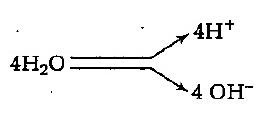
In this process which of the following plays an important role?
A. Chlorophyll
B. Light energy
C. \[C{a^{2 + }}\], \[M{n^{2 + }}\], \[C{l^ - }\]
D. All of the above
Answer
 Verified
504.6k+ views
Hint: Photolysis of water is a chemical reaction that occurs in plants where water molecules are broken down into oxygen and hydrogen. This reaction occurs during photosynthesis in the chloroplast. The electrons produced during this reaction are shunted to the electron transport chain in photosystem II. The electrons are used to convert carbon dioxide into sugars molecules. The oxygen molecules are released as a waste product into the atmosphere.
Complete explanation:
Option A chlorophyll: Splitting of water is done with the help of chlorophyll. When the chlorophyll pigments in the chloroplast absorb light energy, it induces the splitting of water molecules. With the help of light energy or photons, water is split into protons, electrons and oxygen.
Option A is correct.
Option B light energy: Light energy from the sun provides photons which have the ability to split the water into oxygen, electrons and protons (hydrogen ions). Without sunlight, photolysis of water does not occur.
Option B is correct.
Option C \[C{a^{2 + }}\], \[M{n^{2 + }}\], \[C{l^ - }\]: During photolysis reaction, the liberation of oxygen from the water molecule requires mineral ions such as calcium, manganese and chlorine.
Option C is correct.
Option D all of the above: Since all of the given options are correct, option D is the correct answer for this question.
Option D is correct
Therefore, Option D All of the above is the correct answer.
Note:
Photolysis of water is a part of the light dependent reaction or Hill reaction of photosynthesis. It occurs in the photosystem II of chloroplast. The electrons produced during this reaction are passed through an electron transport chain. The electrons are excited to higher-energy levels with the help of sunlight. It is passed through a chain of electron acceptors known as an electron transport chain. The final reaction is the reduction of \[NAD{P^ + }\] to \[NADPH\].
Complete explanation:
Option A chlorophyll: Splitting of water is done with the help of chlorophyll. When the chlorophyll pigments in the chloroplast absorb light energy, it induces the splitting of water molecules. With the help of light energy or photons, water is split into protons, electrons and oxygen.
Option A is correct.
Option B light energy: Light energy from the sun provides photons which have the ability to split the water into oxygen, electrons and protons (hydrogen ions). Without sunlight, photolysis of water does not occur.
Option B is correct.
Option C \[C{a^{2 + }}\], \[M{n^{2 + }}\], \[C{l^ - }\]: During photolysis reaction, the liberation of oxygen from the water molecule requires mineral ions such as calcium, manganese and chlorine.
Option C is correct.
Option D all of the above: Since all of the given options are correct, option D is the correct answer for this question.
Option D is correct
Therefore, Option D All of the above is the correct answer.
Note:
Photolysis of water is a part of the light dependent reaction or Hill reaction of photosynthesis. It occurs in the photosystem II of chloroplast. The electrons produced during this reaction are passed through an electron transport chain. The electrons are excited to higher-energy levels with the help of sunlight. It is passed through a chain of electron acceptors known as an electron transport chain. The final reaction is the reduction of \[NAD{P^ + }\] to \[NADPH\].
Recently Updated Pages
Master Class 11 Computer Science: Engaging Questions & Answers for Success

Master Class 11 Business Studies: Engaging Questions & Answers for Success
Master Class 11 Economics: Engaging Questions & Answers for Success
Master Class 11 English: Engaging Questions & Answers for Success
Master Class 11 Maths: Engaging Questions & Answers for Success
Master Class 11 Biology: Engaging Questions & Answers for Success
Trending doubts
There are 720 permutations of the digits 1 2 3 4 5 class 11 maths CBSE
Discuss the various forms of bacteria class 11 biology CBSE
Explain zero factorial class 11 maths CBSE
What organs are located on the left side of your body class 11 biology CBSE
Draw a labelled diagram of the human heart and label class 11 biology CBSE
What is 1s 2s 2p 3s 3p class 11 chemistry CBSE