




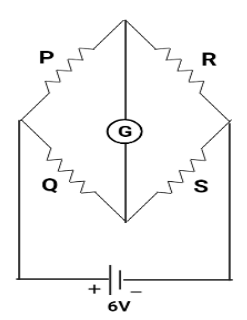
In the wheatstone’s network given, $P = 10\Omega ,Q = 20\Omega ,R = 15\Omega ,S = 30\Omega ,$ the current passing through the battery (of negligible internal resistance) is:
A. $0.36A$
B. $Zero$
C. $0.18A$
D0 $0.72A$
Answer
 Verified
546.9k+ views
Hint:The Wheatstone bridge operates on the null deflection theorem, which states that their resistance ratios are identical and that no current passes through the circuit. In normal circumstances, the bridge is unbalanced, allowing current to pass through the galvanometer.
Complete step by step answer:
In the question it is given that,
$P = 10\Omega \\
\Rightarrow Q = 20\Omega \\
\Rightarrow R = 15\Omega \\
\Rightarrow S = 30\Omega \\ $
Now , we see that
$\dfrac{P}{Q} = \dfrac{{10}}{{20}} = \dfrac{1}{2}$
Similarly,
$\dfrac{R}{S} = \dfrac{{15}}{{30}} = \dfrac{1}{2}$
From the above two equations, We observe that $\dfrac{P}{Q} = \dfrac{R}{S}$ which states that their resistance ratios are identical. Hence, there is no current flowing through the galvanometer. Therefore, The Wheatstone bridge is satisfied.
Now, we see that $P$ and $R$ are in series. Hence, the net resistance will be,
${R_1} = P + R \\
\Rightarrow {R_1} = 10\Omega + 15\Omega \\
\Rightarrow {R_1} = 25\Omega \\ $
Similarly, $Q$ and $S$ are also in series. Hence, the net resistance will be,
${R_2} = Q + S \\
\Rightarrow {R_2} = 20\Omega + 30\Omega \\
\Rightarrow {R_2} = 50\Omega \\$
Now, ${R_1}$ and ${R_2}$ are in parallel combination,
$\dfrac{1}{R} = \dfrac{1}{{{R_1}}} + \dfrac{1}{{{R_2}}}$
$\Rightarrow \dfrac{1}{R} = \dfrac{1}{{50}} + \dfrac{1}{{25}} \\
\Rightarrow \dfrac{1}{R} = \dfrac{{1 + 2}}{{50}} \\
\Rightarrow \dfrac{1}{R} = \dfrac{3}{{50}} \\
\Rightarrow R = \dfrac{{50}}{3} \\ $
Using ohm’s law, $I = \dfrac{V}{R}$
We know that,
$V = 6V \\
\Rightarrow R = \dfrac{{50}}{3}\Omega \\ $
Substituting these values we get,
$I = \dfrac{V}{R} \\
\Rightarrow I = \dfrac{{6 \times 3}}{{50}} \\
\Rightarrow I = \dfrac{{18}}{{50}} \\
\therefore I = 0.36A \\ $
Hence, the correct answer is option A.
Note:A Wheatstone bridge is an electrical circuit that balances two legs of a bridge circuit, one of which contains the unknown part, to test an unknown electrical resistance. The circuit's main advantage is its ability to produce highly precise measurements.
Complete step by step answer:
In the question it is given that,
$P = 10\Omega \\
\Rightarrow Q = 20\Omega \\
\Rightarrow R = 15\Omega \\
\Rightarrow S = 30\Omega \\ $
Now , we see that
$\dfrac{P}{Q} = \dfrac{{10}}{{20}} = \dfrac{1}{2}$
Similarly,
$\dfrac{R}{S} = \dfrac{{15}}{{30}} = \dfrac{1}{2}$
From the above two equations, We observe that $\dfrac{P}{Q} = \dfrac{R}{S}$ which states that their resistance ratios are identical. Hence, there is no current flowing through the galvanometer. Therefore, The Wheatstone bridge is satisfied.
Now, we see that $P$ and $R$ are in series. Hence, the net resistance will be,
${R_1} = P + R \\
\Rightarrow {R_1} = 10\Omega + 15\Omega \\
\Rightarrow {R_1} = 25\Omega \\ $
Similarly, $Q$ and $S$ are also in series. Hence, the net resistance will be,
${R_2} = Q + S \\
\Rightarrow {R_2} = 20\Omega + 30\Omega \\
\Rightarrow {R_2} = 50\Omega \\$
Now, ${R_1}$ and ${R_2}$ are in parallel combination,
$\dfrac{1}{R} = \dfrac{1}{{{R_1}}} + \dfrac{1}{{{R_2}}}$
$\Rightarrow \dfrac{1}{R} = \dfrac{1}{{50}} + \dfrac{1}{{25}} \\
\Rightarrow \dfrac{1}{R} = \dfrac{{1 + 2}}{{50}} \\
\Rightarrow \dfrac{1}{R} = \dfrac{3}{{50}} \\
\Rightarrow R = \dfrac{{50}}{3} \\ $
Using ohm’s law, $I = \dfrac{V}{R}$
We know that,
$V = 6V \\
\Rightarrow R = \dfrac{{50}}{3}\Omega \\ $
Substituting these values we get,
$I = \dfrac{V}{R} \\
\Rightarrow I = \dfrac{{6 \times 3}}{{50}} \\
\Rightarrow I = \dfrac{{18}}{{50}} \\
\therefore I = 0.36A \\ $
Hence, the correct answer is option A.
Note:A Wheatstone bridge is an electrical circuit that balances two legs of a bridge circuit, one of which contains the unknown part, to test an unknown electrical resistance. The circuit's main advantage is its ability to produce highly precise measurements.
Recently Updated Pages
Master Class 12 Business Studies: Engaging Questions & Answers for Success

Master Class 12 Chemistry: Engaging Questions & Answers for Success
Master Class 12 Biology: Engaging Questions & Answers for Success
Class 12 Question and Answer - Your Ultimate Solutions Guide
Master Class 11 English: Engaging Questions & Answers for Success
Master Class 11 Maths: Engaging Questions & Answers for Success
Trending doubts
Which is more stable and why class 12 chemistry CBSE
Which are the Top 10 Largest Countries of the World?
Draw a labelled sketch of the human eye class 12 physics CBSE
Differentiate between homogeneous and heterogeneous class 12 chemistry CBSE
What are the major means of transport Explain each class 12 social science CBSE
Sulphuric acid is known as the king of acids State class 12 chemistry CBSE