




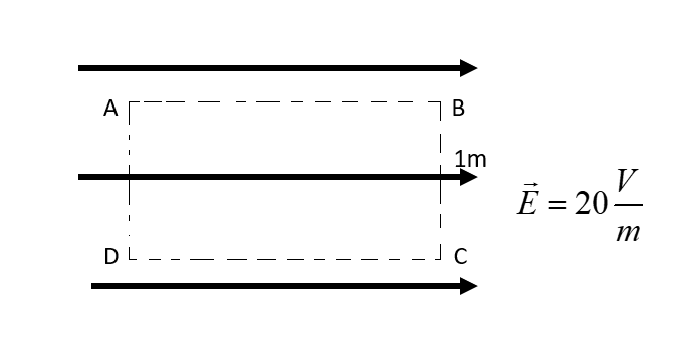
In the uniform electric field shown in figure, \[{V_A} - {V_C}\] is
A) $10V$
B) $20V$
C) $40V$
D) $5V$
Answer
 Verified
620.4k+ views
Hint- Potential difference between two points is defined as the total amount of work done in moving the positive charge from one point to another. The electric field is also due to the charge present on the particular area. It is measured in volt per metre. And it can also be said as the electric force.
Complete step by step answer:
(i) As we know both the potential difference and the electric field is due to the charge present on the particular area, the relation between both the potential difference and the electric field is, \[{V_A} - {V_C} = E \times d\]
(ii) From the diagram, we can understand the electric field of \[20V{m^{ - 1}}\]in the direction of A to B.
(iii) The plane AB and DC is acting in the uniform electric field. From A to B, we can say that the potential at A is higher than B as the electric field is acting in the direction from A to B.
(iv)A potential at D is greater than the potential at C. And the potential at D and the potential at C are equal to the potential at A and potential at B respectively. This is because both planes are in the same electric field. And they are called as equipotential surfaces.
(v) Therefore the potential between A and B and the potential between A and C are equal. Hence, \[{V_A} - {V_C} = 20 \times 1\]
\[\therefore {V_A} - {V_C} = 20V\]
(vi)Therefore the correct option is B.
Note: If the potential difference at two surfaces is equal, those two surfaces are equipotential surfaces. And the difference between the work-done on two surfaces is zero. The unit of potential difference is Volt. One volt is defined as the one joule of work done in moving one unit of positive charge from one place to another.
Complete step by step answer:
(i) As we know both the potential difference and the electric field is due to the charge present on the particular area, the relation between both the potential difference and the electric field is, \[{V_A} - {V_C} = E \times d\]
(ii) From the diagram, we can understand the electric field of \[20V{m^{ - 1}}\]in the direction of A to B.
(iii) The plane AB and DC is acting in the uniform electric field. From A to B, we can say that the potential at A is higher than B as the electric field is acting in the direction from A to B.
(iv)A potential at D is greater than the potential at C. And the potential at D and the potential at C are equal to the potential at A and potential at B respectively. This is because both planes are in the same electric field. And they are called as equipotential surfaces.
(v) Therefore the potential between A and B and the potential between A and C are equal. Hence, \[{V_A} - {V_C} = 20 \times 1\]
\[\therefore {V_A} - {V_C} = 20V\]
(vi)Therefore the correct option is B.
Note: If the potential difference at two surfaces is equal, those two surfaces are equipotential surfaces. And the difference between the work-done on two surfaces is zero. The unit of potential difference is Volt. One volt is defined as the one joule of work done in moving one unit of positive charge from one place to another.
Recently Updated Pages
Master Class 12 Economics: Engaging Questions & Answers for Success

Master Class 12 English: Engaging Questions & Answers for Success
Master Class 12 Social Science: Engaging Questions & Answers for Success
Master Class 12 Maths: Engaging Questions & Answers for Success
Master Class 12 Physics: Engaging Questions & Answers for Success
Master Class 12 Business Studies: Engaging Questions & Answers for Success
Trending doubts
Which are the Top 10 Largest Countries of the World?
Draw a labelled sketch of the human eye class 12 physics CBSE
Differentiate between homogeneous and heterogeneous class 12 chemistry CBSE
Why is the cell called the structural and functional class 12 biology CBSE
Draw ray diagrams each showing i myopic eye and ii class 12 physics CBSE
Which is the correct genotypic ratio of mendel dihybrid class 12 biology CBSE