




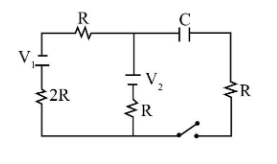
In the transient current circuit shown, the time constant is:
(1) \[\dfrac{5}{3}RC\]
(2) \[\dfrac{5}{2}RC\]
(3) \[\dfrac{7}{4}RC\]
(4) \[\dfrac{7}{3}RC\]
Answer
 Verified
618.6k+ views
Hint: We will use the concept of Thevenin’s theorem to reduce the given network into its simplest form. We will also use the expressions for equivalent resistance when two resistors are in parallel or series combinations. Also, the time constant of the given circuit is equal to the product of capacitance and equivalent resistance of the given circuit.
Complete step by step answer:
According to the concept of Thevenin’s theorem, we can replace several voltages by a single power supply and several resistances by one single resistance, which is connected in series with the load.
We can write the expression for equivalent resistance by analyzing the circuit from the right-hand side, short circuit all the voltages, and opening the resistance R at extreme right.
The equivalent of two resistors connected in series is given by:
\[{R_s} = {R_1} + {R_2}\]…….(1)
The resistors of resistances R and 2R are connected in series, therefore substituting R for \[{R_1}\]and 2R for \[{R_2}\]the above expression.
\[\begin{array}{l}
{R_s} = R + 2R\\
= 3R
\end{array}\]
We know that the equivalent resistance of two resistors connected in parallel is given by:
\[{R_p} = \dfrac{{{R_3}{R_4}}}{{{R_3} + {R_4}}}\]
We can see that the resistor of equivalent resistance 3R and R are in parallel. Therefore we will substitute R for \[{R_3}\] and 2R for \[{R_4}\] in the above expression.
\[\begin{array}{l}
{R_p} = \dfrac{{\left( R \right)\left( {3R} \right)}}{{R + 3R}}\\
= \dfrac{3}{4}R
\end{array}\]
The equivalent resistance of the circuit can be obtained by substituting the series combination of resistance \[\dfrac{3}{4}R\] for \[{R_1}\] and R for \[{R_2}\].
\[\begin{array}{l}
{R_{eq}} = \dfrac{3}{4}R + R\\
= \dfrac{7}{4}R
\end{array}\]
We know that the time constant is given by the product of equivalent resistance and capacitance of the circuit.
\[\tau = {R_{eq}}C\]
On substituting \[\dfrac{7}{4}R\] for \[{R_{eq}}\] in the above expression, we get:
\[\begin{array}{l}
\tau = \left( {\dfrac{7}{4}R} \right)C\\
= \dfrac{7}{4}RC
\end{array}\]
Therefore, the time constant of the given circuit is \[\dfrac{7}{4}RC\], and option (3) is correct.
Note: Do not take the extreme right resistance of the circuit into consideration while converting the given circuit into its reduced form using Thevenin’s theorem. This has to be open and will be treated as a load.
Complete step by step answer:
According to the concept of Thevenin’s theorem, we can replace several voltages by a single power supply and several resistances by one single resistance, which is connected in series with the load.
We can write the expression for equivalent resistance by analyzing the circuit from the right-hand side, short circuit all the voltages, and opening the resistance R at extreme right.
The equivalent of two resistors connected in series is given by:
\[{R_s} = {R_1} + {R_2}\]…….(1)
The resistors of resistances R and 2R are connected in series, therefore substituting R for \[{R_1}\]and 2R for \[{R_2}\]the above expression.
\[\begin{array}{l}
{R_s} = R + 2R\\
= 3R
\end{array}\]
We know that the equivalent resistance of two resistors connected in parallel is given by:
\[{R_p} = \dfrac{{{R_3}{R_4}}}{{{R_3} + {R_4}}}\]
We can see that the resistor of equivalent resistance 3R and R are in parallel. Therefore we will substitute R for \[{R_3}\] and 2R for \[{R_4}\] in the above expression.
\[\begin{array}{l}
{R_p} = \dfrac{{\left( R \right)\left( {3R} \right)}}{{R + 3R}}\\
= \dfrac{3}{4}R
\end{array}\]
The equivalent resistance of the circuit can be obtained by substituting the series combination of resistance \[\dfrac{3}{4}R\] for \[{R_1}\] and R for \[{R_2}\].
\[\begin{array}{l}
{R_{eq}} = \dfrac{3}{4}R + R\\
= \dfrac{7}{4}R
\end{array}\]
We know that the time constant is given by the product of equivalent resistance and capacitance of the circuit.
\[\tau = {R_{eq}}C\]
On substituting \[\dfrac{7}{4}R\] for \[{R_{eq}}\] in the above expression, we get:
\[\begin{array}{l}
\tau = \left( {\dfrac{7}{4}R} \right)C\\
= \dfrac{7}{4}RC
\end{array}\]
Therefore, the time constant of the given circuit is \[\dfrac{7}{4}RC\], and option (3) is correct.
Note: Do not take the extreme right resistance of the circuit into consideration while converting the given circuit into its reduced form using Thevenin’s theorem. This has to be open and will be treated as a load.
Recently Updated Pages
Master Class 12 Business Studies: Engaging Questions & Answers for Success

Master Class 12 Chemistry: Engaging Questions & Answers for Success
Master Class 12 Biology: Engaging Questions & Answers for Success
Class 12 Question and Answer - Your Ultimate Solutions Guide
Master Class 11 English: Engaging Questions & Answers for Success
Master Class 11 Social Science: Engaging Questions & Answers for Success
Trending doubts
Which are the Top 10 Largest Countries of the World?
Draw a labelled sketch of the human eye class 12 physics CBSE
The end of compass needle which points towards north class 12 physics CBSE
Differentiate between homogeneous and heterogeneous class 12 chemistry CBSE
Why is the cell called the structural and functional class 12 biology CBSE
When was the first election held in India a 194748 class 12 sst CBSE