




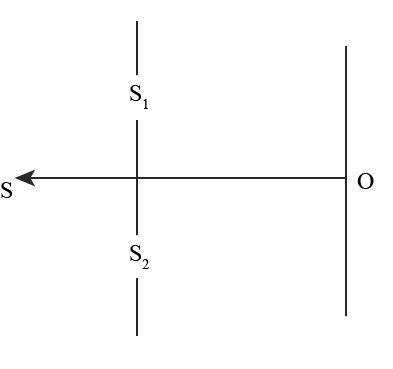
In the set up shown, the two slits ${S_1}$ and ${S_2}$ are not equidistant from the slit. The central fringe at $O$ is then
(A) always bright
(B) always dark
(C) either dark or bright depending on the position of S
(D) neither dark nor bright
Answer
 Verified
578.1k+ views
Hint: This question uses the concept of Young’s Double Slit experiments. You need to apply the formula for the path difference for both dark fringe and bright fringe. On comparing both the obtained expression, you can figure out the correct answer.
Complete step by step answer:
As we know that the expression for the path difference can be given as,
$\Delta d = \left( {S{S_1} + {S_1}O} \right) - \left( {S{S_2} + {S_2}O} \right)$
In the case for the maximum intensity, the above expression would be equal to $n\lambda $. It means, this can be written as,
$\left( {S{S_1} + {S_1}O} \right) - \left( {S{S_2} + {S_2}O} \right) = n\lambda $
Here, the value of n varies as $1,\;2,\;3,\;4,.........$.
Similarly for the minimum intensity, the expression would be equal to $\left( {n - \dfrac{1}{2}} \right)\lambda $. It means, this can be written as,
$\left( {S{S_1} + {S_1}O} \right) - \left( {S{S_2} + {S_2}O} \right) = \left( {n - \dfrac{1}{2}} \right)\lambda $
Here, the value of n varies as $1,\;2,\;3,\;4,.........$.
As both the slits ${S_1}$ and ${S_2}$ are not equidistant from the slit S. So the distance traveled by the light through ${S_1}$ and ${S_2}$ may not differ by integral multiple of the value of wavelength.
So, when the path difference $\Delta d$ will be equal to the $n\lambda $, the fringe will be bright.
Similarly in the other case, when the path difference $\Delta d$ will be equal to the $\left( {n - \dfrac{1}{2}} \right)\lambda $, the fringe will be dark.
Therefore, the fringe may be dark or bright depending upon the position of S.
Thus, option (C) is correct.
Note:
You may go wrong while comparing both the expression for the bright fringe and dark fringe. The bright and dark fringes are obtained due to overlapping of the light waves that are originated by two slits and the central fringe depends on the position of slits from the source.
Complete step by step answer:
As we know that the expression for the path difference can be given as,
$\Delta d = \left( {S{S_1} + {S_1}O} \right) - \left( {S{S_2} + {S_2}O} \right)$
In the case for the maximum intensity, the above expression would be equal to $n\lambda $. It means, this can be written as,
$\left( {S{S_1} + {S_1}O} \right) - \left( {S{S_2} + {S_2}O} \right) = n\lambda $
Here, the value of n varies as $1,\;2,\;3,\;4,.........$.
Similarly for the minimum intensity, the expression would be equal to $\left( {n - \dfrac{1}{2}} \right)\lambda $. It means, this can be written as,
$\left( {S{S_1} + {S_1}O} \right) - \left( {S{S_2} + {S_2}O} \right) = \left( {n - \dfrac{1}{2}} \right)\lambda $
Here, the value of n varies as $1,\;2,\;3,\;4,.........$.
As both the slits ${S_1}$ and ${S_2}$ are not equidistant from the slit S. So the distance traveled by the light through ${S_1}$ and ${S_2}$ may not differ by integral multiple of the value of wavelength.
So, when the path difference $\Delta d$ will be equal to the $n\lambda $, the fringe will be bright.
Similarly in the other case, when the path difference $\Delta d$ will be equal to the $\left( {n - \dfrac{1}{2}} \right)\lambda $, the fringe will be dark.
Therefore, the fringe may be dark or bright depending upon the position of S.
Thus, option (C) is correct.
Note:
You may go wrong while comparing both the expression for the bright fringe and dark fringe. The bright and dark fringes are obtained due to overlapping of the light waves that are originated by two slits and the central fringe depends on the position of slits from the source.
Recently Updated Pages
Master Class 12 Economics: Engaging Questions & Answers for Success

Master Class 12 Physics: Engaging Questions & Answers for Success
Master Class 12 English: Engaging Questions & Answers for Success
Master Class 12 Social Science: Engaging Questions & Answers for Success
Master Class 12 Maths: Engaging Questions & Answers for Success
Master Class 12 Business Studies: Engaging Questions & Answers for Success
Trending doubts
Which are the Top 10 Largest Countries of the World?
What are the major means of transport Explain each class 12 social science CBSE
Draw a labelled sketch of the human eye class 12 physics CBSE
Why cannot DNA pass through cell membranes class 12 biology CBSE
Differentiate between insitu conservation and exsitu class 12 biology CBSE
Draw a neat and well labeled diagram of TS of ovary class 12 biology CBSE