



In the reaction ${C_2}{H_5}OH \to X$ the molecular formula of X is,
A. ${C_4}{H_6}O$
B. ${C_4}{H_{10}}O$
C. ${C_2}{H_4}O$
D. ${C_2}{H_6}$
Answer
 Verified
604.5k+ views
Hint: When alcohol is treated with copper catalyst at ${300^o}C$, then dehydrogenation will take place. There will be removal of hydrogen or oxidation will take place. This reagent is also used for the separation of the primary, secondary and tertiary alcohols.
Step by step answer: Let us see how Copper at ${300^o}C$ will react with different types of alcohol. In the primary alcohol, the carbon connecting to the hydroxyl group will be connected to only one carbon atom. While in case of secondary alcohol, the carbon connecting to the hydroxyl group will be further connected to two more carbon atoms. And in case of tertiary alcohols the carbon connecting to the hydroxyl group, will be further connected to three more carbon atoms.
Primary alcohol-The primary alcohols will react with copper vapours at ${300^o}C$ to form corresponding aldehyde.
Secondary alcohol-The secondary alcohol will react with copper vapours at ${300^o}C$ to form corresponding ketone.
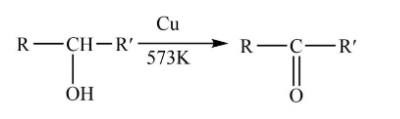
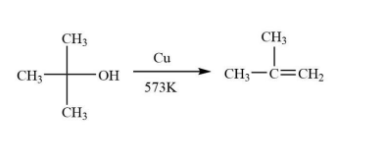
Tertiary alcohol-The tertiary alcohol will react with copper vapours at ${300^o}C$ to undergo dehydrogenation and corresponding alkene will be formed.
The given alcohol given is an example of primary alcohols named as Ethanol which reacts with vapours of copper to form corresponding aldehydes named Acetaldehyde.
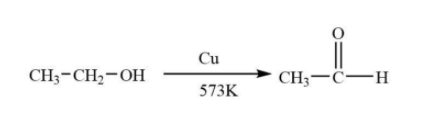
The molecular formula of Acetaldehyde is ${C_2}{H_4}O$.
Hence, option (C) ${C_2}{H_4}O$, is the correct option.
Note: There are various different reagents used for the oxidation of alcohols’ for example potassium dichromate, Collins reagent$Cr{O_3}$,Pyridinium chlorochromate, Dess Martin reagent, Dimethyl Sulphoxide (Swern Oxidation), Jones reagent aluminium isopropoxide/acetone (Oppenauer oxidation).
Step by step answer: Let us see how Copper at ${300^o}C$ will react with different types of alcohol. In the primary alcohol, the carbon connecting to the hydroxyl group will be connected to only one carbon atom. While in case of secondary alcohol, the carbon connecting to the hydroxyl group will be further connected to two more carbon atoms. And in case of tertiary alcohols the carbon connecting to the hydroxyl group, will be further connected to three more carbon atoms.
Primary alcohol-The primary alcohols will react with copper vapours at ${300^o}C$ to form corresponding aldehyde.
Secondary alcohol-The secondary alcohol will react with copper vapours at ${300^o}C$ to form corresponding ketone.
Tertiary alcohol-The tertiary alcohol will react with copper vapours at ${300^o}C$ to undergo dehydrogenation and corresponding alkene will be formed.
The given alcohol given is an example of primary alcohols named as Ethanol which reacts with vapours of copper to form corresponding aldehydes named Acetaldehyde.
The molecular formula of Acetaldehyde is ${C_2}{H_4}O$.
Hence, option (C) ${C_2}{H_4}O$, is the correct option.
Note: There are various different reagents used for the oxidation of alcohols’ for example potassium dichromate, Collins reagent$Cr{O_3}$,Pyridinium chlorochromate, Dess Martin reagent, Dimethyl Sulphoxide (Swern Oxidation), Jones reagent aluminium isopropoxide/acetone (Oppenauer oxidation).
Recently Updated Pages
Master Class 12 Business Studies: Engaging Questions & Answers for Success

Master Class 12 Chemistry: Engaging Questions & Answers for Success
Master Class 12 Biology: Engaging Questions & Answers for Success
Class 12 Question and Answer - Your Ultimate Solutions Guide
Master Class 11 English: Engaging Questions & Answers for Success
Master Class 11 Social Science: Engaging Questions & Answers for Success
Trending doubts
Which are the Top 10 Largest Countries of the World?
Draw a labelled sketch of the human eye class 12 physics CBSE
The end of compass needle which points towards north class 12 physics CBSE
Differentiate between homogeneous and heterogeneous class 12 chemistry CBSE
In order to find out the different types of gametes class 12 biology NEET_UG
Why is the cell called the structural and functional class 12 biology CBSE