




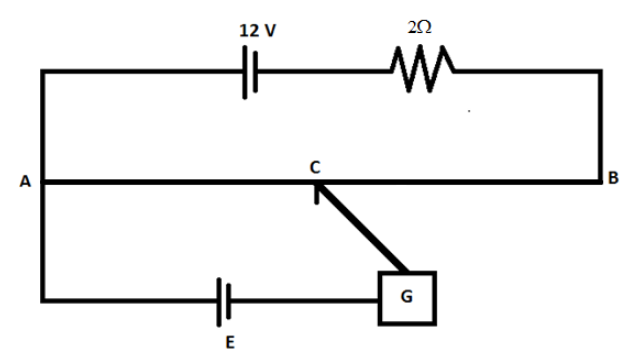
In the potentiometer circuit shown in figure, the internal resistance of the $12V$ battery is $1\Omega $ and length of the wire AB is $100cm$. When CB is $60cm$. The galvanometer shows no deflection. The emf of cell E is (the resistance of wire AB is $3\Omega $)
A. $3.6V$
B. $2.4V$
C. $3V$
D. $4.5V$
Answer
 Verified
573.3k+ views
Hint: In this question, we need to determine the emf of cell E such that the internal resistance of the $12V$ battery is $1\Omega $ and length of the wire AB is $100cm$. When CB is $60cm$. For this, we will first find the value of current and the resistance then, substitute the value in the relation between the emf, current and the resistance to find the E.M.F. of the cell E.
Formula Used:
$E.M.F. = I \times R$
Here $I$ is the current and $R$ is the resistance.
Complete step by step answer:
We have been given a potentiometer circuit diagram.In the given circuit diagram, the $12V$ battery has an internal resistance of $1\Omega $.Also, the wire AB is $100cm$ long.When the length of CB is $60cm$, the galvanometer shows no deflection.We are also given that the resistance of wire AB is $3\Omega $.Now, we need to find out the E.M.F. of the cell E.The current is equal to the voltage divided by the sum of the external resistance, the internal resistance of the battery and the resistance of wire AB. This can be given as,
$
I = \dfrac{{12}}{{2 + 1 + 3}} \\
\Rightarrow I = \dfrac{{12}}{6} \\
\Rightarrow I = 2A \\ $
Here, $12$ is the voltage, $2$ is the external resistance in the circuit, $1$ is the internal resistance of the battery, and 3 is the resistance of wire AB.
Now, the E.M.F. of the cell E is equal to the potential difference across the section AC.
$
E.M.F = I \times R \\
\Rightarrow E.M.F = 2 \times R \\ $
For $100cm$, $R = 3\Omega $.
As $AC = 60cm$, $R = \dfrac{{120}}{{100}}\Omega $.
Therefore, the E.M.F. of cell E is equal to,
$
E.M.F. = I \times R \\
\Rightarrow E.M.F.= 2 \times \dfrac{{120}}{{100}} \\
\therefore E.M.F. = 2.4V$
Therefore, now we can conclude that the E.M.F. of the cell E is $2.4V$.
So, option B is the correct answer.
Note: It is very important to note here that the galvanometer will show zero deflection when there is no flow of current through it. In other words, when there is equal voltage drop across the terminals of the galvanometer then, the galvanometer is said to have zero defection.
Formula Used:
$E.M.F. = I \times R$
Here $I$ is the current and $R$ is the resistance.
Complete step by step answer:
We have been given a potentiometer circuit diagram.In the given circuit diagram, the $12V$ battery has an internal resistance of $1\Omega $.Also, the wire AB is $100cm$ long.When the length of CB is $60cm$, the galvanometer shows no deflection.We are also given that the resistance of wire AB is $3\Omega $.Now, we need to find out the E.M.F. of the cell E.The current is equal to the voltage divided by the sum of the external resistance, the internal resistance of the battery and the resistance of wire AB. This can be given as,
$
I = \dfrac{{12}}{{2 + 1 + 3}} \\
\Rightarrow I = \dfrac{{12}}{6} \\
\Rightarrow I = 2A \\ $
Here, $12$ is the voltage, $2$ is the external resistance in the circuit, $1$ is the internal resistance of the battery, and 3 is the resistance of wire AB.
Now, the E.M.F. of the cell E is equal to the potential difference across the section AC.
$
E.M.F = I \times R \\
\Rightarrow E.M.F = 2 \times R \\ $
For $100cm$, $R = 3\Omega $.
As $AC = 60cm$, $R = \dfrac{{120}}{{100}}\Omega $.
Therefore, the E.M.F. of cell E is equal to,
$
E.M.F. = I \times R \\
\Rightarrow E.M.F.= 2 \times \dfrac{{120}}{{100}} \\
\therefore E.M.F. = 2.4V$
Therefore, now we can conclude that the E.M.F. of the cell E is $2.4V$.
So, option B is the correct answer.
Note: It is very important to note here that the galvanometer will show zero deflection when there is no flow of current through it. In other words, when there is equal voltage drop across the terminals of the galvanometer then, the galvanometer is said to have zero defection.
Recently Updated Pages
Basicity of sulphurous acid and sulphuric acid are

Master Class 12 English: Engaging Questions & Answers for Success
Master Class 12 Social Science: Engaging Questions & Answers for Success
Master Class 12 Maths: Engaging Questions & Answers for Success
Master Class 12 Economics: Engaging Questions & Answers for Success
Master Class 12 Physics: Engaging Questions & Answers for Success
Trending doubts
Which are the Top 10 Largest Countries of the World?
Draw a labelled sketch of the human eye class 12 physics CBSE
Which state in the country is at the forefront in controlling class 12 social science CBSE
Mention the role of cyanobacteria as a biofertiliz class 12 biology ICSE
Where is the largest hydroelectric power station located class 12 biology CBSE
Which country did Danny Casey play for class 12 english CBSE