




In the parabola ${{y}^{2}}=4ax$, the locus of middle points of all chords of constant length c is
$\begin{align}
& \left( a \right)\left( 4ax-{{y}^{2}} \right)\left( {{y}^{2}}-4{{a}^{2}} \right)={{a}^{2}}{{c}^{2}} \\
& \left( b \right)\left( 4ax+{{y}^{2}} \right)\left( {{y}^{2}}+4{{a}^{2}} \right)={{a}^{2}}{{c}^{2}} \\
& \left( c \right)\left( 4ax+{{y}^{2}} \right)\left( {{y}^{2}}-4{{a}^{2}} \right)={{a}^{2}}{{c}^{2}} \\
& \left( d \right)\left( 4ax-{{y}^{2}} \right)\left( {{y}^{2}}+4{{a}^{2}} \right)={{a}^{2}}{{c}^{2}} \\
\end{align}$
Answer
 Verified
666.6k+ views
Hint: To solve the question given above, we will consider that the points making the chords are $P\left( at_{1}^{2},2a{{t}_{1}} \right)\,and\ Q\left( at_{2}^{2},2a{{t}_{2}} \right)$ according to the parametric form we will then consider that R (h, k) is the midpoint of P and Q. Then we will find h and k in terms of ${{a}_{1}},{{t}_{1}}\ and\text{ }{{t}_{2}}.$ Then we will find the distance between P and Q with the help of distance formula and we will equate it to c to get the locus.
Complete step-by-step answer:
The rough sketch of parabola as given in the question is drawn below:
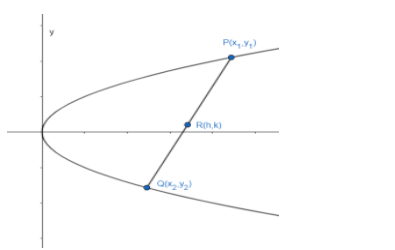
Let the chord of parabola be made by the points P and Q. We can also write ${{x}_{1}}\text{ }and\ {{y}_{1}}\ as\ a{{t}_{1}}\ and\ 2a{{t}_{1}}$ respectively according to the parametric form. Thus, we will get $P\left( at_{1}^{2},2a{{t}_{1}} \right)$. Similarly we can say that $Q\left( at_{2}^{2},2a{{t}_{2}} \right)$. Now, have assumed that R (h, k) is the midpoint of P and Q. Now we will apply the midpoint formula. The midpoint (x, y) of G (a, b) and H (c, d) is given by the formula:
$\begin{align}
& x=\dfrac{a+c}{2} \\
& y=\dfrac{b+d}{2} \\
\end{align}$
Thus, we will get:
\[\begin{align}
& h=\dfrac{at_{1}^{2}+a{{t}^{2}}_{2}}{2} \\
& \Rightarrow 2h=at_{1}^{2}+a{{t}^{2}}_{2} \\
& \Rightarrow \dfrac{2h}{a}=t_{1}^{2}+{{t}^{2}}_{2}.........\left( 1 \right) \\
\end{align}\]
Similarly, \[k=\dfrac{2a{{t}_{1}}+a{{t}_{2}}}{2}\]
$\begin{align}
& \Rightarrow k=a{{t}_{1}}+a{{t}_{2}} \\
& \Rightarrow \dfrac{k}{a}={{t}_{1}}+{{t}_{2}}..........\left( 2 \right) \\
\end{align}$
Now, we will square the equation (2). Thus, we will get:
${{\left( \dfrac{k}{a} \right)}^{2}}={{\left( {{t}_{1}}+{{t}_{2}} \right)}^{2}}$
Now, we will apply identity: ${{\left( a+b \right)}^{2}}={{a}^{2}}+{{b}^{2}}+2a{{b}^{2}}$
\[\begin{align}
& \Rightarrow {{\left( \dfrac{k}{a} \right)}^{2}}=t_{1}^{2}+t_{2}^{2}+2{{t}_{1}}{{t}_{2}} \\
& \Rightarrow \dfrac{{{k}^{2}}}{{{a}^{2}}}-2{{t}_{1}}{{t}_{2}}=t_{1}^{2}+t_{2}^{2}........\left( 3 \right) \\
\end{align}\]
From (1) and (3), we have:
\[\begin{align}
& \Rightarrow \dfrac{{{k}^{2}}}{{{a}^{2}}}-2{{t}_{1}}{{t}_{2}}=\dfrac{2h}{a} \\
& \Rightarrow 2{{t}_{1}}{{t}_{2}}=\dfrac{{{k}^{2}}}{{{a}^{2}}}-\dfrac{2h}{a} \\
& \Rightarrow 2{{t}_{1}}{{t}_{2}}=\dfrac{{{k}^{2}}-2ah}{{{a}^{2}}} \\
& \Rightarrow {{t}_{1}}{{t}_{2}}=\dfrac{{{k}^{2}}-2ah}{2{{a}^{2}}}...........\left( 4 \right) \\
\end{align}\]
Now, we are given that the distance between P and Q is the distance between A (a,b) and B(c,d) is given by:
$\left| AB \right|=\sqrt{{{\left( a-c \right)}^{2}}+{{\left( b-d \right)}^{^{2}}}}$
Thus, we have:
$c=\sqrt{{{\left( {{x}_{1}}-{{x}_{2}} \right)}^{2}}+{{\left( {{y}_{1}}-{{y}_{2}} \right)}^{2}}}$
On putting the parametric form of the variable ${{x}_{1}},{{x}_{2}},{{y}_{1}}\text{ }and\text{ }{{y}_{2}}$, we will get:
\[\begin{align}
& \Rightarrow c=\sqrt{{{\left( at_{1}^{2}-at_{2}^{2} \right)}^{2}}+{{\left( 2a{{t}_{1}}-2a{{t}_{2}} \right)}^{2}}} \\
& \Rightarrow c=\sqrt{{{a}^{2}}{{\left( t_{1}^{2}-t_{2}^{2} \right)}^{2}}+{{a}^{2}}{{\left( 2{{t}_{1}}-2{{t}_{2}} \right)}^{2}}} \\
& \Rightarrow c=a\sqrt{{{\left( t_{1}^{2}-t_{2}^{2} \right)}^{2}}+{{\left( 2{{t}_{1}}-2{{t}_{2}} \right)}^{2}}} \\
\end{align}\]
Now, we will square both sides. Thus, we will get:
$\Rightarrow \dfrac{{{c}^{2}}}{{{a}^{2}}}={{\left( t_{1}^{2}-t_{2}^{2} \right)}^{2}}+{{\left( 2{{t}_{1}}-2{{t}_{2}} \right)}^{2}}.$
Now, we will use the identity: ${{a}^{2}}-{{b}^{2}}=\left( a-b \right)\left( a+b \right).$ Thus, we will get:
$\Rightarrow \dfrac{{{c}^{2}}}{{{a}^{2}}}={{\left[ \left( {{t}_{1}}+{{t}_{2}} \right)\left( {{t}_{1}}-{{t}_{2}} \right) \right]}^{2}}+4\left[ {{\left( {{t}_{1}}-{{t}_{2}} \right)}^{2}} \right]$
Now, taking ${{\left( {{t}_{1}}-{{t}_{2}} \right)}^{2}}$ common from the right hand side. Thus, we will get:
$\Rightarrow \dfrac{{{c}^{2}}}{{{a}^{2}}}={{\left( {{t}_{1}}-{{t}_{2}} \right)}^{2}}\left[ {{\left( {{t}_{1}}+{{t}_{2}} \right)}^{2}}+4 \right]$
Now, we will apply identity: ${{\left( a-b \right)}^{2}}={{a}^{2}}+{{b}^{2}}-2ab.$ Thus, we will get:
$\Rightarrow \dfrac{{{c}^{2}}}{{{a}^{2}}}=\left[ t_{1}^{2}+t_{2}^{2}+2{{t}_{1}}{{t}_{2}} \right]\left[ {{\left( {{t}_{1}}+{{t}_{2}} \right)}^{2}}+4 \right]..........\left( 5 \right)$
Now, we will put the values of \[\left( t_{1}^{2}+t_{2}^{2} \right),\left( {{t}_{1}}{{t}_{2}} \right)\text{ }and\ \left( {{t}_{1}}+{{t}_{2}} \right)\] from (1),(4) and (2) respectively into (5). Thus, after doing this, we will get:
$\begin{align}
& \Rightarrow \dfrac{{{c}^{2}}}{{{a}^{2}}}=\left[ \dfrac{2h}{a}-2\left( \dfrac{{{k}^{2}}-2ah}{2{{a}^{2}}} \right) \right]\left[ \dfrac{{{k}^{2}}}{{{a}^{2}}}+4 \right] \\
& \Rightarrow \dfrac{{{c}^{2}}}{{{a}^{2}}}=\left[ \dfrac{2ha-{{k}^{2}}+2ah}{{{a}^{2}}} \right]\left[ \dfrac{{{k}^{2}}+4{{a}^{2}}}{{{a}^{2}}} \right] \\
& \Rightarrow \dfrac{{{c}^{2}}}{{{a}^{2}}}=\left[ \dfrac{\left( 4ah-{{k}^{2}} \right)\left( {{k}^{2}}+4{{a}^{2}} \right)}{{{a}^{2}}\times {{a}^{2}}} \right] \\
& \Rightarrow {{a}^{2}}{{c}^{2}}=\left( 4ah-{{k}^{2}} \right)\left( {{k}^{2}}+4{{a}^{2}} \right) \\
\end{align}$
On putting x in place of h and y in place of k, we will get: $\left( 4ax-{{y}^{2}} \right)\left( {{y}^{2}}+4{{a}^{2}} \right)={{a}^{2}}{{c}^{2}}$
Hence option (d) is correct.
Note: Instead of taking the points on the chord as the parametric form of points, we can also take points as shown. The equation of parabola is: ${{y}^{2}}=4ax.$ The points P and Q will satisfy it. Thus,
${{y}^{2}}=4a{{x}_{1}}\Rightarrow {{x}_{1}}=\dfrac{y_{1}^{2}}{4{{a}_{1}}}$
Similarly ${{x}_{2}}=\dfrac{y_{2}^{2}}{4{{a}_{2}}}$
Now, \[h=\dfrac{\dfrac{y_{1}^{2}}{4{{a}_{1}}}+\dfrac{y_{2}^{2}}{4{{a}_{2}}}}{2}\]
$\Rightarrow 8{{a}_{1}}h=y_{1}^{2}+y_{2}^{2}.........\left( 1 \right)$
Similarly, \[k=\dfrac{{{y}_{1}}+{{y}_{2}}}{2}\]
$\Rightarrow 2k={{y}_{1}}+{{y}_{2}}........\left( 2 \right)$
When we will put these values in the distance formula and equate it to c, we will get the same result.
Complete step-by-step answer:
The rough sketch of parabola as given in the question is drawn below:
Let the chord of parabola be made by the points P and Q. We can also write ${{x}_{1}}\text{ }and\ {{y}_{1}}\ as\ a{{t}_{1}}\ and\ 2a{{t}_{1}}$ respectively according to the parametric form. Thus, we will get $P\left( at_{1}^{2},2a{{t}_{1}} \right)$. Similarly we can say that $Q\left( at_{2}^{2},2a{{t}_{2}} \right)$. Now, have assumed that R (h, k) is the midpoint of P and Q. Now we will apply the midpoint formula. The midpoint (x, y) of G (a, b) and H (c, d) is given by the formula:
$\begin{align}
& x=\dfrac{a+c}{2} \\
& y=\dfrac{b+d}{2} \\
\end{align}$
Thus, we will get:
\[\begin{align}
& h=\dfrac{at_{1}^{2}+a{{t}^{2}}_{2}}{2} \\
& \Rightarrow 2h=at_{1}^{2}+a{{t}^{2}}_{2} \\
& \Rightarrow \dfrac{2h}{a}=t_{1}^{2}+{{t}^{2}}_{2}.........\left( 1 \right) \\
\end{align}\]
Similarly, \[k=\dfrac{2a{{t}_{1}}+a{{t}_{2}}}{2}\]
$\begin{align}
& \Rightarrow k=a{{t}_{1}}+a{{t}_{2}} \\
& \Rightarrow \dfrac{k}{a}={{t}_{1}}+{{t}_{2}}..........\left( 2 \right) \\
\end{align}$
Now, we will square the equation (2). Thus, we will get:
${{\left( \dfrac{k}{a} \right)}^{2}}={{\left( {{t}_{1}}+{{t}_{2}} \right)}^{2}}$
Now, we will apply identity: ${{\left( a+b \right)}^{2}}={{a}^{2}}+{{b}^{2}}+2a{{b}^{2}}$
\[\begin{align}
& \Rightarrow {{\left( \dfrac{k}{a} \right)}^{2}}=t_{1}^{2}+t_{2}^{2}+2{{t}_{1}}{{t}_{2}} \\
& \Rightarrow \dfrac{{{k}^{2}}}{{{a}^{2}}}-2{{t}_{1}}{{t}_{2}}=t_{1}^{2}+t_{2}^{2}........\left( 3 \right) \\
\end{align}\]
From (1) and (3), we have:
\[\begin{align}
& \Rightarrow \dfrac{{{k}^{2}}}{{{a}^{2}}}-2{{t}_{1}}{{t}_{2}}=\dfrac{2h}{a} \\
& \Rightarrow 2{{t}_{1}}{{t}_{2}}=\dfrac{{{k}^{2}}}{{{a}^{2}}}-\dfrac{2h}{a} \\
& \Rightarrow 2{{t}_{1}}{{t}_{2}}=\dfrac{{{k}^{2}}-2ah}{{{a}^{2}}} \\
& \Rightarrow {{t}_{1}}{{t}_{2}}=\dfrac{{{k}^{2}}-2ah}{2{{a}^{2}}}...........\left( 4 \right) \\
\end{align}\]
Now, we are given that the distance between P and Q is the distance between A (a,b) and B(c,d) is given by:
$\left| AB \right|=\sqrt{{{\left( a-c \right)}^{2}}+{{\left( b-d \right)}^{^{2}}}}$
Thus, we have:
$c=\sqrt{{{\left( {{x}_{1}}-{{x}_{2}} \right)}^{2}}+{{\left( {{y}_{1}}-{{y}_{2}} \right)}^{2}}}$
On putting the parametric form of the variable ${{x}_{1}},{{x}_{2}},{{y}_{1}}\text{ }and\text{ }{{y}_{2}}$, we will get:
\[\begin{align}
& \Rightarrow c=\sqrt{{{\left( at_{1}^{2}-at_{2}^{2} \right)}^{2}}+{{\left( 2a{{t}_{1}}-2a{{t}_{2}} \right)}^{2}}} \\
& \Rightarrow c=\sqrt{{{a}^{2}}{{\left( t_{1}^{2}-t_{2}^{2} \right)}^{2}}+{{a}^{2}}{{\left( 2{{t}_{1}}-2{{t}_{2}} \right)}^{2}}} \\
& \Rightarrow c=a\sqrt{{{\left( t_{1}^{2}-t_{2}^{2} \right)}^{2}}+{{\left( 2{{t}_{1}}-2{{t}_{2}} \right)}^{2}}} \\
\end{align}\]
Now, we will square both sides. Thus, we will get:
$\Rightarrow \dfrac{{{c}^{2}}}{{{a}^{2}}}={{\left( t_{1}^{2}-t_{2}^{2} \right)}^{2}}+{{\left( 2{{t}_{1}}-2{{t}_{2}} \right)}^{2}}.$
Now, we will use the identity: ${{a}^{2}}-{{b}^{2}}=\left( a-b \right)\left( a+b \right).$ Thus, we will get:
$\Rightarrow \dfrac{{{c}^{2}}}{{{a}^{2}}}={{\left[ \left( {{t}_{1}}+{{t}_{2}} \right)\left( {{t}_{1}}-{{t}_{2}} \right) \right]}^{2}}+4\left[ {{\left( {{t}_{1}}-{{t}_{2}} \right)}^{2}} \right]$
Now, taking ${{\left( {{t}_{1}}-{{t}_{2}} \right)}^{2}}$ common from the right hand side. Thus, we will get:
$\Rightarrow \dfrac{{{c}^{2}}}{{{a}^{2}}}={{\left( {{t}_{1}}-{{t}_{2}} \right)}^{2}}\left[ {{\left( {{t}_{1}}+{{t}_{2}} \right)}^{2}}+4 \right]$
Now, we will apply identity: ${{\left( a-b \right)}^{2}}={{a}^{2}}+{{b}^{2}}-2ab.$ Thus, we will get:
$\Rightarrow \dfrac{{{c}^{2}}}{{{a}^{2}}}=\left[ t_{1}^{2}+t_{2}^{2}+2{{t}_{1}}{{t}_{2}} \right]\left[ {{\left( {{t}_{1}}+{{t}_{2}} \right)}^{2}}+4 \right]..........\left( 5 \right)$
Now, we will put the values of \[\left( t_{1}^{2}+t_{2}^{2} \right),\left( {{t}_{1}}{{t}_{2}} \right)\text{ }and\ \left( {{t}_{1}}+{{t}_{2}} \right)\] from (1),(4) and (2) respectively into (5). Thus, after doing this, we will get:
$\begin{align}
& \Rightarrow \dfrac{{{c}^{2}}}{{{a}^{2}}}=\left[ \dfrac{2h}{a}-2\left( \dfrac{{{k}^{2}}-2ah}{2{{a}^{2}}} \right) \right]\left[ \dfrac{{{k}^{2}}}{{{a}^{2}}}+4 \right] \\
& \Rightarrow \dfrac{{{c}^{2}}}{{{a}^{2}}}=\left[ \dfrac{2ha-{{k}^{2}}+2ah}{{{a}^{2}}} \right]\left[ \dfrac{{{k}^{2}}+4{{a}^{2}}}{{{a}^{2}}} \right] \\
& \Rightarrow \dfrac{{{c}^{2}}}{{{a}^{2}}}=\left[ \dfrac{\left( 4ah-{{k}^{2}} \right)\left( {{k}^{2}}+4{{a}^{2}} \right)}{{{a}^{2}}\times {{a}^{2}}} \right] \\
& \Rightarrow {{a}^{2}}{{c}^{2}}=\left( 4ah-{{k}^{2}} \right)\left( {{k}^{2}}+4{{a}^{2}} \right) \\
\end{align}$
On putting x in place of h and y in place of k, we will get: $\left( 4ax-{{y}^{2}} \right)\left( {{y}^{2}}+4{{a}^{2}} \right)={{a}^{2}}{{c}^{2}}$
Hence option (d) is correct.
Note: Instead of taking the points on the chord as the parametric form of points, we can also take points as shown. The equation of parabola is: ${{y}^{2}}=4ax.$ The points P and Q will satisfy it. Thus,
${{y}^{2}}=4a{{x}_{1}}\Rightarrow {{x}_{1}}=\dfrac{y_{1}^{2}}{4{{a}_{1}}}$
Similarly ${{x}_{2}}=\dfrac{y_{2}^{2}}{4{{a}_{2}}}$
Now, \[h=\dfrac{\dfrac{y_{1}^{2}}{4{{a}_{1}}}+\dfrac{y_{2}^{2}}{4{{a}_{2}}}}{2}\]
$\Rightarrow 8{{a}_{1}}h=y_{1}^{2}+y_{2}^{2}.........\left( 1 \right)$
Similarly, \[k=\dfrac{{{y}_{1}}+{{y}_{2}}}{2}\]
$\Rightarrow 2k={{y}_{1}}+{{y}_{2}}........\left( 2 \right)$
When we will put these values in the distance formula and equate it to c, we will get the same result.
Recently Updated Pages
Which of the following graphs shows the variation of class 12 physics CBSE

Draw a labelled diagram of the human male reproductive class 12 biology CBSE
Describe the experiment to compare the emf of two cells class 12 physics CBSE
What is standard hydrogen electrode
What is conventional current and electric current class 12 physics CBSE
2Bromopentane is treated with an alcoholic KOH solution class 12 chemistry CBSE
Trending doubts
Draw a labelled sketch of the human eye class 12 physics CBSE
Which are the Top 10 Largest Countries of the World?
Differentiate between homogeneous and heterogeneous class 12 chemistry CBSE
Draw ray diagrams each showing i myopic eye and ii class 12 physics CBSE
Which is the correct genotypic ratio of mendel dihybrid class 12 biology CBSE
What is the Full Form of PVC, PET, HDPE, LDPE, PP and PS ?