




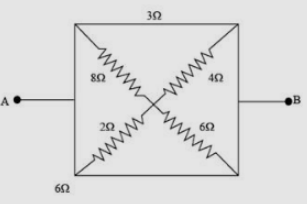
In the network shown, the equivalent resistance between A and B is
A. \[\dfrac{4}{3}\;\Omega \]
B. \[\dfrac{3}{4}\;\Omega \]
C. \[\dfrac{{24}}{{17}}\;\Omega \]
D. \[\dfrac{{17}}{{24}}\;\Omega \]
Answer
 Verified
600.3k+ views
Hint:The above problem can be resolved using the concept and the fundamentals of the network analysis. The network diagrams consist of various resistances, connected in series as well as in parallel connection. These arrangements are resolved by undertaking the mathematical formulas for the series arrangement as well as the parallel arrangements. Moreover, these concepts are critical in resolving the phenomenal analysis of voltage drop and the current flow through the circuit.
Complete step by step answer:
From the given network diagram, the resistance \[8\;\Omega \] and \[2\;\Omega \] from point A are in parallel combination. Then, the net resistance is,
\[
\dfrac{1}{{{R_1}}} = \dfrac{1}{{8\;\Omega }} + \dfrac{1}{{2\;\Omega }}\\
\Rightarrow{R_1} = \dfrac{8}{5}\;\Omega
\]
Now from point B, the resistance \[4\;\Omega \] and \[6\;\Omega \] are also in parallel combination. Then the net resistance is,
\[
\dfrac{1}{{{R_2}}} = \dfrac{1}{{4\;\Omega }} + \dfrac{1}{{6\;\Omega }}\\
\Rightarrow{R_2} = \dfrac{{12}}{5}\;\Omega
\]
Now, as we can see that the above net resistances \[{R_1}\] and \[{R_2}\] are in series. Therefore, they contribute a resistance of magnitude,
\[
{R_s} = {R_1} + {R_2}\\
\Rightarrow{R_s} = \dfrac{8}{5}\;\Omega + \dfrac{{12}}{5}\;\Omega \\
\Rightarrow{R_s} = 4\;\Omega
\]
Clearly, the above resistances are parallel to the resistors of \[3\;\Omega \] and \[6\;\Omega \].
Then, the resistance across the terminals AB is given as,
\[
\dfrac{1}{{{R_{AB}}}} = \dfrac{1}{{4\;\Omega }} + \dfrac{1}{{3\;\Omega }} + \dfrac{1}{{6\;\Omega }}\\
\therefore{R_{AB}} = \dfrac{4}{3}\;\Omega
\]
Therefore, the equivalent resistance between A and B is \[\dfrac{4}{3}\;\Omega \] and option (A) is correct.
Note: To resolve the given problem, one must understand the key concept behind the network analysis and some derived mathematical relations. These relations are obtained once we easily predict the phenomenal variation of current and the voltage along each of such paths in an electronic circuit. It is observed that the net resistance for the circuit is always coming out to be more as compared to the net resistance in the parallel connection.
Complete step by step answer:
From the given network diagram, the resistance \[8\;\Omega \] and \[2\;\Omega \] from point A are in parallel combination. Then, the net resistance is,
\[
\dfrac{1}{{{R_1}}} = \dfrac{1}{{8\;\Omega }} + \dfrac{1}{{2\;\Omega }}\\
\Rightarrow{R_1} = \dfrac{8}{5}\;\Omega
\]
Now from point B, the resistance \[4\;\Omega \] and \[6\;\Omega \] are also in parallel combination. Then the net resistance is,
\[
\dfrac{1}{{{R_2}}} = \dfrac{1}{{4\;\Omega }} + \dfrac{1}{{6\;\Omega }}\\
\Rightarrow{R_2} = \dfrac{{12}}{5}\;\Omega
\]
Now, as we can see that the above net resistances \[{R_1}\] and \[{R_2}\] are in series. Therefore, they contribute a resistance of magnitude,
\[
{R_s} = {R_1} + {R_2}\\
\Rightarrow{R_s} = \dfrac{8}{5}\;\Omega + \dfrac{{12}}{5}\;\Omega \\
\Rightarrow{R_s} = 4\;\Omega
\]
Clearly, the above resistances are parallel to the resistors of \[3\;\Omega \] and \[6\;\Omega \].
Then, the resistance across the terminals AB is given as,
\[
\dfrac{1}{{{R_{AB}}}} = \dfrac{1}{{4\;\Omega }} + \dfrac{1}{{3\;\Omega }} + \dfrac{1}{{6\;\Omega }}\\
\therefore{R_{AB}} = \dfrac{4}{3}\;\Omega
\]
Therefore, the equivalent resistance between A and B is \[\dfrac{4}{3}\;\Omega \] and option (A) is correct.
Note: To resolve the given problem, one must understand the key concept behind the network analysis and some derived mathematical relations. These relations are obtained once we easily predict the phenomenal variation of current and the voltage along each of such paths in an electronic circuit. It is observed that the net resistance for the circuit is always coming out to be more as compared to the net resistance in the parallel connection.
Recently Updated Pages
Master Class 12 Business Studies: Engaging Questions & Answers for Success

Master Class 12 Biology: Engaging Questions & Answers for Success
Master Class 12 Chemistry: Engaging Questions & Answers for Success
Class 12 Question and Answer - Your Ultimate Solutions Guide
Master Class 11 Social Science: Engaging Questions & Answers for Success
Master Class 11 English: Engaging Questions & Answers for Success
Trending doubts
Differentiate between insitu conservation and exsitu class 12 biology CBSE
Name the part of the flower which the tassels of the class 12 biology CBSE
Write the difference between chasmogamous and cleistogamous class 12 biology CBSE
What is the structural formula of Aspirin A B C D class 12 chemistry CBSE
Why should a magnesium ribbon be cleaned before burning class 12 chemistry CBSE
Quantisation of charge implies a Charge does not exist class 12 physics CBSE