




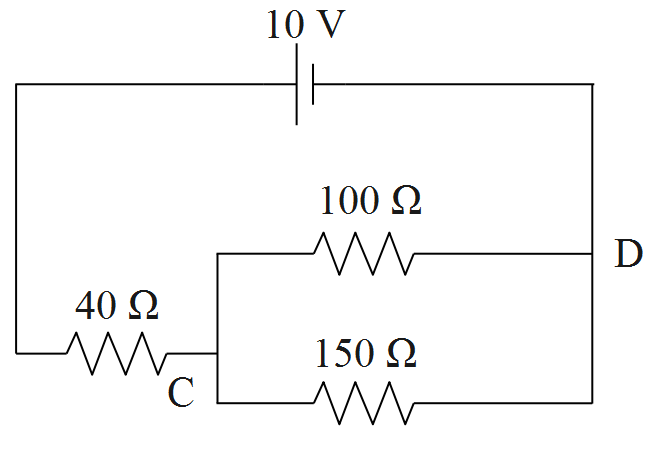
In the network shown below, the potential difference across CD is
1. 4 V
2. 6 V
3. 10 V
4. 5 V
Answer
 Verified
580.8k+ views
Hint: Using the formula for computing the resistance in parallel, we will first compute the parallel resistance value. Then, using the formula for computing the resistance in series, we will compute the series resistance, that is, equivalent resistance value. Finally, we will subtract the total voltage by the voltage across 40 Ohm resistance using the product of current and resistance.
Formula used:
\[\begin{align}
& \dfrac{1}{{{R}_{P}}}=\dfrac{1}{{{R}_{1}}}+\dfrac{1}{{{R}_{2}}}+.... \\
& {{R}_{S}}={{R}_{1}}+{{R}_{2}}+... \\
& V=IR \\
\end{align}\]
Complete step-by-step solution:
Firstly, we will compute the parallel resistance value of 2 resistors. The formula for computing the same is given as follows.
\[\dfrac{1}{{{R}_{P}}}=\dfrac{1}{{{R}_{1}}}+\dfrac{1}{{{R}_{2}}}\]
Substitute the values in the above formula.
\[\begin{align}
& \dfrac{1}{{{R}_{P}}}=\dfrac{1}{100}+\dfrac{1}{150} \\
& \therefore {{R}_{P}}=75\Omega \\
\end{align}\]
Now, we will compute the parallel resistance value of 2 resistors. The formula for computing the same is given as follows.
\[{{R}_{S}}={{R}_{1}}+{{R}_{2}}\]
Substitute the values in the above formula.
\[\begin{align}
& {{R}_{S}}=75+40 \\
& \therefore {{R}_{S}}=115\Omega \\
\end{align}\]
Therefore, the equivalent resistance of the circuit is, \[115\,\Omega \].
The current flowing through the circuit is given as the voltage by the resistance. The mathematical representation of the same is given as follows.
\[I=\dfrac{V}{R}\]
Substitute the values in the above formula.
\[\begin{align}
& I=\dfrac{10}{115} \\
& \therefore I=0.086A \\
\end{align}\]
Now we will compute the potential difference across the 40 Ohm resistor. The formula for computing the potential difference is the product of current and the resistance.
The mathematical representation of the same is given as follows.
\[V=IR\]
Substitute the values in the above formula.
\[\begin{align}
& V=0.086\times 40 \\
& \therefore V=3.44\,V \\
\end{align}\]
Finally, we will compute the potential difference across CD, so, we have,
\[\begin{align}
& {{V}_{CD}}=V-{{V}_{40\Omega }} \\
& \Rightarrow {{V}_{CD}}=10-3.44 \\
& \therefore {{V}_{CD}}=6.56\,V \\
\end{align}\]
\[\therefore \] The potential difference across the CD is, 6.56.
Note: Instead of computing the potential difference across CD, subtracting the total voltage by the voltage across 40 Ohm resistance using the product of current and resistance becomes easier. The units of the parameters should be taken care of.
Formula used:
\[\begin{align}
& \dfrac{1}{{{R}_{P}}}=\dfrac{1}{{{R}_{1}}}+\dfrac{1}{{{R}_{2}}}+.... \\
& {{R}_{S}}={{R}_{1}}+{{R}_{2}}+... \\
& V=IR \\
\end{align}\]
Complete step-by-step solution:
Firstly, we will compute the parallel resistance value of 2 resistors. The formula for computing the same is given as follows.
\[\dfrac{1}{{{R}_{P}}}=\dfrac{1}{{{R}_{1}}}+\dfrac{1}{{{R}_{2}}}\]
Substitute the values in the above formula.
\[\begin{align}
& \dfrac{1}{{{R}_{P}}}=\dfrac{1}{100}+\dfrac{1}{150} \\
& \therefore {{R}_{P}}=75\Omega \\
\end{align}\]
Now, we will compute the parallel resistance value of 2 resistors. The formula for computing the same is given as follows.
\[{{R}_{S}}={{R}_{1}}+{{R}_{2}}\]
Substitute the values in the above formula.
\[\begin{align}
& {{R}_{S}}=75+40 \\
& \therefore {{R}_{S}}=115\Omega \\
\end{align}\]
Therefore, the equivalent resistance of the circuit is, \[115\,\Omega \].
The current flowing through the circuit is given as the voltage by the resistance. The mathematical representation of the same is given as follows.
\[I=\dfrac{V}{R}\]
Substitute the values in the above formula.
\[\begin{align}
& I=\dfrac{10}{115} \\
& \therefore I=0.086A \\
\end{align}\]
Now we will compute the potential difference across the 40 Ohm resistor. The formula for computing the potential difference is the product of current and the resistance.
The mathematical representation of the same is given as follows.
\[V=IR\]
Substitute the values in the above formula.
\[\begin{align}
& V=0.086\times 40 \\
& \therefore V=3.44\,V \\
\end{align}\]
Finally, we will compute the potential difference across CD, so, we have,
\[\begin{align}
& {{V}_{CD}}=V-{{V}_{40\Omega }} \\
& \Rightarrow {{V}_{CD}}=10-3.44 \\
& \therefore {{V}_{CD}}=6.56\,V \\
\end{align}\]
\[\therefore \] The potential difference across the CD is, 6.56.
Note: Instead of computing the potential difference across CD, subtracting the total voltage by the voltage across 40 Ohm resistance using the product of current and resistance becomes easier. The units of the parameters should be taken care of.
Recently Updated Pages
Master Class 12 Economics: Engaging Questions & Answers for Success

Master Class 12 Social Science: Engaging Questions & Answers for Success
Master Class 12 English: Engaging Questions & Answers for Success
Master Class 12 Maths: Engaging Questions & Answers for Success
Master Class 12 Physics: Engaging Questions & Answers for Success
Master Class 12 Biology: Engaging Questions & Answers for Success
Trending doubts
Draw a labelled sketch of the human eye class 12 physics CBSE
Draw a ray diagram of compound microscope when the class 12 physics CBSE
Derive an expression for the electric field intensity class 12 physics CBSE
Ethylidene chloride and ethylene dichloride are A Chain class 12 chemistry CBSE
What is a transformer Explain the principle construction class 12 physics CBSE
Calculate the equivalent resistance between a and b class 12 physics CBSE