




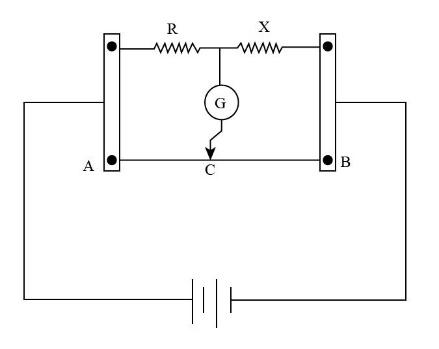
In the meter bridge shown, the resistance X has a negative temperature coefficient of resistance. Neglecting the variation in other resistors, when current is passed for some time, in the circuit balance point should be shifted towards:
(A) A
(B) B
(C) First A then B
(D) It will remain at C
Answer
 Verified
579.3k+ views
Hint: The question uses the concept of the Wheatstone bridge, so you should know the balanced condition for the circuit. Also, this question uses the relation between temperature and resistance, which share an inverse relationship. So when the temperature increases, the resistance of the wire decreases. So when you put this concept in the balanced condition of the Wheatstone bridge, you will get the correct answer.
Complete step by step answer:
We already know that, when current flows through the wire, heat is produced and the temperature of the wire increases. As the resistance $X$ has a negative temperature coefficient, so when the current passes through the resistance $X$ , the temperature of the resistance increases. Due to the increase in the temperature, the resistance of $X$ gets decreased.
In the meter bridge, we know that the balanced condition is given as,
$\dfrac{R}{{X}}$ = $\dfrac{AC}{{BC}}$.
We saw that the resistance of $X$ will decrease. So, in order to keep the ratio equal or equivalent, $BC$ should decrease and on other hand, $AC$ should increase. This means that the distance between the balance point of the circuit and $B$ will decrease.
Since, the distance gets decreased, which means that balance point should be shifted towards $B$ .
So, the correct answer is “Option B”.
Note:
Meter Bridge works on the principle of Wheatstone bridge, so you need to apply it correctly. Moreover, the balance condition for the circuit should be applied appropriately. Further, you should know about the negative temperature coefficient and the factors on which the resistance of a wire depends.
Complete step by step answer:
We already know that, when current flows through the wire, heat is produced and the temperature of the wire increases. As the resistance $X$ has a negative temperature coefficient, so when the current passes through the resistance $X$ , the temperature of the resistance increases. Due to the increase in the temperature, the resistance of $X$ gets decreased.
In the meter bridge, we know that the balanced condition is given as,
$\dfrac{R}{{X}}$ = $\dfrac{AC}{{BC}}$.
We saw that the resistance of $X$ will decrease. So, in order to keep the ratio equal or equivalent, $BC$ should decrease and on other hand, $AC$ should increase. This means that the distance between the balance point of the circuit and $B$ will decrease.
Since, the distance gets decreased, which means that balance point should be shifted towards $B$ .
So, the correct answer is “Option B”.
Note:
Meter Bridge works on the principle of Wheatstone bridge, so you need to apply it correctly. Moreover, the balance condition for the circuit should be applied appropriately. Further, you should know about the negative temperature coefficient and the factors on which the resistance of a wire depends.
Recently Updated Pages
Master Class 12 Economics: Engaging Questions & Answers for Success

Master Class 12 Physics: Engaging Questions & Answers for Success
Master Class 12 English: Engaging Questions & Answers for Success
Master Class 12 Social Science: Engaging Questions & Answers for Success
Master Class 12 Maths: Engaging Questions & Answers for Success
Master Class 12 Business Studies: Engaging Questions & Answers for Success
Trending doubts
Which are the Top 10 Largest Countries of the World?
What are the major means of transport Explain each class 12 social science CBSE
Draw a labelled sketch of the human eye class 12 physics CBSE
Why cannot DNA pass through cell membranes class 12 biology CBSE
Differentiate between insitu conservation and exsitu class 12 biology CBSE
Draw a neat and well labeled diagram of TS of ovary class 12 biology CBSE